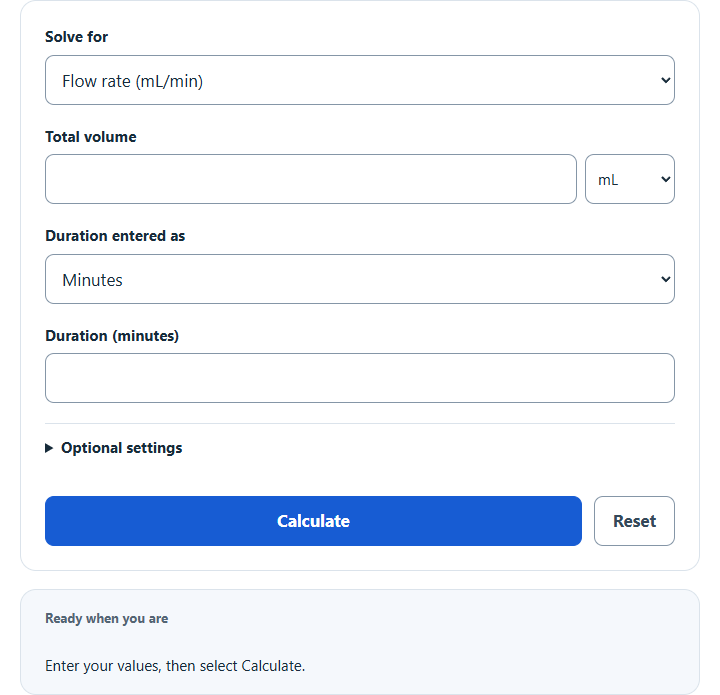
Calculate mL per minute from a volume and time, find the volume or time from a flow rate, or convert mL/min to mL/hr, L/hr, gallons or IV drops.
- All Unit Converters
- mL Per Dose Calculator
- Price Per 100 mL Calculator
- mM To ug/mL Calculator
- ml to mg
Calculator Functions
| Function | What it does | What it requires |
|---|---|---|
| Flow rate (mL/min) | Finds the flow in mL per minute that moves a volume in a set time | Requires the total volume and the duration |
| Volume delivered | Finds the volume that a steady flow delivers in a set time | Requires the known flow, as a volume per time or in drops per minute, and the duration |
| Time required | Finds how long a steady flow takes to deliver a volume | Requires the total volume and the known flow, as a volume per time or in drops per minute |
| IV drip arithmetic | Converts a volume and duration into mL per minute and drops per minute | Requires the total volume, the duration and the tubing factor in gtt/mL |
| Convert a flow rate | Converts a flow in another unit, or in drops per minute, to mL per minute | Requires the known flow and its unit, or the drop rate and the tubing factor |
Volume can be entered in mL, cc, L, US fl oz or US gal, and the duration in minutes, seconds, hours, or hours and minutes. Every result also shows the flow per hour. Optional settings add a start clock time, which gives a finish time, and a fluid density in g/mL, which gives the mass flow in g/min and kg/hr.
mL Per Minute Formulas
| FR | Flow rate (mL/min) |
| V | Volume (mL). 1 L = 1,000 mL, 1 cc = 1 mL, 1 US fl oz = 29.5735 mL and 1 US gal = 3,785.41 mL [1] |
| T | Time (minutes). Seconds are divided by 60 and hours are multiplied by 60 |
Flow rate (mL/min)
The formula above applies directly. 500 mL in 10 minutes is 500 ÷ 10 = 50 mL/min. 250 mL over 60 minutes is 4.167 mL/min, 20 mL in 30 seconds is 40 mL/min, and 1 L in 1 hour 30 minutes is 1,000 ÷ 90 = 11.11 mL/min.
Volume delivered
A flow of 2.5 mL/min running for 45 minutes delivers 2.5 × 45 = 112.5 mL.
Time required
Filling 600 mL at 3 mL/min takes 600 ÷ 3 = 200 minutes, or 3.33 hours. When the flow is known in drops per minute, it is first divided by the tubing factor: 30 gtt/min through 20 gtt/mL tubing is 1.5 mL/min, so 500 mL takes 333.3 minutes.
IV drip arithmetic
The drop factor is the number of drops in 1 mL for a given gravity tubing set, and it is printed on the tubing package. Macrodrip tubing is 10, 12, 15 or 20 gtt/mL and microdrip tubing is 60 gtt/mL [2]. 1,000 mL over 8 hours is 1,000 ÷ 480 = 2.083 mL/min, or 125 mL/hr. Through 15 gtt/mL tubing that is 2.083 × 15 = 31.25 gtt/min. The calculator also shows the nearest whole drop count, 31 gtt/min, and what it would do to the flow and the duration: 2.067 mL/min and 483.9 minutes.
Convert a flow rate
A flow in mL/hr is divided by 60, so 100 mL/hr is 1.667 mL/min. A drop rate is divided by the tubing factor, so 60 gtt/min through 20 gtt/mL tubing is 3 mL/min. The table gives 1 mL/min in the other units the calculator reports.
| Unit | Equal to 1 mL/min | To get mL/min |
|---|---|---|
| mL/hr | 60 | Divide by 60 |
| mL/s | 0.016667 | Multiply by 60 |
| L/min | 0.001 | Multiply by 1,000 |
| L/hr | 0.06 | Multiply by 16.667 |
| US gal/min | 0.000264 | Multiply by 3,785.41 |
| US gal/hr | 0.01585 | Multiply by 63.09 |
mL to Minutes
Milliliters measure volume and minutes measure time, so mL to minutes and minutes to mL have no single answer. A flow rate connects them. At 2 mL/min, 90 mL takes 45 minutes and 45 minutes delivers 90 mL. At 10 mL/min the same 45 minutes delivers 450 mL. Use Time required to turn a volume into minutes and Volume delivered to turn minutes into a volume.
Limits of This Estimate
- Every result assumes a constant flow from start to finish. Pumps that ramp up, containers that drain more slowly as they empty and gravity lines that change with bag height do not hold one rate.
- The IV figures are arithmetic only. For an infusion, verify the order, the exact tubing factor and the device settings independently. A whole-drop comparison does not establish a suitable clinical setting.
- Gallons and fluid ounces are US units. Imperial gallons and fluid ounces are different sizes.
- The finish clock time adds the duration to the start time without a date, time zone or daylight-saving change.
Sources
- National Institute of Standards and Technology, Guide to the SI, Appendix B.8: liter, US fluid ounce and US gallon in metric units
- Open Resources for Nursing, Nursing Skills, Chapter 5: Math Calculations (NCBI Bookshelf): drop factors, macrodrip and microdrip tubing, and drops per minute