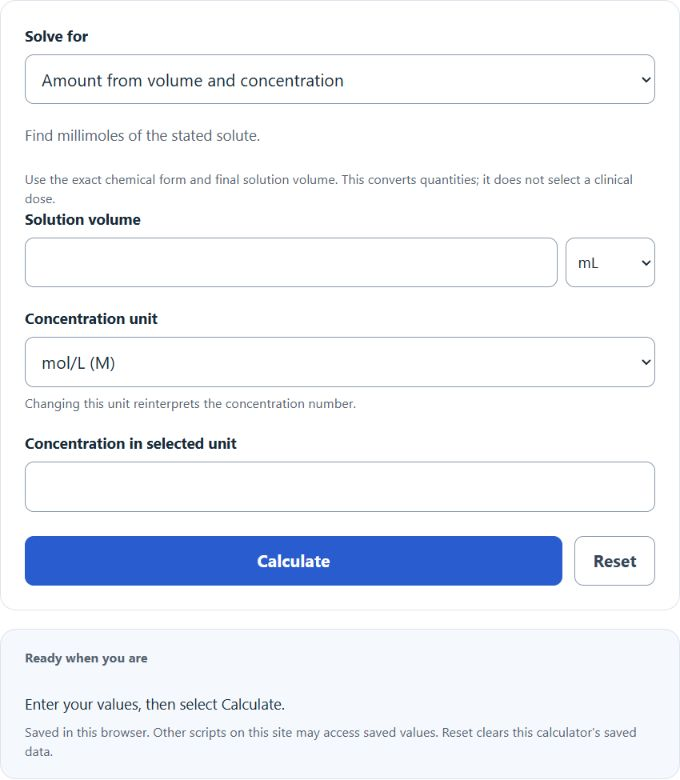
Calculate mL to mmol or mmol to mL from volume, concentration and molecular weight for lab solutions, with common substances and several units.
| mL to mmol | mmol to mL |
|---|---|
| 0.1 mL = 0.1 mmol | 0.05 mmol = 0.05 mL |
| 0.25 mL = 0.25 mmol | 0.2 mmol = 0.2 mL |
| 0.5 mL = 0.5 mmol | 0.75 mmol = 0.75 mL |
| 1 mL = 1 mmol | 1.5 mmol = 1.5 mL |
| 2 mL = 2 mmol | 3 mmol = 3 mL |
| 5 mL = 5 mmol | 4 mmol = 4 mL |
| 10 mL = 10 mmol | 6 mmol = 6 mL |
| 15 mL = 15 mmol | 8 mmol = 8 mL |
| 20 mL = 20 mmol | 12 mmol = 12 mL |
| 25 mL = 25 mmol | 18 mmol = 18 mL |
| 50 mL = 50 mmol | 30 mmol = 30 mL |
| 100 mL = 100 mmol | 60 mmol = 60 mL |
| Formula (for fixed concentration): mmol = M × mL; mL = mmol ÷ M. (Here, M = 1.0 mol/L.) | |
| mL to mmol | mmol to mL |
|---|---|
| 0.5 mL = 0.05 mmol | 0.02 mmol = 0.2 mL |
| 1 mL = 0.1 mmol | 0.075 mmol = 0.75 mL |
| 2.5 mL = 0.25 mmol | 0.15 mmol = 1.5 mL |
| 5 mL = 0.5 mmol | 0.3 mmol = 3 mL |
| 10 mL = 1 mmol | 0.6 mmol = 6 mL |
| 25 mL = 2.5 mmol | 1.5 mmol = 15 mL |
| 50 mL = 5 mmol | 3 mmol = 30 mL |
| 100 mL = 10 mmol | 7.5 mmol = 75 mL |
| Formula (for fixed concentration): mmol = M × mL; mL = mmol ÷ M. (Here, M = 0.1 mol/L.) | |
ml to mmol Formula
The core formula for converting milliliters of a solution to millimoles of solute is:
This works because molarity (M) is defined as moles of solute per liter of solution. Multiplying M by volume in liters gives moles, and since 1 mL = 0.001 L, multiplying M by volume in mL directly yields millimoles. The relationship holds because the milli- prefix cancels: (mol/L) x (mL) = (mol/L) x (0.001 L) = 0.001 mol = 1 mmol per unit of each.
When concentration is given in mass-based units (mg/mL, g/L, or % w/v) rather than molarity, you need to incorporate the molecular weight (MW) of the solute:
Dividing solute mass in milligrams by molar mass in g/mol gives millimoles directly, because 1 g/mol is numerically 1 mg/mmol.
Why mL Cannot Be Directly Converted to mmol
Milliliters measure volume. Millimoles measure the amount of a chemical substance. These are fundamentally different physical quantities, much like comparing distance to weight. The bridge between them is concentration, specifically molarity for solutions or density plus molecular weight for pure liquids. Without knowing the concentration of the solution, any mL-to-mmol conversion is impossible. A 10 mL sample from a 0.01 M solution contains 0.1 mmol, while 10 mL from a 5 M stock solution contains 500 times as much substance at 50 mmol.
Molecular Weights of Common Laboratory and Clinical Substances
Knowing the molecular weight (MW) of a solute is essential when concentration is expressed in mass-based units. The table below lists MW values for substances frequently encountered in research labs, clinical chemistry, and pharmacy settings.
| Substance | Formula | MW (g/mol) | Typical Context |
|---|---|---|---|
| Sodium chloride | NaCl | 58.44 | Saline IV fluids (0.9% w/v = 154 mM) |
| Glucose, anhydrous | C6H12O6 | 180.16 | Blood glucose reporting; hydrous dextrose products use 198.17 g/mol |
| Potassium chloride | KCl | 74.55 | Electrolyte replacement, buffer prep |
| Calcium chloride, anhydrous | CaCl2 | 110.98 | Reagent calculations; the dihydrate uses 147.02 g/mol |
| Magnesium chloride | MgCl2 | 95.21 | PCR master mixes; do not confuse magnesium chloride with magnesium sulfate |
| Sodium hydroxide | NaOH | 40.00 | pH adjustment in buffers |
| Sodium bicarbonate | NaHCO3 | 84.01 | Metabolic acidosis correction |
| Tris base | C4H11NO3 | 121.14 | Tris-HCl buffer systems (molecular biology) |
| HEPES | C8H18N2O4S | 238.30 | Cell culture buffering at physiological pH |
| EDTA (disodium dihydrate) | Na2C10H14N2O8·2H2O | 372.24 | Blood collection tubes, chelation therapy |
| Sucrose | C12H22O11 | 342.30 | Density gradients, cryoprotection |
| Urea | CH4N2O | 60.06 | Protein denaturation; BUN reports urea nitrogen, not whole urea mass |
| Creatinine | C4H7N3O | 113.12 | Renal function panels (serum creatinine) |
| Cholesterol | C27H46O | 386.65 | Lipid panels (mmol/L vs. mg/dL reporting) |
Clinical and Laboratory Applications
The mL-to-mmol conversion appears constantly in healthcare and research settings, though the context varies widely.
IV fluid calculations. A 500 mL bag of normal saline (0.9% w/v NaCl, MW 58.44) delivers approximately 77 mmol of Na+ ions. Pharmacists and nurses calculate this to verify electrolyte delivery rates, especially in pediatric and critical care dosing where precise mmol/kg/hr targets are required.
Blood chemistry unit conversions. Most of the world reports blood glucose in mmol/L, while the United States uses mg/dL. Converting between these requires the molecular weight of glucose (180.16 g/mol). A fasting glucose of 5.5 mmol/L equals approximately 99 mg/dL. For cholesterol (MW 386.65), a reading of 5.2 mmol/L translates to roughly 201 mg/dL. The conversion factor differs for every analyte because molecular weights differ.
Drug dilution and dosing. Injectable medications are frequently labeled in mg/mL. When a protocol requires a specific number of mmol (common with electrolyte replacement), converting from the labeled mg/mL concentration to mmol requires dividing by the molecular weight. For example, 10 mL containing 100 mg/mL of calcium chloride dihydrate (MW 147.02) contains approximately 6.80 mmol of CaCl2 units. Using the anhydrous molar mass gives a different answer. Verify the exact product label and chemical form; this conversion does not determine a safe dose.
Buffer and reagent preparation. Biochemistry protocols specify buffer concentrations in molar units. Preparing 250 mL of 50 mM Tris buffer requires 12.5 mmol of Tris base, which equals 1.514 g when multiplied by the molecular weight of 121.14 g/mol. Working backward from available stock solution volumes to mmol is a daily task at the bench.
Relationship Between mmol, mEq, and mg
In clinical chemistry, three units frequently overlap: millimoles (mmol), milliequivalents (mEq), and milligrams (mg). They are connected by molecular weight and ionic valence.
For monovalent ions (Na+, K+, Cl-, HCO3-), 1 mmol = 1 mEq. For divalent ions (Ca2+, Mg2+), 1 mmol = 2 mEq because each ion carries two charges. The conversion to milligrams always goes through molecular weight: mg = mmol x MW. This means 1 mmol of NaCl (MW 58.44) weighs 58.44 mg, while 1 mmol of glucose (MW 180.16) weighs 180.16 mg.
Understanding these relationships is critical when reading electrolyte panels. A serum potassium of 4.0 mmol/L is also 4.0 mEq/L (monovalent), but a serum calcium of 2.5 mmol/L equals 5.0 mEq/L (divalent). Confusing these units in a dosing context can lead to a twofold error.
Common Unit Confusions
mM vs. mmol/mL. Millimolar (mM) means mmol/L, not mmol/mL. Since 1 L = 1,000 mL, a 1 mM solution contains 0.001 mmol per mL, not 1 mmol per mL. Misreading mM as mmol/mL introduces a 1,000-fold error.
Molarity (M) vs. molality (m). Molarity is moles per liter of solution. Molality is moles per kilogram of solvent. For sufficiently dilute aqueous solutions with density near 1 kg/L, their numerical values can be close, but they remain different quantities and may diverge in concentrated or non-aqueous solutions. The calculator on this page uses molarity.
Volume of solution vs. volume of solvent. For a specified final concentration, bring the total solution volume to 100 mL (for example, in a volumetric flask). An instruction to add 100 mL of solvent is different; clarify ambiguous protocol wording. The distinction affects the resulting concentration by a small but non-trivial amount in concentrated preparations.
Converting mL to mmol for Pure Liquids
For a pure liquid rather than a solution, the conversion uses density and molecular weight instead of molarity:
For example, 1 mL of pure water (assumed density 0.997 g/mL, MW 18.015 g/mol) contains approximately 55.34 mmol of H2O. For pure ethanol (density 0.789 g/mL, MW 46.07 g/mol), 1 mL contains approximately 17.13 mmol. This approach is used when calculating molar ratios in organic synthesis where neat reagents are measured by volume rather than weighed.