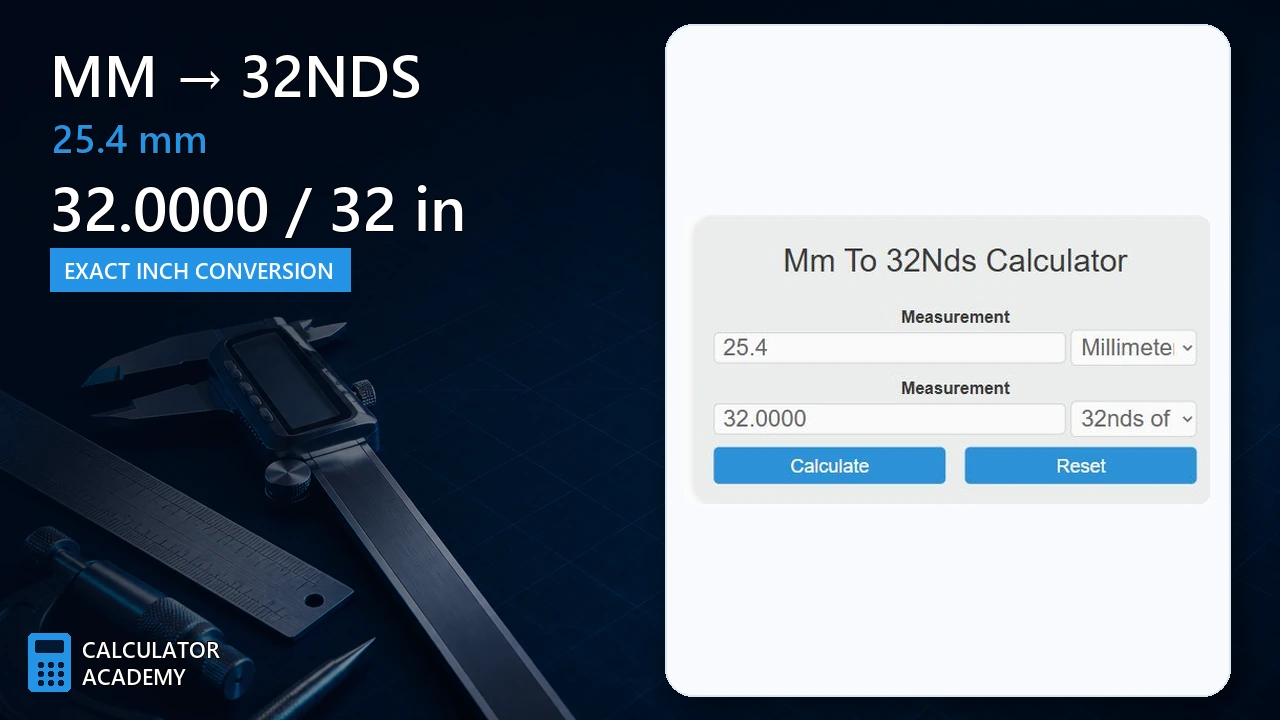
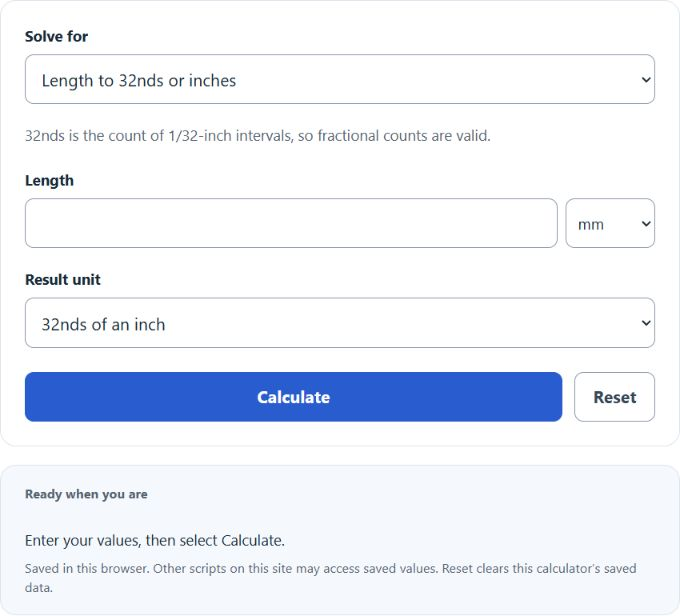
Convert millimeters, centimeters, meters, inches, or feet to 32nds of an inch, or enter 32nds/inches to find the equivalent millimeters.
| Millimeters to 32nds | 32nds to Millimeters |
|---|---|
| 1 mm = 1.2598 32nds | 1 32nd = 0.7938 mm |
| 2 mm = 2.5197 32nds | 2 32nds = 1.5875 mm |
| 3 mm = 3.7795 32nds | 3 32nds = 2.3813 mm |
| 4 mm = 5.0394 32nds | 4 32nds = 3.1750 mm |
| 5 mm = 6.2992 32nds | 5 32nds = 3.9688 mm |
| 6 mm = 7.5591 32nds | 6 32nds = 4.7625 mm |
| 8 mm = 10.0787 32nds | 7 32nds = 5.5563 mm |
| 10 mm = 12.5984 32nds | 8 32nds = 6.3500 mm |
| 12 mm = 15.1181 32nds | 10 32nds = 7.9375 mm |
| 15 mm = 18.8976 32nds | 12 32nds = 9.5250 mm |
| 16 mm = 20.1575 32nds | 14 32nds = 11.1125 mm |
| 18 mm = 22.6772 32nds | 16 32nds = 12.7000 mm |
| 19 mm = 23.9370 32nds | 18 32nds = 14.2875 mm |
| 20 mm = 25.1969 32nds | 20 32nds = 15.8750 mm |
| 22 mm = 27.7165 32nds | 24 32nds = 19.0500 mm |
| 25 mm = 31.4961 32nds | 28 32nds = 22.2250 mm |
| 30 mm = 37.7953 32nds | 32 32nds = 25.4000 mm |
| 32 mm = 40.3150 32nds | 40 32nds = 31.7500 mm |
| 40 mm = 50.3937 32nds | 48 32nds = 38.1000 mm |
| 50 mm = 62.9921 32nds | 64 32nds = 50.8000 mm |
| Formula: 32nds = mm × 32 ÷ 25.4 | mm = 32nds × 25.4 ÷ 32 | |
- All Unit Converters
- mm to Fraction Calculator
- Gauge to Inches Calculator
- Fraction to mm Calculator
- mm to Mils Calculator
- mm to Thousandths Calculator
- Gauge to mm Calculator
mm To 32nds Formula
The exact formula for converting millimeters to 32nds of an inch is derived from the definition of the inch (1 inch = 25.4 mm exactly) divided into 32 equal parts:
Variables:
- 32N is the measurement in 32nds of an inch
- Mm is the measurement in millimeters
The reverse formula is: Mm = 32N × 25.4 ÷ 32 = 32N × 0.79375. Each 32nd of an inch is exactly 0.79375 mm. Note: the commonly cited approximation of × 1.27 introduces a ~0.8% error because it assumes 1 inch = 25.2 mm rather than the standard 25.4 mm.
What Are 32nds of an Inch?
A 32nd of an inch (1/32″) equals exactly 0.79375 mm. The unit divides one inch into 32 equal parts, providing a measurement granularity fine enough to detect meaningful differences while remaining coarse enough to read without precision instruments. It is commonly used for tire tread measurements. Exactly 2/32 inch is 1.5875 mm, usually rounded to 1.6 mm. Tire requirements depend on the jurisdiction and vehicle; this unit conversion does not establish compliance.
Tire Tread Depth Reference: 32nds vs mm
The table below illustrates equivalent tread depths. New-tire depth and wet or winter performance depend on the tire, vehicle and conditions; follow the tire manufacturer and local requirements. NHTSA recommends replacement at 2/32 inch.
| Tread Depth (32nds) | Tread Depth (mm) | Status |
|---|---|---|
| 13/32″ or more | 10.3 mm+ | New (off-road / truck tires) |
| 10/32″ to 11/32″ | 7.9 to 8.7 mm | New (passenger car tires) |
| 8/32″ | 6.4 mm | Equivalent depth; performance depends on tire and conditions |
| 6/32″ | 4.8 mm | Equivalent depth; follow the tire manufacturer’s winter guidance |
| 4/32″ | 3.2 mm | Worn tread can reduce wet traction; no universal friction-loss percentage is implied |
| 3/32″ | 2.4 mm | Replace soon; quarter test positive (Washington’s head visible) |
| 2/32″ | 1.6 mm | NHTSA replacement threshold; approximately 1.6 mm. Check local law and inspect the tire. |
| Source: NHTSA TireWise recommends replacement at 2/32 inch. Conversions use exactly 25.4 mm per inch; table values are rounded. Legal requirements and winter guidance vary. | ||