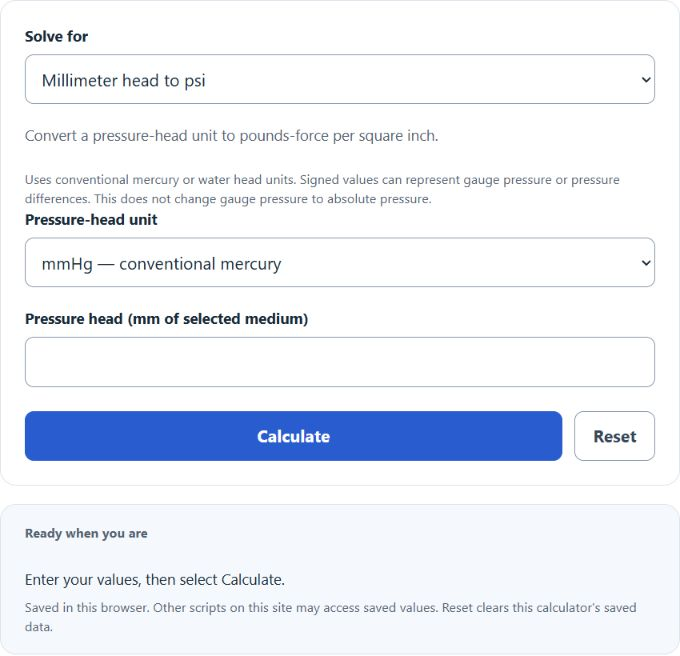
Convert millimeters of mercury or millimeters of water to psi and reverse psi to either pressure-head unit, with Pa, kPa, inHg, and inH2O results.
mm To psi Formula
The following formula is used to convert millimeters of mercury (mmHg) to pounds per square inch (psi).
Variables:
- PSI is the pressure in pounds per square inch
- MMHG is the pressure in millimeters of mercury
To calculate the pressure in pounds per square inch, multiply the pressure in conventional millimeters of mercury by approximately 0.0193367775. For conventional water head, use approximately 0.0014223343 psi per mmH₂O.
| Pascals (Pa) | Kilopascals (kPa) |
|---|---|
| 100 | 0.100 |
| 250 | 0.250 |
| 500 | 0.500 |
| 750 | 0.750 |
| 1000 | 1.000 |
| 2000 | 2.000 |
| 2500 | 2.500 |
| 5000 | 5.000 |
| 7500 | 7.500 |
| 10000 | 10.000 |
| 25000 | 25.000 |
| 50000 | 50.000 |
| 75000 | 75.000 |
| 100000 | 100.000 |
| 101325 | 101.325 |
| 200000 | 200.000 |
| 250000 | 250.000 |
| 500000 | 500.000 |
| 750000 | 750.000 |
| 1000000 | 1000.000 |
| * Rounded to 3 decimals. SI relation: 1 kPa = 1000 Pa (so 1 Pa = 0.001 kPa). | |
What Does “mm to psi” Mean?
Here, mm means a pressure-head unit, either millimeters of mercury (mmHg) or millimeters of water (mmH₂O), selected in the calculator. Linear millimeters alone cannot convert to psi. Both are units of pressure commonly used in various fields. Millimeters of mercury is often used in medicine and physiology, while pounds per square inch is widely used in the engineering and technical fields. The conversion is necessary when one needs to express measurements in different units for specific applications.
How to Calculate mm To psi?
The following steps outline how to calculate the pressure in pounds per square inch (PSI) from millimeters of mercury (mmHg) using the conventional mercury formula PSI ≈ MMHG * 0.0193367775. Choose the pressure medium and conversion direction before entering a value; the reference remains gauge, absolute, or differential as supplied.
- First, determine the pressure in millimeters of mercury (MMHG).
- Next, multiply conventional mmHg by approximately 0.0193367775. Water head uses a different factor: 1 conventional mmH₂O = 9.80665 Pa.
- Finally, calculate the pressure in pounds per square inch (PSI).
- After inserting the variables and calculating the result, check your answer with the calculator above.
Example Problem:
Use the following variables as an example problem to test your knowledge.
Pressure in conventional millimeters of mercury (mmHg) = 50. The equivalent is approximately 0.96683887 psi. Conventional water and mercury units use standard gravity; temperature-specific real column densities can differ.