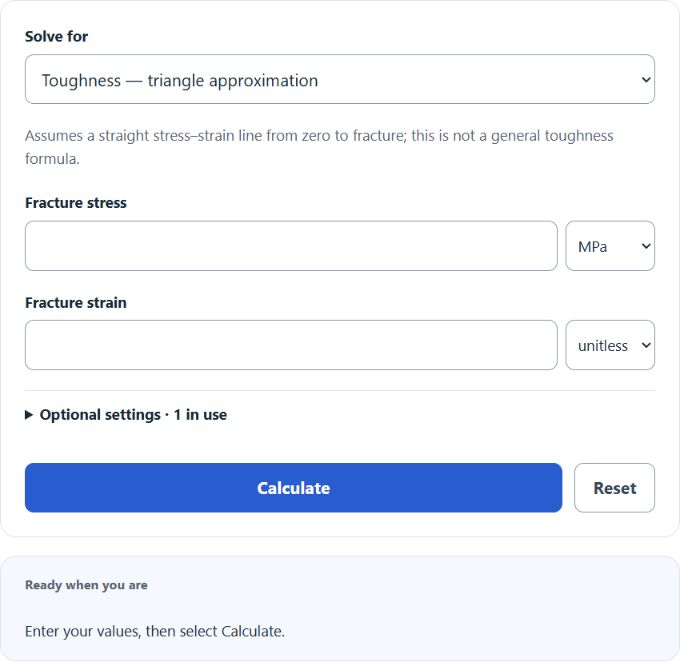
Estimate toughness, fracture stress, or fracture strain using an explicit triangle approximation, or integrate measured stress-strain points with the trapezoidal rule.
Modulus Of Toughness Formula
The modulus of toughness is defined as the area under the stress–strain curve up to fracture. In general, it is calculated by integrating stress with respect to strain. A simple triangular approximation is sometimes used only when the curve is approximately linear from the origin to fracture.
Variables:
- MT is the modulus of toughness (energy per unit volume), in J/m³ (numerically equivalent to Pa; 1 MPa = 1 MJ/m³)
- σ(ε) is stress as a function of strain (Pa, MPa, etc.)
- ε is strain (dimensionless), and εf is the strain at fracture
To calculate the modulus of toughness accurately, integrate the full stress–strain curve from zero strain to fracture (or use trapezoidal integration on discrete data points). The triangular formula MT ≈ 0.5·σf·εf is only an approximation that assumes a straight-line curve from the origin to fracture.
What is Modulus Of Toughness?
The modulus of toughness is an indicator of a material's ability to absorb energy up to the point of fracture. It is defined as the area under the stress–strain curve from the origin to the point of fracture. This property is crucial in applications where materials are subjected to impact and must not fail catastrophically.
How to Calculate Modulus Of Toughness?
The following steps outline how to calculate the Modulus Of Toughness.
- Obtain the stress–strain curve for the material up to fracture (from a tensile test or other appropriate test method).
- Determine the fracture strain εf (dimensionless; percent strain must be converted to a decimal for calculations).
- Compute the area under the curve using MT = ∫₀εf σ(ε) dε, or use a numerical method such as trapezoidal integration on measured data points.
- Report the Modulus Of Toughness (MT) as energy per unit volume (J/m³). It is often displayed in Pa/MPa because 1 Pa = 1 J/m³.
- If you do not have the full curve, select a triangle-approximation mode and recognize that it assumes a straight line from zero to fracture and may differ from the true value.
Example Problem:
Use the following variables as an example problem to test your knowledge.
maximum stress (σ) = 300 MPa
strain (ε) at fracture = 0.02
If you assume a linear (triangular) stress–strain curve from the origin to fracture, then MT ≈ 0.5 × 300 MPa × 0.02 = 3 MPa, which is equivalent to 3 MJ/m³.