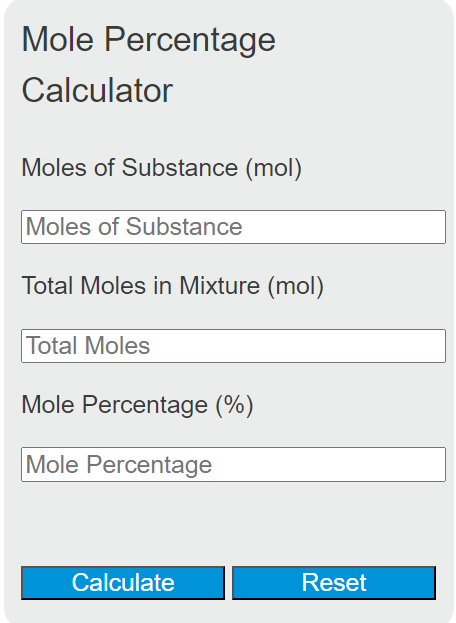
Calculate mole percentage from component moles, mass and molar mass, or up to four mixture components, with mole fraction and ppm.
Related Calculators
- Mole Percent To Weight Percent Calculator
- Volume Fraction Calculator
- Alloy Percent Calculator
- Mg To Moles Calculator
- All Chemistry Calculators
Mole Percentage Formula
The following formula is used to calculate the mole percentage:
Variables:
- Moles of Substance is the number of moles of the specific substance in the mixture.
- Total Moles in Mixture is the sum of the moles of all substances in the mixture.
To calculate the mole percentage, divide the moles of the substance by the total moles in the mixture and then multiply by 100 to get the percentage.
What is Mole Percentage?
Mole percentage (also called molar percentage or amount fraction percentage) is a dimensionless expression of the concentration of a single component in a mixture. It is calculated by taking the ratio of the moles of one component to the total moles of every component present, then multiplying by 100. Mole percentage is the percent form of mole fraction; a mole fraction of 0.25 is identical to a mole percentage of 25%. In any mixture, the mole percentages of all components always sum to exactly 100%.
Unlike molarity or molality, mole percentage is independent of temperature and pressure because it is a ratio of quantities (moles) rather than a ratio involving volume or mass of solution. This property makes it particularly valuable in gas-phase chemistry, high-temperature industrial processes, and any situation where temperature fluctuations would cause volume-based concentrations to shift.
Mole Percentage of Earth's Atmosphere
The most familiar large-scale application of mole percentage is the composition of dry air. Because gases at similar conditions approximate ideal behavior, the mole percentage of each atmospheric gas is nearly equal to its volume percentage. The following table shows the mole percent composition of Earth's dry atmosphere at sea level.
| Gas | Chemical Formula | Mole Percentage (%) | Molar Mass (g/mol) |
|---|---|---|---|
| Nitrogen | N₂ | 78.084 | 28.014 |
| Oxygen | O₂ | 20.946 | 31.998 |
| Argon | Ar | 0.9340 | 39.948 |
| Carbon Dioxide | CO₂ | 0.0421 | 44.009 |
| Neon | Ne | 0.001818 | 20.180 |
| Helium | He | 0.000524 | 4.003 |
| Methane | CH₄ | 0.000192 | 16.043 |
| Krypton | Kr | 0.000114 | 83.798 |
Because each gas has a different molar mass, the mole percent and mass percent of the atmosphere are not the same. Nitrogen accounts for 78.08 mol% but 75.52 wt% of dry air, while argon accounts for only 0.93 mol% but 1.29 wt% because argon atoms (39.95 g/mol) are heavier than the average air molecule (28.97 g/mol). This distinction matters when calculating partial pressures using Dalton's Law, where the partial pressure of any gas equals its mole fraction multiplied by the total atmospheric pressure.
Mole Percentage vs. Other Concentration Units
Chemistry uses several different ways to express how much of a substance is present in a mixture. Mole percentage is one of five common concentration measures, and each has specific conditions where it is most useful. The table below compares them directly.
| Unit | Formula | Depends on Temperature? | Best Used For |
|---|---|---|---|
| Mole Percentage (mol%) | (moles of solute / total moles) x 100 | No | Gas mixtures, vapor-liquid equilibria, phase diagrams |
| Mass Percentage (wt%) | (mass of solute / total mass) x 100 | No | Industrial formulations, alloys, food labeling |
| Molarity (M) | moles of solute / liters of solution | Yes | Aqueous lab solutions, titrations |
| Molality (m) | moles of solute / kg of solvent | No | Colligative property calculations |
| Mole Fraction (x) | moles of solute / total moles | No | Thermodynamic equations, Raoult's Law |
The key advantage of mole percentage over molarity is that mole percentage does not change when a solution is heated or cooled, because no volume term appears in the formula. Mole percentage and mole fraction carry the same information (one is simply 100 times the other), but mole percentage is often preferred in applied and industrial contexts because percentages are more intuitive for quality control and product specifications.
Converting Between Mole Percent and Weight Percent
Mole percent and weight percent (mass percent) are not interchangeable unless every component in the mixture has the same molar mass. Converting between them requires knowledge of each component's molar mass. The conversion formula for a component A in a mixture of n components is:
Where M represents the molar mass of each component. As an example, consider a binary mixture of ethanol (C₂H₅OH, M = 46.07 g/mol) and water (H₂O, M = 18.015 g/mol) at 50 mol% each. The weight percent of ethanol would be (50 x 46.07) / ((50 x 46.07) + (50 x 18.015)) x 100 = 71.9 wt%. Even though the two substances are present in equal molar amounts, ethanol dominates by mass because its molecules are roughly 2.5 times heavier than water molecules.
Mole Percentage in Raoult's Law and Colligative Properties
Raoult's Law states that the vapor pressure of a solvent above a solution equals the vapor pressure of the pure solvent multiplied by the mole fraction of the solvent. In equation form: P = x_solvent x P*, where P* is the pure solvent vapor pressure. Because mole fraction is simply mole percentage divided by 100, mole percentage is directly linked to predictions of boiling point elevation, freezing point depression, and vapor pressure lowering.
For example, if a solution contains 90 mol% water and 10 mol% a nonvolatile solute, the vapor pressure above that solution is 90% of pure water's vapor pressure at the same temperature. This 10% reduction in vapor pressure causes the boiling point to rise and the freezing point to drop. These colligative properties depend only on the mole fraction (and thus mole percentage) of the solute particles, not on the chemical identity of the solute itself.
Industrial and Scientific Applications
Mole percentage is used across many fields beyond the classroom. In semiconductor manufacturing, the doping concentration of silicon wafers is tracked in mole percent of the dopant element (boron, phosphorus, or arsenic) relative to silicon atoms, because even fractions of a mol% can alter electrical conductivity by orders of magnitude. In metallurgy, phase diagrams of alloys (such as the copper-nickel or iron-carbon systems) plot composition along the horizontal axis in either mole percent or atomic percent, which are equivalent for elemental mixtures.
In the pharmaceutical industry, mole percentage is used to define the composition of drug co-crystals and solid dispersions, where the ratio of active pharmaceutical ingredient to co-former must be held to a precise molar ratio for consistent bioavailability. Environmental scientists report atmospheric trace gas concentrations in units derived from mole fraction, such as parts per million by volume (ppmv), which is equivalent to micromole percent (10⁻⁴ mol%). The current atmospheric CO₂ level of approximately 421 ppmv, for instance, is the same as 0.0421 mol%.
In natural gas processing, pipeline specifications for impurities such as hydrogen sulfide (H₂S) and carbon dioxide are given in mole percent. A typical sales gas specification allows a maximum of 4 mol% CO₂ and 0.25 mol% (roughly 4 grains per 100 standard cubic feet) H₂S. These thresholds exist because the corrosive potential and heating value of the gas stream depend on the molar proportions of each component, not their mass proportions.
Common Mole Percentage Values in Everyday Chemistry
| Mixture | Component | Approximate Mol% |
|---|---|---|
| Dry air | N₂ | 78.08 |
| Dry air | O₂ | 20.95 |
| Seawater (dissolved salts) | NaCl | 85.6 (of dissolved ions) |
| Exhaled breath | CO₂ | ~4.0 |
| Natural gas (typical) | CH₄ | 70 to 90 |
| Natural gas (typical) | C₂H₆ | 0 to 20 |
| Stainless steel 304 (atomic%) | Fe | ~69 |
| Stainless steel 304 (atomic%) | Cr | ~19 |
| Stainless steel 304 (atomic%) | Ni | ~10 |
| Vehicle exhaust (gasoline) | CO₂ | ~12 to 15 |
This table illustrates that mole percentage appears in contexts ranging from atmospheric science to materials engineering to fossil fuel processing. In each case the mole-based ratio gives a count of particles or atoms, which is often more chemically meaningful than a mass-based ratio when predicting reaction behavior, thermodynamic properties, or regulatory compliance.