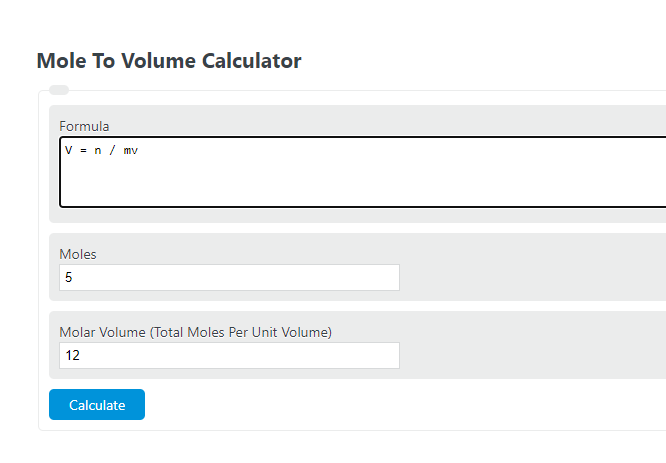
Convert moles to gas volume at any pressure and temperature or solve solution volume from molarity, with reverse modes, unit conversions, and steps.
- All Volume Calculators
- All Chemistry Calculators
- mL to Moles Calculator
- Moles to Molecules Calculator
- Mg to Percentage Calculator
| Calculator Operations | Required Inputs |
|---|---|
| Convert Volume to Moles | Volume, Molar Volume |
| Convert Moles to Molar Volume | Volume, Moles |
| Convert Moles to Volume | Moles, Molar Volume |
Mole to Volume Formula
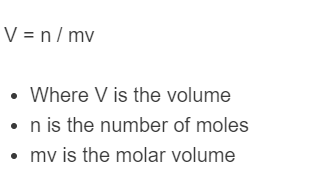
The following formula is used to convert the number of moles into volume.
- Where V is the volume
- n is the number of moles
- Vm is the molar volume (volume per mole, e.g., L/mol) at the specified conditions
To calculate volume from moles, multiply the number of moles by the molar volume. For ideal gases, Vm = RT/P, where R = 8.31446 J/(mol·K). Because molar volume scales directly with absolute temperature, every 1% increase in Kelvin temperature (at constant pressure) increases gas volume by 1%.
| Moles (mol) | Volume (L) at STP (22.414 L/mol) | Volume (L) at SATP (24.465 L/mol) |
|---|---|---|
| 0.001 | 0.022 | 0.024 |
| 0.005 | 0.112 | 0.122 |
| 0.010 | 0.224 | 0.245 |
| 0.020 | 0.448 | 0.489 |
| 0.050 | 1.121 | 1.223 |
| 0.075 | 1.681 | 1.835 |
| 0.100 | 2.241 | 2.447 |
| 0.125 | 2.802 | 3.058 |
| 0.200 | 4.483 | 4.893 |
| 0.250 | 5.604 | 6.116 |
| 0.500 | 11.207 | 12.233 |
| 0.750 | 16.811 | 18.349 |
| 1.000 | 22.414 | 24.465 |
| 1.250 | 28.018 | 30.581 |
| 1.500 | 33.621 | 36.698 |
| 2.000 | 44.828 | 48.930 |
| 2.500 | 56.035 | 61.163 |
| 3.000 | 67.242 | 73.395 |
| 4.000 | 89.656 | 97.860 |
| 5.000 | 112.070 | 122.325 |
| Assumes ideal gas behavior. V = n × Vm. STP Vm = 22.414 L/mol (0°C, 1 atm). SATP Vm = 24.465 L/mol (25°C, 1 atm). Values rounded to 3 decimals. | ||
Molar Volume vs. Temperature (Ideal Gas at 1 atm)
Because Vm = RT/P, molar volume is directly proportional to absolute temperature. The table below shows how Vm changes across the temperature range relevant to chemistry and engineering. Furnace exhaust at 500°C holds 2.83 times the volume per mole that the same gas would at STP, which directly affects flow rates, duct sizing, and catalyst bed design.
| Temperature (°C) | Temperature (K) | Vm (L/mol) | Relative to STP |
|---|---|---|---|
| -100 | 173.15 | 14.21 | 0.634x |
| -50 | 223.15 | 18.32 | 0.817x |
| 0 (STP) | 273.15 | 22.41 | 1.000x |
| 25 (SATP) | 298.15 | 24.47 | 1.092x |
| 50 | 323.15 | 26.52 | 1.183x |
| 100 | 373.15 | 30.62 | 1.366x |
| 200 | 473.15 | 38.83 | 1.733x |
| 300 | 573.15 | 47.02 | 2.098x |
| 500 | 773.15 | 63.44 | 2.830x |
| 1000 | 1273.15 | 104.47 | 4.662x |
| Vm = RT/P. R = 8.31446 J/(mol·K), P = 101,325 Pa. Note the linear relationship: doubling absolute temperature exactly doubles molar volume at constant pressure. | |||
Common Gases at STP (0°C, 1 atm): Real Molar Volumes
| Gas | Z at STP | Vm (L/mol) |
|---|---|---|
| Hydrogen (H₂) | 1.0006 | 22.428 |
| Helium (He) | 1.0005 | 22.425 |
| Nitrogen (N₂) | 0.9995 | 22.403 |
| Oxygen (O₂) | 0.9990 | 22.392 |
| Argon (Ar) | 0.9982 | 22.377 |
| Carbon Dioxide (CO₂) | 0.9934 | 22.260 |
| Ammonia (NH₃) | 0.9844 | 22.074 |
Ideal gas: Z = 1, Vm = 22.414 L/mol. H₂ and He exceed Z = 1 because quantum effects suppress attractive interactions at low temperatures. CO₂ and NH₃ deviate most due to stronger intermolecular forces.
Common Liquids at 25°C: Molar Volume via Vm = M/ρ
| Substance | M (g/mol) | ρ (g/mL) | Vm (cm³/mol) | Gas/Liquid Ratio at STP |
|---|---|---|---|---|
| Water (H₂O) | 18.015 | 0.997 | 18.07 | 1,240x |
| Methanol | 32.04 | 0.791 | 40.5 | 553x |
| Ethanol | 46.07 | 0.785 | 58.7 | 382x |
| Acetone | 58.08 | 0.784 | 74.1 | 302x |
| Benzene | 78.11 | 0.874 | 89.4 | 251x |
| Glycerol | 92.09 | 1.261 | 73.0 | 307x |
Gas/Liquid Ratio = 22,414 cm³/mol (ideal gas at STP) / Vm,liquid. Water has the highest ratio because hydrogen bonding compresses its liquid phase unusually tightly. This ratio governs tank sizing when liquids are stored and dispensed as vapor.
Common Solids at 25°C: Molar Volume via Vm = M/ρ
| Substance | M (g/mol) | ρ (g/cm³) | Vm (cm³/mol) |
|---|---|---|---|
| Aluminum (Al) | 26.98 | 2.70 | 9.99 |
| Iron (Fe) | 55.85 | 7.87 | 7.09 |
| Copper (Cu) | 63.55 | 8.96 | 7.09 |
| Gold (Au) | 196.97 | 19.3 | 10.2 |
| Table salt (NaCl) | 58.44 | 2.165 | 27.0 |
| Silicon (Si) | 28.09 | 2.33 | 12.1 |
Dense metals (Fe, Cu) have small molar volumes despite high atomic masses because they pack tightly in crystal structures. Gold’s molar volume rivals that of aluminum despite a 7x higher molar mass, reflecting its extreme density.
Mole to Volume: Gases, Liquids, and Solids
For gases, Avogadro’s principle establishes that equal volumes of any ideal gas at the same temperature and pressure contain the same number of molecules. This is why every ideal gas has a molar volume of 22.414 L/mol at STP. Real gases deviate proportionally to their intermolecular forces: H₂ and He stay within 0.1% of ideal at STP, while CO₂ and NH₃ fall 0.7-1.6% short due to stronger molecular attractions.
For liquids and solids, use Vm = M/ρ. A mole of water occupies just 18.07 cm³, roughly 1,240 times less volume than the same mole as an ideal gas at STP. This distinction matters whenever converting between moles and volume in non-gas systems such as solution chemistry or materials science. The gas-to-liquid volume ratio also drives industrial tank sizing: a cylinder holding 1 kg of liquid CO₂ (about 22.7 mol, Vm,liquid ~44 cm³/mol) releases roughly 510 liters of CO₂ gas at STP when fully vaporized.
Molar Volume in Chemical Reactions
The most practical application of mole-to-volume conversion is predicting gas volumes produced or consumed in reactions. Because all ideal gases share the same molar volume at a given temperature and pressure, stoichiometric coefficients translate directly into volume ratios. In the combustion of methane (CH₄ + 2O₂ → CO₂ + 2H₂O), every liter of CH₄ consumed at STP requires exactly 2 liters of O₂ and produces 1 liter of CO₂.
A precise real-world example: a car airbag inflator uses sodium azide (2NaN₃ → 2Na + 3N₂). To inflate a driver-side bag to 60 liters at 25°C (Vm = 24.47 L/mol), the system must generate 60/24.47 = 2.45 mol N₂. By stoichiometry, that requires (2/3) × 2.45 = 1.63 mol NaN₃, or about 106 grams. The entire inflation takes roughly 30 milliseconds. Mole-to-volume conversion is what determines the charge mass in each airbag module.
Mole to Volume Example
How to calculate mole to volume?
- First, determine the number of moles.
Calculate the number of moles.
- Next, determine the molar volume.
Determine the molar volume (volume per mole, e.g., L/mol) at your temperature and pressure.
- Finally, calculate the total volume.
Calculate the total volume using the equation above.
V = n × Vm = 2.5 mol × 24.47 L/mol = 61.2 L
At STP (0°C): 2.5 × 22.41 = 56.0 L — about 9% less, from the 25°C temperature difference alone.
FAQ
Molar volume (Vₘ) is the volume occupied by one mole of a substance at a specified temperature and pressure. It is not a universal constant; it varies with conditions for gases, and with density for liquids and solids.
At STP (0°C, 1 atm), one mole of any ideal gas occupies 22.414 L. At SATP (25°C, 1 atm), the value rises to 24.465 L/mol. Both values follow from PV = nRT with R = 8.31446 J/(mol·K).
Use Vm = M / ρ, where M is the molar mass in g/mol and ρ is the density in g/cm³. For example, ethanol (M = 46.07 g/mol, ρ = 0.785 g/mL) gives Vm = 58.7 cm³/mol.
Yes, especially for gases. For an ideal gas, Vm = RT/P; doubling the absolute temperature at constant pressure doubles molar volume. For liquids and solids, thermal expansion causes small changes but the effect is far smaller than for gases.
Molar volume (L/mol or cm³/mol) is the volume per mole of a pure substance. Molar concentration (mol/L) describes moles of solute per liter of solution. For a pure liquid they are reciprocally related: concentration = ρ / M = 1 / Vm.
For an ideal gas, use Vm = RT/P. At 100°C (373.15 K) and 1 atm: Vm = 8.31446 × 373.15 / 101,325 = 30.62 L/mol. For real gases, multiply by the compressibility factor Z: Vm,real = Z × RT/P. At temperatures well above the boiling point and moderate pressures, Z is close to 1.0 for most gases, so the ideal gas approximation introduces less than 1% error.