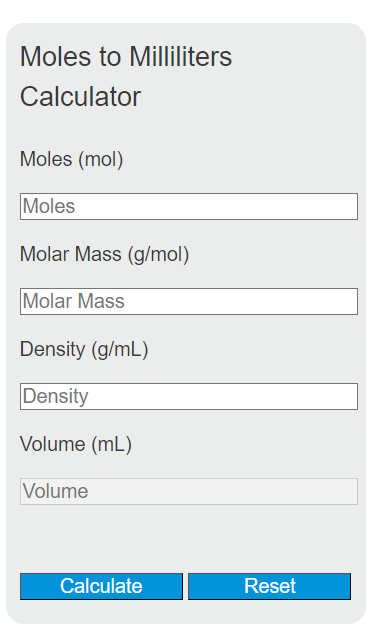
Calculate mL from moles using solution molarity or liquid molar mass and density, or find moles from volume, with mol, mmol, µmol, L, mL, and µL units.
Moles to Milliliters Formulas
Converting moles to milliliters requires knowing the physical context of the substance. The correct formula depends on whether you are working with a solution of known molarity, a pure liquid, or a gas. Each scenario uses a different relationship between amount of substance and volume.
For solutions (known molarity):
Where n is moles of solute and M is the molar concentration (molarity) of the solution in mol/L. This is the most common scenario in wet chemistry labs, where reagents are stored as standardized solutions.
For pure liquids (known density):
Where MW is the molar mass and ρ is the liquid density. This applies when dispensing a neat (undiluted) liquid reagent such as ethanol, acetic acid, or sulfuric acid from a stock bottle.
For ideal gases at STP:
At standard temperature and pressure (0 °C, 1 atm), one mole of any ideal gas occupies 22.414 L (22,414 mL). Under the newer IUPAC definition (0 °C, 1 bar), the molar volume is 22.711 L. At 25 °C and 1 atm (SATP), it increases to 24.465 L. For non-standard conditions, use the full ideal gas law: V = nRT/P.
Reference Data: Common Laboratory Substances
The table below lists the molar mass, density, and volume of one mole for substances frequently encountered in chemistry labs. These values let you convert between moles and milliliters without looking up each property separately.
| Substance | Formula | MW (g/mol) | Density (g/mL) | mL per mol |
|---|---|---|---|---|
| Water | H₂O | 18.015 | 0.998 | 18.05 |
| Ethanol | C₂H₅OH | 46.07 | 0.789 | 58.39 |
| Methanol | CH₃OH | 32.04 | 0.792 | 40.45 |
| Acetone | C₃H₆O | 58.08 | 0.784 | 74.08 |
| Acetic acid (glacial) | CH₃COOH | 60.05 | 1.049 | 57.24 |
| Sulfuric acid (conc.) | H₂SO₄ | 98.08 | 1.840 | 53.30 |
| Hydrochloric acid (conc.) | HCl (aq, 37%) | 36.46 | 1.200 | 30.38* |
| Nitric acid (conc.) | HNO₃ (aq, 70%) | 63.01 | 1.413 | 44.59* |
| Phosphoric acid (conc.) | H₃PO₄ (aq, 85%) | 98.00 | 1.685 | 58.16* |
| Ammonia solution (conc.) | NH₃ (aq, 28%) | 17.03 | 0.900 | 18.92* |
| Glycerol | C₃H₈O₃ | 92.09 | 1.261 | 73.03 |
| Dimethyl sulfoxide (DMSO) | C₂H₆OS | 78.13 | 1.100 | 71.03 |
| Chloroform | CHCl₃ | 119.38 | 1.489 | 80.17 |
| Diethyl ether | C₄H₁₀O | 74.12 | 0.713 | 103.96 |
| Toluene | C₇H₈ | 92.14 | 0.867 | 106.28 |
| Hexane | C₆H₁₄ | 86.18 | 0.659 | 130.77 |
| Mercury | Hg | 200.59 | 13.534 | 14.82 |
| Bromine | Br₂ | 159.81 | 3.103 | 51.50 |
| * Aqueous acid/base values are for the concentrated commercial grade. The mL per mol figure refers to the volume of solution containing 1 mol of the solute, not the pure compound. V = MW / (ρ × weight fraction). | ||||
Moles to Milliliters Conversion Table (1.00 M Solution)
| Moles (mol) | Milliliters (mL) |
|---|---|
| 0.0005 | 0.500 |
| 0.001 | 1.000 |
| 0.002 | 2.000 |
| 0.0025 | 2.500 |
| 0.005 | 5.000 |
| 0.0075 | 7.500 |
| 0.010 | 10.000 |
| 0.020 | 20.000 |
| 0.025 | 25.000 |
| 0.050 | 50.000 |
| 0.075 | 75.000 |
| 0.100 | 100.000 |
| 0.200 | 200.000 |
| 0.250 | 250.000 |
| 0.300 | 300.000 |
| 0.500 | 500.000 |
| 0.750 | 750.000 |
| 1.000 | 1000.000 |
| 1.500 | 1500.000 |
| 2.000 | 2000.000 |
| * Rounded to 3 decimals. Assumes M = 1.00 mol/L. Relation: V(mL) = n(mol) / M(mol/L) × 1000. | |
Why the Conversion Depends on Physical State
A mole is a count of particles (6.022 × 10²³), not a unit of volume. The volume that count occupies changes dramatically depending on whether those particles are dissolved in a solvent, present as a neat liquid, or dispersed as a gas. One mole of water as a pure liquid occupies about 18 mL, while one mole of water vapor at STP fills 22,414 mL, a factor of roughly 1,245. This is why no single formula converts moles to milliliters universally; you must know the phase and conditions.
In solutions, the solvent contributes most of the volume, so the relevant quantity is concentration (molarity). A 1 M NaCl solution contains 58.44 g of salt per liter, but the solution’s total volume is still approximately 1,000 mL because the dissolved ions occupy only a small fraction of the space. For dilute aqueous solutions (below about 0.1 M), the solution volume is nearly equal to the volume of pure water used, which simplifies preparation.
Concentrated Acid and Base Volume Calculations
Stock bottles of concentrated acids and bases are labeled by weight percent and density rather than molarity. To find the volume of concentrated reagent that delivers a desired number of moles, you need to determine the effective molarity of the stock first. The general relationship is: M = (1000 × ρ × weight fraction) / MW. For concentrated HCl (37% w/w, ρ = 1.20 g/mL), the effective molarity is about 12.2 M. To obtain 0.05 mol of HCl from this stock, you would need 0.05 / 12.2 × 1000 ≈ 4.1 mL.
Below are the approximate effective molarities for the most commonly used concentrated reagents: HCl 37% is about 12.2 M, H₂SO₄ 96% is about 18.0 M, HNO₃ 70% is about 15.7 M, H₃PO₄ 85% is about 14.6 M, NH₃ (aq) 28% is about 14.8 M, NaOH 50% (w/w) is about 19.1 M, and acetic acid (glacial, 99.7%) is about 17.4 M. These values are approximate because commercial grades vary slightly by manufacturer.
Temperature and Pressure Effects on Mole-to-Volume Conversions
Liquid densities decrease with rising temperature as thermal expansion increases molecular spacing. Water’s density drops from 0.9998 g/mL at 4 °C to 0.9584 g/mL at 100 °C, a roughly 4% shift. Organic solvents expand more: ethanol’s density falls from 0.806 g/mL at 0 °C to 0.772 g/mL at 40 °C, nearly a 4.2% change over just 40 degrees. For routine lab work at ambient temperature (20 to 25 °C), these variations are usually within acceptable error margins. For precision analytical work such as gravimetric or titrimetric analysis, always use the density at the measured temperature.
Gases are far more sensitive. The ideal gas law (PV = nRT) shows that volume scales linearly with absolute temperature and inversely with pressure. Doubling the Kelvin temperature doubles the volume. At high pressures or low temperatures, real gases deviate from ideal behavior; the van der Waals equation or compressibility factors (Z) correct for intermolecular attractions and finite molecular size. For most lab-bench conversions at near-atmospheric pressure, the ideal gas law is accurate within 1 to 2%.
Practical Applications
Titration and volumetric analysis. The core equation of any titration is n(analyte) = M(titrant) × V(titrant). Once you know the moles required to reach the equivalence point, converting to the volume you must dispense from a buret is a direct moles-to-mL calculation. Analytical chemists rely on this conversion thousands of times per day in quality control labs across pharmaceutical manufacturing, food safety testing, and environmental water analysis.
Pharmaceutical compounding and IV preparation. Hospital pharmacists convert between moles (or millimoles) and milliliters when preparing electrolyte infusions. Physiological saline is 0.154 M NaCl; a physician ordering 10 mmol of KCl supplementation needs the pharmacist to calculate the exact volume of a 2 M KCl concentrate to draw up (5 mL). Errors in this conversion can be clinically significant, which is why automated calculators serve as a cross-check.
Molecular biology buffer preparation. Protocols in molecular biology specify buffer concentrations in molar terms (e.g., 50 mM Tris-HCl pH 7.5, 10 mM EDTA). Researchers must convert these mole quantities to the volume of stock solutions they need to pipette. A typical lab keeps 1 M Tris and 0.5 M EDTA stocks, so preparing 500 mL of working buffer at 50 mM Tris requires 25 mL of the 1 M stock, and 10 mM EDTA requires 10 mL of the 0.5 M stock, with water to volume.
Industrial chemical dosing. Water treatment plants dose coagulants and disinfectants by moles per volume of treated water. If a plant must add 0.002 mol of sodium hypochlorite (NaOCl, MW 74.44) per cubic meter of water and the stock bleach is approximately 0.8 M, the operator needs 2.5 mL of stock per cubic meter. Scaling this across millions of liters per day makes accurate moles-to-volume conversion a key operational parameter.