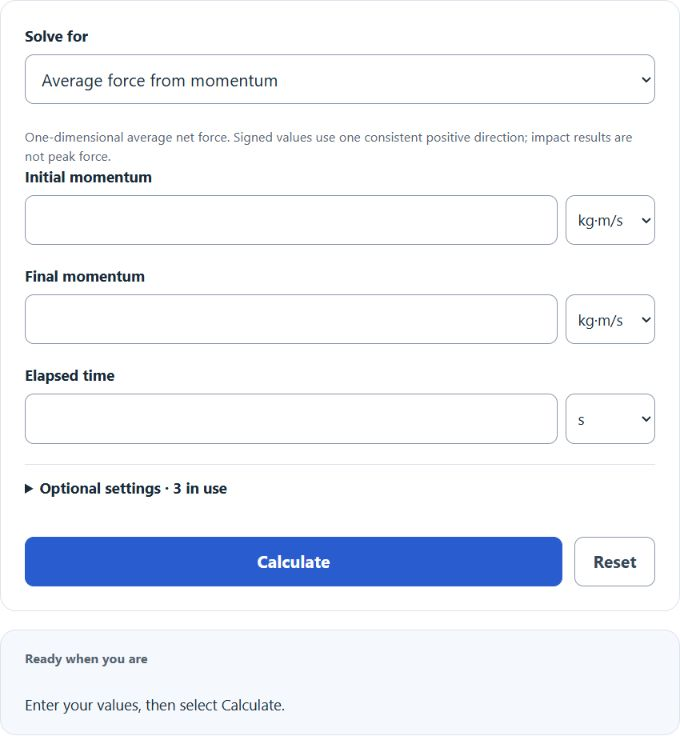
Calculate average net force from momentum change, mass and velocity, or impulse, with unit conversions and illustrative duration presets.
- All Physics Calculators
- Mechanics and Physics Unit Converters
- All Force Calculators
- Energy To Force Calculator
- Velocity to Force Calculator
- Acceleration to Force Calculator
Momentum to Force Formula
The following equation gives the magnitude of the one-dimensional average net force. The signed form is Favg = (Mf − Mi)/∆t, using one consistent positive direction.
- Where F is the average net force magnitude (N)
- Mi is the initial momentum (kg*m/s)
- Mf is the final momentum (kg*m/s)
- ∆t is the change in time (s)
To calculate the force from momentum, divide the change in momentum by the change in time.
| Newtons (N) | Pounds-force (lbf) |
|---|---|
| 1 | 0.225 |
| 2 | 0.450 |
| 5 | 1.124 |
| 10 | 2.248 |
| 20 | 4.496 |
| 25 | 5.620 |
| 30 | 6.744 |
| 40 | 8.992 |
| 50 | 11.240 |
| 75 | 16.861 |
| 100 | 22.481 |
| 150 | 33.721 |
| 200 | 44.962 |
| 250 | 56.202 |
| 300 | 67.443 |
| 400 | 89.924 |
| 500 | 112.404 |
| 750 | 168.607 |
| 1,000 | 224.809 |
| 2,000 | 449.618 |
| *Conversion factor: 1 N ≈ 0.224809 lbf (exact: 1 lbf = 4.4482216152605 N). | |
Can Momentum be Converted to Force?
Force is defined as the change in momentum with respect to time, so you must know the change in time to convert between momentum and force.
How to Calculate Force from Momentum?
Example Problem:
The following example outlines the steps and information needed to calculate force from momentum.
First, determine the initial momentum. In this example, the initial momentum is 50 kg*m/s.
Next, determine the final momentum. The final momentum in this case is 75 kg*m/s.
Next, determine the change in time. The change in time is measured to be 5 seconds.
Finally, calculate the force using the formula above:
F = |Mf-Mi| / ∆t
F = |75-50| / 5
F = 5 N
FAQ
What is momentum and how is it calculated?
Momentum is a physical quantity that represents the quantity of motion of a moving body. It is calculated as the product of an object's mass and its velocity. The formula for momentum (p) is p = m*v, where m is the mass in kilograms and v is the velocity in meters per second (m/s).
Why is the change in time important when calculating force from momentum?
The change in time (∆t) is crucial because force is defined as the rate of change of momentum with respect to time. Without knowing the time interval over which the momentum changes, it's impossible to calculate the force accurately. The shorter the time interval for a given change in momentum, the greater the force applied.
Can the momentum to force formula be used for any type of motion?
The formula gives the magnitude of the average net force along one dimension. The signed relation Favg = (Mf − Mi)/∆t also applies when force varies during the interval; it does not give peak force. Vector components must be treated consistently in multiple dimensions.