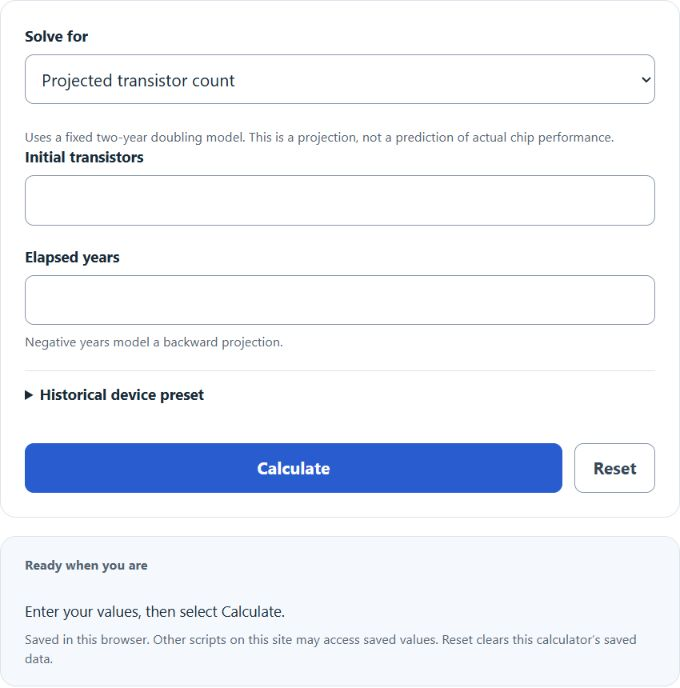
Calculate transistor growth with Moore’s Law by finding missing years, transistor counts, and projected transistor counts between device release dates.
Moores Law Formula
The following formula is used to calculate the number of transistors on a microchip according to Moore’s Law.
Variables:
- T is the number of transistors on a microchip
- P is the initial number of transistors on a microchip
- y is the number of years since the initial number of transistors was measured
To calculate the number of transistors on a microchip according to Moore’s Law, multiply the initial number of transistors by 2 raised to the power of half the number of years since the initial number of transistors was measured. This formula assumes that the number of transistors doubles every two years.
What is Moore’s Law?
Gordon Moore’s 1965 observation originally projected a yearly doubling in integrated-circuit components; he revised the estimate to approximately two years in 1975. This calculator uses that two-year convention as an exponential model. Transistor count alone does not determine computing performance, and the projection does not guarantee actual future device counts.
How to Calculate Moores Law?
The following steps outline how to calculate the number of transistors on a microchip using Moore’s Law.
- First, determine the initial number of transistors on a microchip (P).
- Next, determine the number of years since the initial number of transistors was measured (y).
- Next, use the formula T = P * (2^(y/2)) to calculate the number of transistors on a microchip (T).
- Finally, calculate the number of transistors on a microchip using the obtained values for P and y.
- After inserting the variables and calculating the result, check your answer with the calculator above.
Example Problem:
Use the following variables as an example problem to test your knowledge.
Initial number of transistors on a microchip (P) = 1000
Number of years since the initial number of transistors was measured (y) = 5