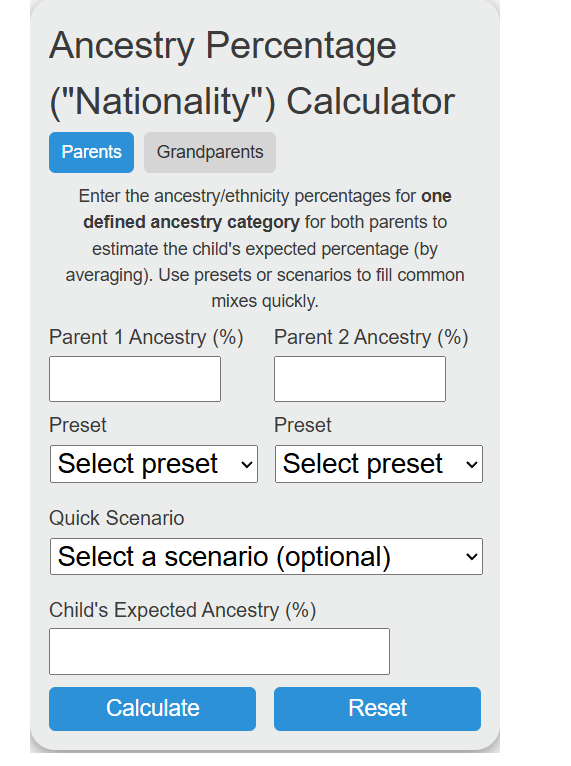
Calculate an expected ancestry percentage from two parents or four grandparents, or solve for one parent using equal family-tree contributions.
Related Calculators
- Percentage Calculator
- Population Proportion Calculator
- Phenotypic Ratio Calculator
- Genetic Linkage Distance Calculator
- Fixation Index Calculator
- All Everyday Life and Education Calculators
Nationality Percentage Formula
- CNP = child’s expected ancestry percentage (%)
- PNP1 = Parent 1’s ancestry percentage for the same category (%)
- PNP2 = Parent 2’s ancestry percentage for the same category (%)
Expected Ancestry Percentage by Generation
Expected percentage halves with each generation. The observed range widens significantly due to recombination; by the 4th generation, some individuals inherit 0% from a specific ancestor while others inherit over 15%.
| Ancestor | Generations Back | Expected % | Typical Observed Range | Chance of 0% Inheritance |
|---|---|---|---|---|
| Parent | 1 | 50% | ~50% (near-fixed) | <1% |
| Grandparent | 2 | 25% | 17%–34% | <1% |
| Great-grandparent | 3 | 12.5% | 6%–20% | ~2% |
| 2x Great-grandparent | 4 | 6.25% | 0%–15% | ~10% |
| 3x Great-grandparent | 5 | 3.125% | 0%–12% | ~32% |
Why Estimates Differ from Expected Values
The formula gives a statistical expectation, not a guaranteed outcome. Three compounding factors cause real-world results to diverge:
- Recombination randomness: Full siblings share an average of 50% of DNA, but actual shared amounts range from 1,613 to 3,488 cM. Documented cases show siblings differing by over 20 percentage points for the same specific ancestry region despite having identical parents.
- Sex-linked recombination rate: Females recombine more frequently than males, so DNA transmitted via the maternal line has higher per-segment variance than paternal DNA. A child’s maternal ancestry percentage therefore has a wider possible range than the paternal equivalent.
- Testing platform differences: Concordance for identical twins tested by two different DNA companies is only 52.7%–84.1%, versus 94.5%–99.2% when tested by the same company. The same person’s DNA can return different ethnicity percentages depending on which reference panel and algorithm a company uses.
DNA Test Confidence and Accuracy
DNA testing companies do not report ancestry percentages as exact values. 23andMe offers five confidence thresholds (50%, 60%, 70%, 80%, 90%); at the default 50% threshold, an ancestry assignment is as statistically likely to be incorrect as correct. AncestryDNA displays ranges rather than point estimates for each region. Ethnicity categories below 5% from any platform carry the highest error rate and are unreliable inputs for generational calculations. For the best calculator inputs, use the highest available confidence threshold from your test results.
What is Nationality Percentage?
“Nationality” is a legal citizenship concept not expressed as a percentage. In this context, the term refers to an ancestry or ethnicity percentage: a model-based estimate of how much of a person’s autosomal DNA resembles reference populations tied to specific geographic regions. It differs from citizenship, language, culture, or self-identification. Results vary across testing companies because each uses different reference populations and statistical models.
How to Calculate Nationality Percentage
- Determine Parent 1’s ancestry percentage for one defined category (PNP1).
- Determine Parent 2’s ancestry percentage for the same category (PNP2).
- Apply: CNP = (PNP1 + PNP2) / 2
Example: Parent 1 = 50% Italian, Parent 2 = 70% Italian. CNP = (50 + 70) / 2 = 60%. The child’s expected Italian ancestry is 60%, with an actual inherited range of roughly 45%–75% due to recombination variance.