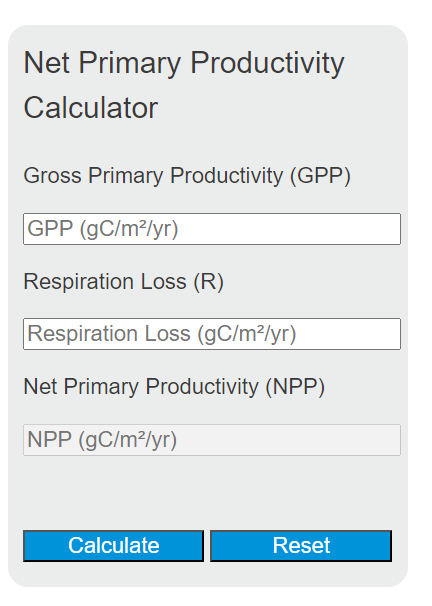
Calculate net primary productivity, gross primary productivity, or respiration from two known values with selectable carbon units and a worked solution.
Related Calculators
- NDVI Calculator
- Crop Coefficient Calculator
- Carrying Capacity Calculator
- Land Equivalent Ratio Calculator
- All Biology Calculators
Net Primary Productivity Formula
Net primary productivity (NPP) is the amount of carbon retained by plants after subtracting the carbon they use for respiration. In practical terms, it tells you how much new plant material is available for growth, storage, and transfer through the food web. This calculator is most useful when you know any two of the three values: gross primary productivity, respiration loss, and net primary productivity.
| Variable | Meaning | Typical Units |
|---|---|---|
| NPP | Net primary productivity; carbon retained in plant biomass after respiration | gC/m²/yr, kgC/m²/yr, kgC/ha/yr, MgC/ha/yr, gC/m²/day |
| GPP | Gross primary productivity; total carbon fixed by photosynthesis before respiration is removed | Same unit basis as NPP |
| R | Respiration loss; carbon used by plants for metabolic activity | Same unit basis as NPP |
For a valid calculation, all three values must use the same area basis and same time basis. If one value is per hectare per year and another is per square meter per day, convert them first before comparing or solving.
How to Use the Calculator
- Enter any two known values: GPP, respiration loss, or NPP.
- Select matching units for each field so the area and time basis are consistent.
- Leave the unknown field blank and click calculate.
- If you enter all three fields, the calculator can check whether the inputs are internally consistent.
- Use the advanced section if you want to convert a rate-based NPP value into a total carbon amount over a chosen area and duration.
How to Interpret the Result
| Result Type | What It Means |
|---|---|
| Positive NPP | Plants are storing carbon in new biomass after covering respiration costs. |
| Zero NPP | Gross production and plant respiration are balanced. |
| Negative NPP | Respiration exceeds gross production for the selected unit period, or the inputs may be inconsistent. |
Because respiration is subtracted from gross production, NPP cannot be greater than GPP when all values use the same units and time window.
Total NPP Over Area and Time
If you already have an NPP rate and want the total carbon fixed into biomass across a site or study period, multiply the rate by area and duration using compatible units.
Examples of compatible combinations include:
- NPP in gC/m²/yr with area in m² and time in years
- NPP in kgC/ha/yr with area in hectares and time in years
- NPP in gC/m²/day with area in m² and time in days
If the time unit does not match the NPP rate, convert one of them first. For example, an annual NPP value should be paired with years, while a daily NPP value should be paired with days.
Useful Unit Conversions
Example
Suppose an ecosystem has a gross primary productivity of 1000 gC/m²/yr and plant respiration loss of 600 gC/m²/yr. The net carbon retained by plants is:
This means each square meter retains 400 grams of carbon per year in new plant biomass after respiration has been accounted for.
Area and Time Example
If the NPP is 400 gC/m²/yr across 2 hectares for 3 years, first convert hectares to square meters, then multiply by the duration:
This type of calculation is useful for scaling plot-level productivity to fields, forests, restoration sites, or research areas.
Common Input Mistakes
- Mixing time bases: combining daily, monthly, and annual values without conversion.
- Mixing area bases: entering per square meter values alongside per hectare values.
- Using total carbon in one field and rate-based carbon in another: totals and rates are not interchangeable.
- Confusing NPP with GPP: GPP is the total fixed carbon before respiration; NPP is what remains after respiration.
- Entering respiration larger than gross production unintentionally: this can create a negative result that may or may not reflect real conditions.
Why NPP Matters
NPP is a core metric in ecology, forestry, agriculture, and carbon-cycle analysis because it helps quantify how efficiently ecosystems convert atmospheric carbon into plant biomass. Higher NPP generally indicates greater biomass accumulation potential, while lower NPP can reflect stress, nutrient limitation, drought, shading, disturbance, or seasonal dormancy.
- Compare productivity across ecosystems or land covers
- Estimate vegetation growth and carbon storage potential
- Scale field measurements to larger management areas
- Support ecosystem modeling and biomass assessments
- Track changes over seasons, years, or treatment conditions
Frequently Asked Questions
- Is NPP the same as GPP?
- No. GPP is total photosynthetic production before respiration is removed. NPP is the remaining carbon after subtracting plant respiration.
- Can NPP be negative?
- Yes, over a given period it can be negative if respiration exceeds gross production, though a negative result may also signal inconsistent units or data entry errors.
- Is NPP the same as net ecosystem productivity?
- No. NPP subtracts plant respiration only. Net ecosystem productivity also considers respiration by decomposers and other heterotrophs.
- What does the calculator return in the advanced section?
- It converts a productivity rate into a total amount of carbon over the selected area and time period, provided the units are compatible.