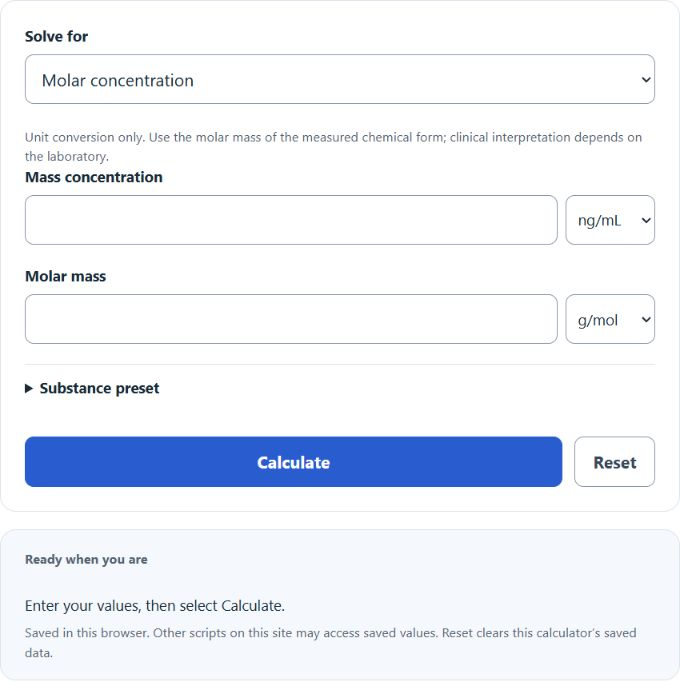
Convert ng/mL to nmol/L or back using molecular weight, with optional substance presets for common hormones, vitamins, and metabolites.
| ng/mL to nmol/L | nmol/L to ng/mL |
|---|---|
| 10 ng/mL = 24.960 nmol/L | 25 nmol/L = 10.016 ng/mL |
| 12 ng/mL = 29.952 nmol/L | 50 nmol/L = 20.032 ng/mL |
| 15 ng/mL = 37.440 nmol/L | 75 nmol/L = 30.048 ng/mL |
| 20 ng/mL = 49.920 nmol/L | 100 nmol/L = 40.064 ng/mL |
| 25 ng/mL = 62.400 nmol/L | 125 nmol/L = 50.080 ng/mL |
| 30 ng/mL = 74.880 nmol/L | 150 nmol/L = 60.096 ng/mL |
| 40 ng/mL = 99.840 nmol/L | 175 nmol/L = 70.112 ng/mL |
| 50 ng/mL = 124.800 nmol/L | 200 nmol/L = 80.128 ng/mL |
| 60 ng/mL = 149.760 nmol/L | 250 nmol/L = 100.160 ng/mL |
| 80 ng/mL = 199.681 nmol/L | 300 nmol/L = 120.192 ng/mL |
| Formula: nmol/L = (ng/mL × 1000) ÷ MW and ng/mL = (nmol/L × MW) ÷ 1000. MW = 400.64 g/mol (25‑OH Vitamin D3), so 1 ng/mL = 2.496 nmol/L. | |
| ng/mL to nmol/L | nmol/L to ng/mL |
|---|---|
| 0.2 ng/mL = 0.636 nmol/L | 1 nmol/L = 0.314 ng/mL |
| 0.5 ng/mL = 1.590 nmol/L | 2 nmol/L = 0.629 ng/mL |
| 1 ng/mL = 3.180 nmol/L | 5 nmol/L = 1.572 ng/mL |
| 2 ng/mL = 6.360 nmol/L | 10 nmol/L = 3.145 ng/mL |
| 5 ng/mL = 15.900 nmol/L | 20 nmol/L = 6.289 ng/mL |
| 10 ng/mL = 31.800 nmol/L | 30 nmol/L = 9.434 ng/mL |
| 15 ng/mL = 47.699 nmol/L | 50 nmol/L = 15.724 ng/mL |
| 20 ng/mL = 63.599 nmol/L | 75 nmol/L = 23.585 ng/mL |
| 30 ng/mL = 95.399 nmol/L | 100 nmol/L = 31.447 ng/mL |
| 40 ng/mL = 127.198 nmol/L | 150 nmol/L = 47.171 ng/mL |
| Formula: nmol/L = (ng/mL × 1000) ÷ MW and ng/mL = (nmol/L × MW) ÷ 1000. MW = 314.47 g/mol (Progesterone), so 1 ng/mL ≈ 3.18 nmol/L. | |
- All Unit Converters
- Medical and Health Unit Converters
- mmol/L to mg/dL Calculator
- mol/L to g/L Calculator
- nmol/L to ng/dL Calculator
- ng/dL to nmol/L Calculator
- ng/mL to Molarity Calculator
ng/mL To nmol/L Formula
The following formula converts mass concentration (ng/mL) to molar concentration (nmol/L). Molecular weight (MW) is required because a nanomole of testosterone weighs far less than a nanomole of albumin.
Formula source: CDC NHANES Sex Steroid Hormone Data Documentation (2022 rev.)
Variables:
- nmol/L is the concentration in nanomoles per liter (nmol/L)
- ng/mL is the concentration in nanograms per milliliter (ng/mL)
- MW is the molecular weight of the substance (g/mol)
The conversion factor is fixed per substance: 1 ng/mL = 1000 / MW nmol/L. For 25-hydroxyvitamin D3 (MW 400.64), 1 ng/mL = 2.496 nmol/L. For testosterone (MW 288.42), 1 ng/mL = 3.467 nmol/L. Because molecular weight varies widely across analytes, no single universal factor applies.
US vs. SI Units: Why Two Systems Are Used
US clinical laboratories report most hormones and metabolites in mass-based conventional units (ng/mL, pg/mL, µg/dL), a standard established before global SI adoption. The UK, EU, Canada, Australia, and international research publications follow SI molar units (nmol/L, pmol/L, µmol/L). The same physiological state produces completely different-looking numbers depending on the lab reporting convention. Testosterone results of 6.94 ng/mL and 24.07 nmol/L are identical values; only the unit system differs. This divergence is most clinically significant for vitamin D, testosterone, progesterone, and thyroid hormones, where patients frequently compare US results against European research thresholds or reference ranges from international guidelines.
Clinical Reference Ranges: ng/mL and nmol/L
The table below provides molecular weights, per-unit conversion factors, and illustrative laboratory ranges for the most commonly converted analytes. Multiply any ng/mL value by the listed factor to obtain nmol/L.
| Substance | MW (g/mol) | Factor (ng/mL → nmol/L) | Conventional (US) | SI / International |
|---|---|---|---|---|
| 25-OH Vitamin D3 | 400.64 | ×2.496 | Risk of deficiency: <12 ng/mL Generally adequate for most: ≥20 ng/mL |
Risk of deficiency: <30 nmol/L Generally adequate for most: ≥50 nmol/L |
| Testosterone (male) | 288.42 | ×3.467 | 300‑1000 ng/dL (3.0‑10.0 ng/mL) |
10.4‑34.7 nmol/L |
| Testosterone (female) | 288.42 | ×3.467 | 15‑70 ng/dL (0.15‑0.70 ng/mL) |
0.52‑2.43 nmol/L |
| Progesterone (luteal phase) | 314.47 | ×3.180 | 5‑20 ng/mL | 15.9‑63.6 nmol/L |
| Progesterone (ovulation confirmed) | 314.47 | ×3.180 | >3 ng/mL | >9.5 nmol/L |
| Cortisol (AM serum) | 362.46 | ×2.759 | 7‑25 µg/dL (70‑250 ng/mL) |
193‑690 nmol/L |
| T4 (total thyroxine) | 776.87 | ×1.287 | 5.0‑12.0 µg/dL (50‑120 ng/mL) |
64‑154 nmol/L |
| T3 (total triiodothyronine) | 650.97 | ×1.536 | 80‑200 ng/dL (0.8‑2.0 ng/mL) |
1.23‑3.07 nmol/L |
| Ranges vary by assay, population, sampling time, and guideline; use the reporting laboratory’s reference interval. These examples are not diagnostic thresholds. Vitamin D wording follows NIH ODS/NASEM context; levels above 50 ng/mL may be associated with adverse effects, and optimal thresholds are not universal. Note: ng/dL values divide by 100 to get ng/mL; µg/dL values multiply by 10 to get ng/mL. | ||||
How to Calculate ng/mL To nmol/L
Formula: nmol/L = (ng/mL × 1000) / MW
- Determine the concentration in nanograms per milliliter (ng/mL).
- Find the molecular weight of the substance in grams per mole (g/mol). Use the preset dropdown in the calculator for common hormones, vitamins, and metabolites.
- Multiply the ng/mL value by 1000, then divide by the molecular weight. The result is the concentration in nmol/L.
Example Problem:
Progesterone result = 8 ng/mL; Molecular weight = 314.47 g/mol
nmol/L = (8 × 1000) / 314.47 = 25.4 nmol/L (rounded conversion; clinical interpretation requires the laboratory’s reference interval)