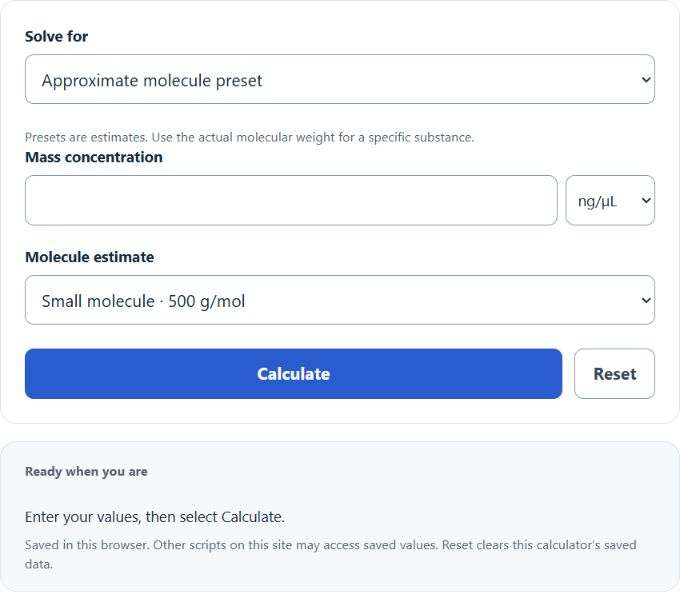
Convert ng/µL concentrations to molarity and µM for small molecules, proteins, antibodies, and dsDNA using approximate molecular weight.
- Grams Per Liter Calculator
- EC to TDS Calculator
- mg/l to lb/gal Converter
- Parts Per Thousand To mg/L Calculator
- All Unit Converters
ng/µL to Molarity Formula
The following formula is used to convert a concentration in nanograms per microliter to molarity.
Variables:
- M is the molarity in mol/L
- C is the concentration in ng/µL
- MW is the molecular weight in g/mol
To calculate molarity, multiply the concentration in ng/µL by 10-3 and divide the result by the molecular weight of the substance in g/mol.
What is ng/µL to Molarity Conversion?
Converting ng/µL to molarity changes a mass-per-volume concentration into a mole-per-volume concentration. This is useful because molarity reflects the number of molecules present in solution rather than just the total mass. Since heavier molecules contain fewer moles for the same mass, the molecular weight is required for the conversion. As a result, the same ng/µL concentration can represent a much higher molarity for a small molecule than for a large protein or DNA fragment.
How to Calculate Molarity from ng/µL?
The following steps outline how to convert ng/µL to molarity.
- First, determine the concentration in ng/µL.
- Next, determine the molecular weight of the substance in g/mol.
- Apply the formula M = (C × 10-3) / MW.
- Finally, review the result in mol/L or convert it to µM if needed.
Common Molecular Weight Reference Values
- Small organic molecules are often around 200 to 800 g/mol.
- Typical proteins are often in the tens of kilodaltons, such as 50 kDa = 50,000 g/mol.
- Large antibodies such as IgG are often around 150 kDa = 150,000 g/mol.
- Double-stranded DNA is approximately 660 g/mol per base pair.
ng/µL to Molarity Conversion Table
The table below shows example conversions for a 50 ng/µL solution using several common approximate molecular weights.
| Molecule | Approximate MW (g/mol) | 50 ng/µL in mol/L (and µM) |
|---|---|---|
| Small molecule (~500 g/mol) | 500 | 0.0001 mol/L (100 µM) |
| Protein (~50 kDa) | 50,000 | 0.000001 mol/L (1 µM) |
| IgG antibody (~150 kDa) | 150,000 | 0.000000333 mol/L (~0.33 µM) |
| dsDNA fragment (~500 bp, ~330 kDa) | 330,000 | 0.000000152 mol/L (~0.15 µM) |
| dsDNA fragment (~1000 bp, ~660 kDa) | 660,000 | 0.000000076 mol/L (~0.08 µM) |
In laboratory work, concentrations may be reported in ng/µL, mg/mL, µM, or mol/L depending on the application. Knowing the molecular weight makes it easy to move between mass-based and molar concentration units.
Example Problem :
Use the following variables as an example problem to test your knowledge.
Concentration (C) = 50 ng/µL
Molecular Weight (MW) = 50,000 g/mol
Molarity (M) = (50 × 10-3) / 50,000 = 0.000001 mol/L = 1 µM