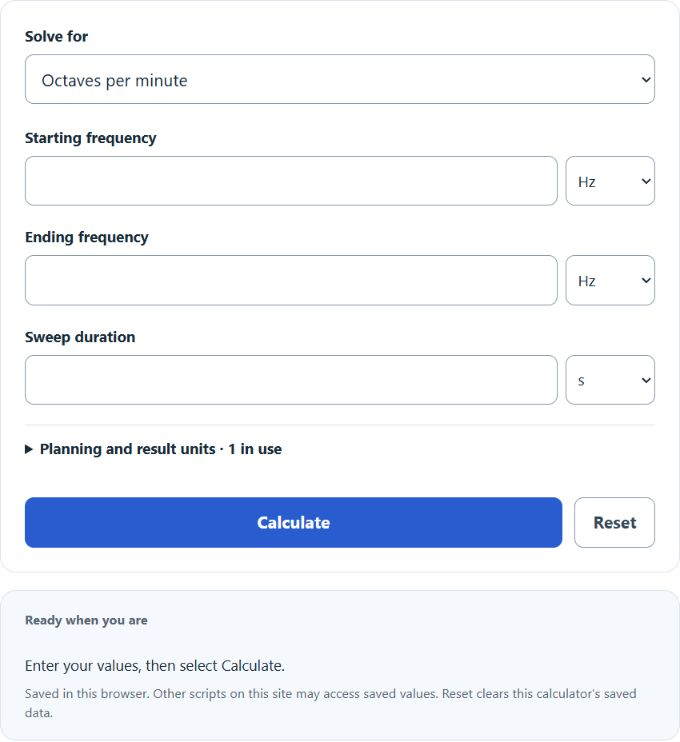
Calculate logarithmic sweep rate, duration, or ending frequency in octaves per minute, with octave span, frequency ratio, local Hz/s rate, and fractional-octave dwell time.
Octaves per Minute Formula
The calculator uses the octave sweep relationship between starting frequency, final frequency, time, and octave rate.
f_2 = f_1 * 2^(r*t)
- f_1 = starting frequency
- f_2 = final frequency
- r = signed octave rate (positive upward, negative downward)
- t = time
If r is in octaves per minute, then t must be in minutes. The calculator converts Hz, kHz, MHz, seconds, minutes, and hours before solving. The widget uses a positive rate magnitude in octaves per minute; choose upward or downward for ending frequency.
Rearranged formulas:
f_1 = f_2 / 2^(r*t)
Frequencies and sweep duration must be greater than zero, and the endpoints must define a nonzero sweep. In these formulas, a positive signed rate increases frequency and a negative signed rate decreases it. The widget reports the rate magnitude and direction separately.
Useful Tables
Use these conversions when checking inputs or interpreting the result.
| Frequency unit | Equivalent in Hz |
|---|---|
| 1 Hz | 1 Hz |
| 1 kHz | 1,000 Hz |
| 1 MHz | 1,000,000 Hz |
| Octave change | Frequency ratio | Meaning |
|---|---|---|
| -2 octaves | 1/4 | Final frequency is one quarter of the start |
| -1 octave | 1/2 | Final frequency is half the start |
| 0 octaves | 1 | No frequency change |
| 1 octave | 2 | Final frequency is double the start |
| 2 octaves | 4 | Final frequency is four times the start |
Quick Example
If a sweep starts at 100 Hz and ends at 800 Hz, the change is 3 octaves because 800 / 100 = 8 and log2(8) = 3.
If that sweep takes 2 minutes, the rate is:
For a downward sweep, the formula uses a negative signed rate. In the widget, enter its positive magnitude and select Downward when solving for ending frequency.