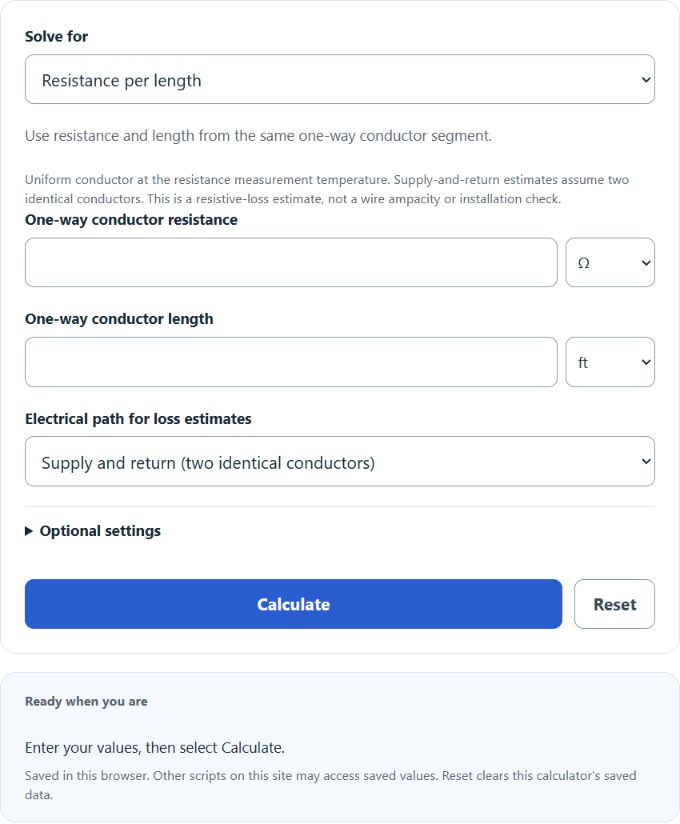
Calculate ohms per foot or meter, reverse-solve resistance or conductor length, and estimate one-way or round-trip voltage drop and power loss.
- All Physics Calculators
- Ohm’s Law Calculator
- Resistance Per Meter Calculator
- Ohms To Henries Calculator
- Ohms To Kilowatts Calculator
Ohms Per Foot Formula
Ohms per foot describes the resistance a conductor adds for each foot of length. It is a useful way to compare wires, estimate voltage drop, evaluate heating losses, and check whether a measured conductor behaves as expected.
Where:
- rft = resistance per foot
- R = total resistance of the conductor
- L = conductor length in feet
If you know any two values, you can solve for the third:
How to Calculate Ohms Per Foot
- Measure or obtain the total resistance of the conductor.
- Measure the conductor length in feet.
- Divide the total resistance by the total length.
- Interpret the result as the resistance added by each foot of that conductor.
Inputs support feet, meters, kilometers and yards. The primary rate is reported in ohms per foot, with ohms per meter and per 1,000 feet alongside it.
Example
If a conductor has a total resistance of 5 ohms and a length of 50 feet, then:
This means each additional foot of the same conductor adds about 0.1 ohms of resistance.
Why Ohms Per Foot Matters
Resistance per foot directly affects circuit performance. As wire length increases, total resistance increases, which can reduce delivered voltage and increase heat generation.
- Higher ohms per foot usually means more voltage drop over long runs.
- Higher resistance also means more power lost as heat at the same current.
- Lower ohms per foot generally indicates a better conducting path for power delivery.
- Comparing conductors is easier when resistance is normalized to a unit length.
What Changes the Value?
Ohms per foot depends mainly on conductor material and cross-sectional area. In consistent units, resistance follows:
Dividing by length shows why conductor type and size matter so much:
- Material: conductors with higher resistivity have higher resistance per foot.
- Area: larger cross-sectional area lowers resistance per foot.
- Temperature: the resistance of most metallic conductors increases as temperature rises.
- Condition: corrosion, poor terminations, and damaged strands can raise measured resistance.
Unit Conversion Reference
| Conversion | Formula |
|---|---|
| Ohms per foot to ohms per meter | rₘ = 3.28084 rft |
| Ohms per meter to ohms per foot | rft = 0.3048 rₘ |
| Ohms per foot to ohms per yard | ryd = 3 rft |
Practical Notes
- Use the same conductor segment for both the resistance and length inputs.
- Keep units consistent before interpreting the result.
- Enter one-way conductor resistance and one-way length. The supply-and-return option doubles resistance only for loss estimates, assuming two identical conductors; do not enter a loop value and double it again.
- Very small resistance values may require a meter designed for low-resistance measurement to avoid lead and contact errors.
- If a measured value is much higher than expected, inspect for loose connections, damaged wire, or temperature-related changes.
Common Questions
- Is a lower ohms-per-foot value better?
- For most power and wiring applications, yes. Lower resistance per foot means less voltage drop and less heat for the same current.
- Can this be used for any conductor?
- Resistance per length can describe a uniform conductor at the measurement temperature. The optional voltage-drop model includes resistance only; it does not include AC reactance, establish ampacity or account for unequal return paths.
- Why might my measured value differ from a wire table?
- Temperature, connection resistance, strand construction, conductor condition, and meter accuracy can all affect the reading.
- What does a high result suggest?
- A high ohms-per-foot value usually points to a smaller conductor, a higher-resistivity material, excess temperature, or an abnormal resistance issue that should be checked.