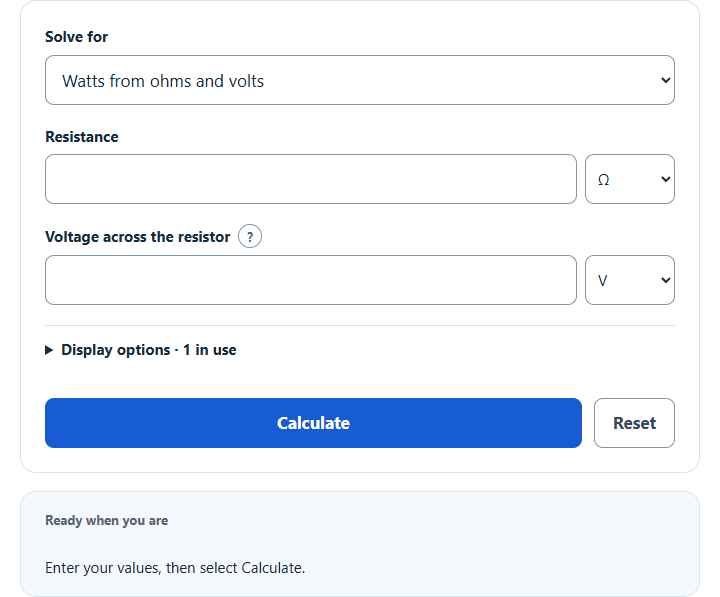
Convert ohms to watts by entering resistance with the voltage or current, or find the resistance in ohms from watts and volts using Ohm’s law.
- All Physics Calculators
- Electricity, Magnetism, and Electronics Unit Converters
- Inductance to Ohms Calculator
- Watts to Ohms Calculator
- Ohms to Volts Calculator
- Ohms to Amps Calculator
- Watts to Amps Calculator
Calculator Functions
| Function | What it does | What it requires |
|---|---|---|
| Watts from ohms and volts | Finds the power a resistance dissipates at a given voltage, and the current it draws | Requires the resistance and the voltage across it |
| Watts from ohms and amps | Finds the power a resistance dissipates at a given current, and the voltage across it | Requires the resistance and the current through it |
| Ohms from watts and volts | Finds the resistance that draws a given power at a given voltage, and the current | Requires the power and the voltage |
Resistance goes in as Ω, kΩ or MΩ, voltage as V, mV or kV, current as A, mA or µA and power as W, mW or kW. The voltage field suggests common values such as 3.7 V, 12 V, 120 V and 230 V. An optional setting shows results to 2, 3 or 4 decimal places.
Ohms to Watts Formulas
| P | Power dissipated in the resistance (W) |
| V | Voltage across the resistance (V) |
| R | Resistance (Ω) |
An ohm is one volt per ampere and a watt is one volt times one ampere [1], so V = I × R and P = V × I. Putting the first into the second gives P = V² ÷ R and P = I² × R. Ohms alone do not convert to watts: the same resistance dissipates a different power at every voltage.
Watts from ohms and volts
The main formula applies directly. An 8 Ω load at 12 V dissipates 12² ÷ 8 = 18 W and draws 12 ÷ 8 = 1.5 A. The table gives the watts for common resistances at four voltages.
| Resistance (Ω) | At 3.7 V | At 12 V | At 120 V | At 230 V |
|---|---|---|---|---|
| 1 | 13.69 | 144 | 14,400 | 52,900 |
| 2 | 6.85 | 72 | 7,200 | 26,450 |
| 3 | 4.56 | 48 | 4,800 | 17,633.33 |
| 4 | 3.42 | 36 | 3,600 | 13,225 |
| 6 | 2.28 | 24 | 2,400 | 8,816.67 |
| 8 | 1.71 | 18 | 1,800 | 6,612.5 |
| 16 | 0.86 | 9 | 900 | 3,306.25 |
| 30 | 0.46 | 4.8 | 480 | 1,763.33 |
| 40 | 0.34 | 3.6 | 360 | 1,322.5 |
At a fixed voltage, halving the resistance doubles the power. An amplifier putting out 20 V delivers 20² ÷ 8 = 50 W into an 8 Ω speaker and 100 W into a 4 Ω speaker, so a speaker’s ohm rating is not a wattage.
Watts from ohms and amps
I is the current through the resistance in amperes. A 10 Ω resistor carrying 5 A dissipates 5² × 10 = 250 W, with 5 × 10 = 50 V across it. A 1 kΩ resistor carrying 20 mA dissipates 0.02² × 1,000 = 0.4 W.
Ohms from watts and volts
A 60 W load on 120 V has a resistance of 120² ÷ 60 = 240 Ω and draws 60 ÷ 120 = 0.5 A.
Limits of This Estimate
- The formulas hold for DC, and for AC only with RMS values on a purely resistive load. They do not give real power from the impedance of a motor, speaker or other load that is not purely resistive.
- The result is the power dissipated. It is not a recommended resistor wattage rating, which needs a margin above it.
Sources
- NIST Special Publication 330 (2019), The International System of Units (SI), Table 4: the watt, volt and ohm expressed in terms of each other