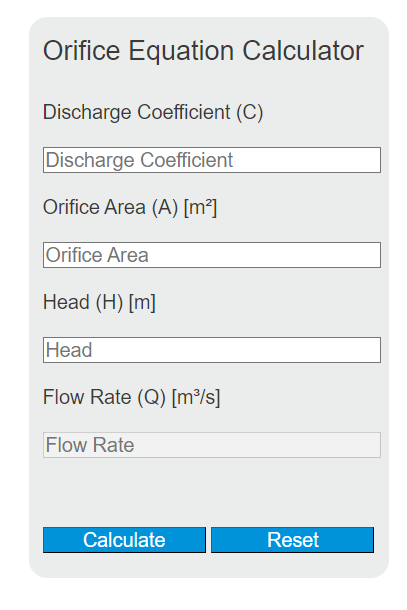
Solve liquid orifice flow, diameter, head, or pressure differential using Cd, circular area, fluid density, and pressure, flow, and length conversions.
Related Calculators
- Stream Velocity Calculator
- Pressure Volume Energy Calculator
- Layne Equation Calculator
- Tsunami Velocity Calculator
- All Physics Calculators
Orifice Equation
The orifice equation estimates the volumetric flow rate of a liquid leaving an opening because of gravity head. This calculator is most useful for tanks, reservoirs, and open vessels where the fluid discharges through an orifice and the pressure driving the flow comes primarily from the liquid height above the opening.
In this relationship, the square-root term gives the ideal exit velocity created by the available head, while the discharge coefficient adjusts that ideal result for real-world effects such as vena contracta formation, edge losses, and minor turbulence at the opening.
Variable Definitions
| Variable | Meaning | Typical Unit |
|---|---|---|
| Q | Volumetric flow rate through the orifice | m³/s, ft³/s, L/s, or gpm |
| C | Discharge coefficient that accounts for non-ideal flow | Dimensionless |
| A | Cross-sectional area of the opening | m², ft², or in² |
| g | Gravitational acceleration | 9.81 m/s² in SI units |
| H | Head measured from the liquid surface to the orifice centerline | m, ft, or in |
Rearranged Forms
If you know three of the four main quantities, the same equation can be rearranged to solve for the missing value.
These forms are useful when you are sizing an opening, back-calculating a discharge coefficient from test data, or estimating the required liquid head to achieve a target flow rate.
How to Use the Calculator
- Enter the discharge coefficient for the orifice geometry.
- Enter the orifice area using a consistent unit system.
- Enter the head above the opening.
- Calculate the missing value and confirm that the output unit matches your application.
For best results, keep all inputs within a single unit system. If the area is entered in square meters and the head is entered in meters, the resulting flow rate will be in cubic meters per second.
Finding Orifice Area
If the opening size is given as a diameter or a width and height, convert that geometry to area before using the calculator.
Circular orifice
Rectangular orifice
Be sure to convert diameter, width, and height into the same length unit before calculating area. Small conversion errors can produce large flow-rate errors.
Interpreting the Discharge Coefficient
The discharge coefficient is a correction factor that makes the ideal equation match real flow behavior. It depends on edge shape, surface finish, Reynolds number, and how cleanly the fluid approaches the opening. A perfectly ideal opening would have a coefficient of 1, but actual values are lower. Many sharp-edged orifices use values around 0.60 to 0.65, while better-rounded entries can be higher.
- Higher coefficient: less energy loss and more flow for the same head.
- Lower coefficient: greater contraction and loss at the opening.
- Uncertain coefficient: test data or manufacturer information should be preferred when accuracy matters.
Important Assumptions
- The fluid is treated as incompressible.
- The flow is driven mainly by gravity head.
- The head is measured to the center of the orifice, not to its top or bottom edge.
- The upstream liquid level is sufficiently stable during the calculation interval.
- The opening is flowing freely rather than being strongly affected by downstream backpressure.
If the orifice is submerged on both sides, use the net head difference between upstream and downstream liquid levels rather than only the upstream depth.
Example Calculation
Suppose the discharge coefficient is 0.62, the orifice area is 0.005 m², and the head is 3 m.
This is approximately 23.8 L/s. The example shows two important sensitivities: flow increases directly with area and coefficient, but only with the square root of head.
Quick Design Insights
- If the orifice area doubles, the flow rate doubles.
- If the discharge coefficient increases by 10%, the flow rate also increases by 10%.
- If the head becomes four times larger, the flow rate becomes two times larger.
- If the head is reduced significantly as the tank drains, the flow rate will also fall during discharge.
Common Mistakes
- Using diameter directly where area is required.
- Measuring head to the wrong point on the opening.
- Mixing SI and imperial units in the same calculation.
- Assuming the discharge coefficient is always the same for every orifice shape.
- Applying this simple gravity-based form to gas flow or high-backpressure conditions.
Common Questions
Is head the total liquid depth in the tank?
Not always. The head used here is the vertical distance from the liquid surface to the centerline of the orifice.
Can this be used for draining tanks?
Yes, but remember that the head changes as the liquid level falls, so the flow rate is not constant over the full drain period.
Why does the flow rate not increase linearly with head?
The velocity term depends on the square root of head, so larger heads still increase flow, but at a diminishing rate.