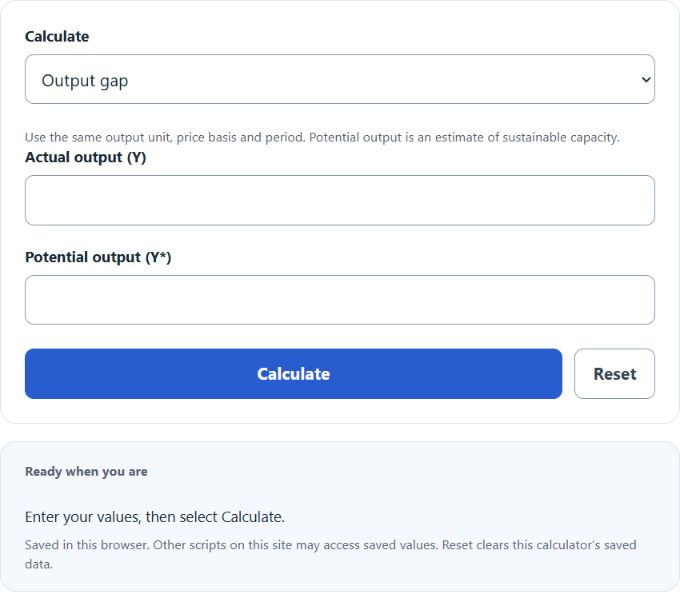
Choose the unknown actual output, potential output or output gap and enter the two known values. Output gap supports percentage or decimal entry.
Related Calculators
- Efficiency Ratio Calculator
- Cost Function Calculator
- Cost Per Unit Calculator
- Manufacturing Days Calculator
- All Business Calculators
Output Gap Formula
The output gap measures how far actual production is above or below an economy’s sustainable production capacity. It is most commonly used with real GDP, but the same structure works for any consistent measure of output.
- OG = output gap as a decimal
- Y = actual output
- Y* = potential output
If you want the result as a percentage, convert the decimal output gap using:
How to Interpret the Output Gap
| Result | Interpretation | Typical Economic Signal |
|---|---|---|
| Negative | Actual output is below potential output | Unused capacity, weaker demand, recessionary pressure |
| Zero | Actual output matches potential output | Economy is operating near sustainable capacity |
| Positive | Actual output is above potential output | Capacity strain, labor tightness, inflationary pressure |
How to Use the Calculator
- Choose the value to calculate and enter the other two known values.
- Make sure actual output and potential output use the same unit and the same time period.
- Calculate the missing value.
- Interpret the sign of the result: negative means underperformance relative to potential, while positive means output is running above sustainable capacity.
The calculator accepts percentage or decimal output gaps. In the formulas below, convert a percentage to a decimal using:
Rearranged Forms
This calculator can also solve for actual output or potential output when the other two variables are known.
Example
If actual output is 500 and potential output is 550, the output gap is:
This means the economy is producing about 9.09% below its estimated potential output.
Why the Output Gap Matters
- Business cycle analysis: It helps identify whether an economy is running cold, neutral, or hot.
- Policy decisions: Central banks and fiscal planners often monitor the gap when assessing stimulus, taxes, interest rates, and inflation risk.
- Capacity planning: Businesses and analysts use it to understand whether demand is weak relative to available productive resources.
- Cross-period comparison: Because the formula scales the gap by potential output, it is easier to compare across economies and time periods than using a raw difference alone.
Important Notes
- Use real output instead of nominal output when possible so inflation does not distort the comparison.
- Potential output is an estimate, not a directly observed number. Different estimation methods can produce different output gaps.
- A negative output gap does not mean output is negative; it only means output is below potential.
- A positive output gap may be possible for a time, but it can be difficult to sustain without creating pricing and capacity pressures.
- Potential output should be greater than zero for the formula to be valid.
Common Mistakes
- Mixing different units for actual and potential output
- Comparing values from different periods without adjustment
- Using a percentage output gap as though it were already a decimal
- Assuming potential output is the absolute maximum possible output rather than a sustainable long-run level
Frequently Asked Questions
- What does a negative output gap mean?
- It means actual output is below potential output, which usually indicates slack in labor, capital, or demand.
- What does a positive output gap mean?
- It means actual output is above estimated sustainable capacity, which can signal overheating or inflation pressure.
- Can I use units other than GDP?
- Yes. Any output measure works if actual output and potential output use the same unit and refer to the same period.
- Why divide by potential output?
- Dividing by potential output standardizes the gap, making the result more comparable across different scales of production.