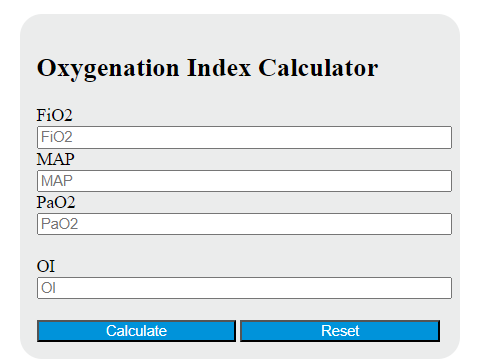
Calculate oxygenation index from simultaneous FiO₂, mean airway pressure, and PaO₂ values, or calculate a separate PaO₂/FiO₂ ratio. The output does not diagnose ARDS or recommend respiratory support.
Oxygenation Index Formula
The oxygenation index is OI = FiO2 as a fraction × mean airway pressure (mPaw) in cmH2O × 100 ÷ PaO2 in mmHg. When FiO2 is entered as a percentage, the equivalent shortcut is FiO2 percent × mPaw ÷ PaO2. This page calculates OI only in the forward direction; it does not solve backward for an oxygen setting, airway pressure, or desired PaO2.
The separate P/F mode uses PaO2/FiO2 ratio = PaO2 in mmHg ÷ FiO2 as a fraction. P/F does not include airway pressure. Both calculations require contemporaneous values. An arterial blood gas drawn under one support condition should not be paired with an FiO2 or mean airway pressure from a different time.
Variables and Units
| Variable | Meaning | Accepted entry |
|---|---|---|
| FiO2 | Fraction of inspired oxygen | 21% to 100%, or 0.21 to 1.00 |
| mPaw | Mean airway pressure over the ventilatory cycle | cmH2O, greater than zero |
| PaO2 | Arterial oxygen tension from an arterial blood gas | mmHg or kPa, greater than zero |
| OI | Support-adjusted oxygenation index | Unitless convention |
| P/F | PaO2 divided by FiO2 | Reported in mmHg when PaO2 is normalized to mmHg |
The calculator converts kPa to mmHg using 1 kPa = 7.50062 mmHg. It labels mean airway pressure as mPaw because the abbreviation MAP is often used for mean arterial pressure, a completely different cardiovascular measurement. FiO2 must be at least room-air fraction, 0.21, and no greater than 1.00.
What Oxygenation Index Is Used For
OI is principally used in neonatal and pediatric critical care during invasive mechanical ventilation. It relates the delivered oxygen concentration and mean airway pressure to the arterial oxygen tension achieved. Because the numerator includes a measure of respiratory support, OI carries different information from PaO2 alone or the P/F ratio.
This calculator provides neutral arithmetic. It does not establish ARDS or PARDS, estimate mortality, recommend ECMO, or direct a ventilator change. Those decisions require population-specific definitions, complete syndrome criteria, timing, serial measurements, imaging, assessment of edema origin, support conditions, hemodynamics, and local protocols. A single number cannot replace that work.
How to Calculate OI
- Select Oxygenation index.
- Enter FiO2 as a percent or fraction and choose the matching format.
- Enter mean airway pressure in cmH2O from the ventilator at the same steady-state time.
- Enter arterial PaO2 from the contemporaneous blood gas and select mmHg or kPa.
- Select Calculate and verify the substituted values shown with the result.
Use measured values rather than targets. The calculator intentionally does not rearrange the formula, because a reverse result could be mistaken for a recommended oxygen concentration or ventilator pressure. Only trained clinicians using the full bedside context should change respiratory support.
Worked OI Example
Suppose FiO2 is 60%, mean airway pressure is 12 cmH2O, and PaO2 is 80 mmHg. Convert 60% to 0.60, then calculate 0.60 × 12 × 100 ÷ 80. The oxygenation index is 9.0. The result describes the relationship among these three simultaneous inputs; it does not by itself assign a diagnosis or treatment threshold.
If PaO2 were entered as 10.6658 kPa, conversion would give about 80 mmHg and the same OI, apart from rounding. Classification and clinical decisions should never hinge on a unit mismatch or on display rounding. Confirm which pressure unit appears on the blood-gas report before entry.
What a Change in OI Reflects
OI can rise when FiO2 rises, mean airway pressure rises, PaO2 falls, or some combination occurs. It can fall when less support is used, oxygenation improves, or both. That is why two identical OI values can arise from different input combinations and why the component values remain important. A change also may reflect timing, sampling, recruitment, hemodynamics, ventilation strategy, or measurement variability.
Trends are meaningful only when measurements are made and interpreted consistently. A blood gas taken during a transient event or before a support change reaches steady state may not represent the later condition. OI is not a direct measurement of tissue oxygen delivery, oxygen consumption, or regional organ perfusion.
PALICC-2 Context
PALICC-2 includes OI in the framework for pediatric acute respiratory distress syndrome during invasive mechanical ventilation. OI of at least 4 is one oxygenation component for the invasive-ventilation PARDS definition. After at least four hours following initial diagnosis, OI from 4 to less than 16 and OI of 16 or greater are used in its severity framework.
Those numbers are not stand-alone bands for every patient. PALICC-2 also requires the appropriate age and clinical setting, timing, new pulmonary findings, respiratory failure not fully explained by cardiac failure or fluid overload, and the specified support and measurement conditions. The calculator has not tested those criteria. It therefore does not automatically label a result as PARDS or convert an OI into a treatment recommendation.
P/F Ratio Formula and Example
For PaO2 of 80 mmHg and FiO2 of 0.60, P/F is 80 ÷ 0.60 = 133.333 mmHg. Unlike OI, the P/F ratio omits mean airway pressure. It is therefore a different oxygenation metric, not a unit conversion of OI. Select the P/F mode only when that forward calculation is the question.
Adult ARDS Context
The Berlin definition historically organized adult ARDS oxygenation at P/F boundaries of 300, 200, and 100 mmHg under specified PEEP or CPAP conditions: greater than 200 through 300, greater than 100 through 200, and 100 or less. The newer global ARDS definition expands recognition across settings and respiratory-support approaches. Neither framework can be applied from P/F alone.
Timing, acute risk or insult, bilateral imaging findings, edema origin, and support conditions remain part of the definition. Population and method matter, so the calculator does not attach adult ARDS bands to a P/F result and does not apply adult definitions to a neonatal or pediatric OI calculation.
OI, OSI, P/F, and S/F Are Different
OI uses PaO2 from arterial blood and includes mPaw. Oxygen saturation index, OSI, uses an SpO2-based term with mean airway pressure under defined conditions. P/F divides PaO2 by FiO2 without airway pressure. S/F divides pulse-oximeter saturation by FiO2. These measures have different validation ranges, sources of error, and population-specific uses; they should not be interchanged by renaming a field.
Limitations and Common Errors
- Do not enter mean arterial pressure in the mPaw field.
- Do not mix FiO2 percent and fraction formats.
- Confirm whether PaO2 is reported in mmHg or kPa.
- Do not combine measurements from different times or support settings.
- Do not interpret one OI as a universal ECMO threshold or mortality forecast.
- Do not use the reverse algebra to set FiO2, pressure, or a target PaO2.
Frequently Asked Questions
Is OI the same as P/F ratio?
No. OI incorporates mean airway pressure; P/F does not. They also have different common clinical contexts.
Does a particular OI mean ECMO is required?
No. Historical and protocol thresholds are population- and context-specific. This result is not a recommendation or eligibility decision.
Why are there no automatic severity bands?
Because syndrome definitions require more than the numeric oxygenation result, and the applicable framework depends on population and support conditions.
Primary Sources
- PALICC-2 executive summary: doi:10.1097/PCC.0000000000003147 and full text.
- New Global Definition of Acute Respiratory Distress Syndrome: doi:10.1164/rccm.202303-0558WS.
- The Berlin Definition of ARDS: doi:10.1001/jama.2012.5669.