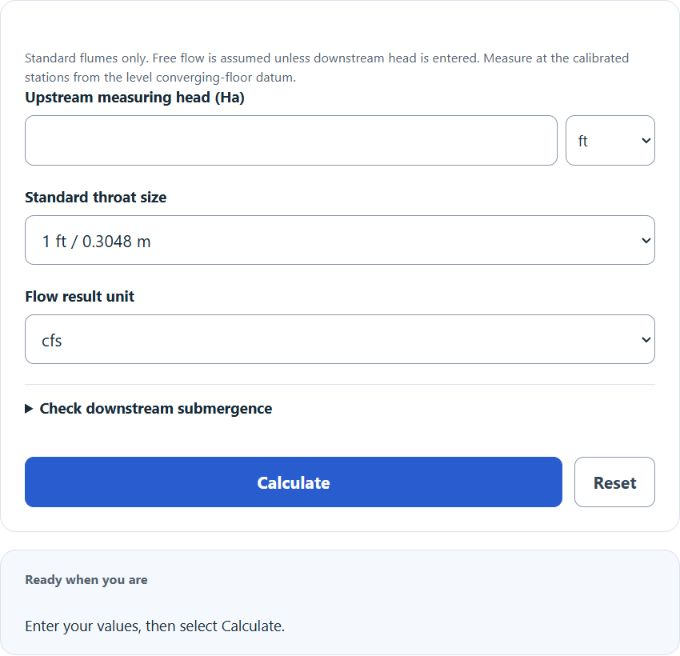
Calculate conditional free-flow discharge for standard Parshall flumes from 1 inch through 6 feet. Enter measuring heads in feet, inches, cm or m; choose flow in cfs, m³/s or L/s. Use the calibrated head stations, standard dimensions and the level converging-floor datum.
Related Calculators
- Storm Water Runoff Calculator
- Drainage Fall Calculator
- Channel Slope Calculator
- Static Head Calculator
- All Construction Calculators
Parshall Flume Flow Rate Formula
The Parshall flume flow calculator estimates open-channel discharge from the measured upstream head and the flume throat width. Under free-flow conditions, the discharge follows a power-law relationship, which is why even a small change in head can noticeably change the computed flow rate.
This calculator uses the standard-size coefficient and exponent in USBR Water Measurement Manual, Table 8-6, with head in feet and discharge in cfs. It does not interpolate arbitrary throat widths:
| Standard throat width | C | n | Supported Ha (ft) |
|---|---|---|---|
| 1 in / 2.54 cm | 0.338 | 1.55 | 0.2–0.69 |
| 2 in / 5.08 cm | 0.676 | 1.55 | 0.2–0.79 |
| 3 in / 7.62 cm | 0.992 | 1.55 | 0.2–1.09 |
| 6 in / 15.24 cm | 2.06 | 1.58 | 0.2–1.29 |
| 9 in / 22.86 cm | 3.07 | 1.53 | 0.2–1.59 |
| 1 ft / 0.3048 m | 3.95 | 1.55 | 0.2–2.5 |
| 2 ft / 0.6096 m | 8 | 1.55 | 0.2–2.5 |
| 3 ft / 0.9144 m | 12 | 1.57 | 0.2–2.5 |
| 4 ft / 1.2192 m | 16 | 1.58 | 0.2–2.5 |
| 5 ft / 1.524 m | 20 | 1.59 | 0.25–2.5 |
| 6 ft / 1.8288 m | 24 | 1.59 | 0.25–2.5 |
- Q = flow rate in cubic feet per second (cfs)
- W = nominal throat width in feet (ft)
- Ha = upstream head in feet (ft)
- K and n = discharge constants that vary with flume size
What a Parshall flume measures
A Parshall flume is a specially shaped hydraulic structure used to measure flow in an open channel. As water passes through the converging section and throat, the geometry creates a predictable relationship between water depth and discharge. That makes the flume useful for irrigation channels, stormwater systems, plant outfalls, and wastewater applications where direct flow measurement may be difficult.
| Calculator Field | Meaning | How to Use It |
|---|---|---|
| Head (Ha) | The upstream water depth used for the rating equation | Measure at the calibrated Ha station and reference it to the level converging-section floor datum, not the depressed throat floor |
| Throat Width (W) | The nominal width of the flume throat | Select the actual standard flume size, not a channel width or an interpolated nonstandard size |
| Flow Rate (Q) | The computed discharge through the flume | Read the output in cfs, m³/s, or L/s as needed |
How to calculate Parshall flume flow
- Measure the upstream head Ha.
- Identify the nominal throat width W of the flume.
- Convert Ha to feet and select the matching standard-size C and n from the rating table.
- Substitute the values into the discharge formula.
- Convert the result to the desired output units if necessary.
The free-flow limits for Hb/Ha are 50% for 1-, 2- and 3-inch flumes, 60% for 6- and 9-inch flumes, and 70% for the supported 1- through 6-foot flumes. Both heads must use their calibrated stations and the level converging-floor datum. The optional Hb check rejects higher ratios; leaving Hb blank assumes free flow without verifying it. Submerged-flow corrections and modified flumes require a separate calibration.
Unit conversion reference
If you need to move between output units, the following relationship is useful:
Example calculation
If the measured upstream head is 6 inches and the flume throat width is 12 inches, first convert both values to feet:
For the standard 1-foot flume, Table 8-6 gives C = 3.95 and n = 1.55. Assuming free flow, substitute:
The same result is approximately 0.0381984 m³/s or 38.1984 L/s. This uses Table 8-6; the manual’s separate tabulated ratings are rounded and may differ slightly.
When the result is most reliable
- The flume is operating under free-flow conditions.
- The head is measured at the correct upstream location.
- The flume is reasonably clean, level, and free of excessive sediment or debris buildup.
- The entered throat width matches the flume’s nominal size.
- The water surface is calm enough to obtain a stable reading.
Common input mistakes
- Using the wrong head reference: The reading should be tied to the flume datum, not estimated from a random point in the channel.
- Entering channel width instead of throat width: The formula depends on the flume throat size, not the overall channel width.
- Ignoring submergence: Backwater conditions can invalidate a free-flow-only calculation.
- Mixing units manually: If you solve by hand, use Ha in feet, Q in cfs and the constants for the actual standard size.
Why throat width matters
The throat width affects both the coefficient and the exponent in the discharge relationship. Each standard size has its own empirical rating; sizes are not geometrically proportional. Larger flumes generally pass more water at the same head. That is why selecting the correct nominal flume size is just as important as taking an accurate head reading.
Practical note for field use
If your calculated value seems unusually high or low, first verify the head measurement location, then confirm the throat width, and finally check whether downstream conditions may be causing submergence. In many field situations, those three issues account for most flow calculation errors.