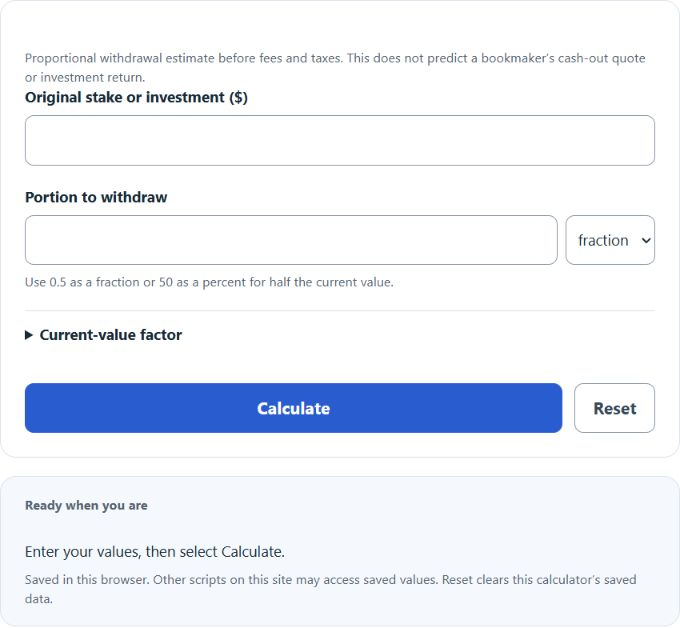
Estimate a proportional withdrawal and remaining value from an original stake, withdrawal portion, and optional current-value factor. Fees, taxes and platform cash-out quotes are not included.
Partial Cash Out Formula
The following equation is used to calculate a proportional partial cash out based on the current value of a position:
- Where PCO is the partial cash out amount ($)
- S is the original stake or initial investment ($)
- F is the return factor (multiplier), where F = Current Value / Original Stake (e.g., 1.25 means +25%; 0.90 means −10%)
- V is the current value of the position ($)
- R is the portion of the current value to withdraw (fraction from 0 to 1; select % to enter 0 to 100)
To calculate a proportional partial cash out, first compute the current value (V) and then multiply it by the portion you wish to withdraw (R). The remaining value after cashing out is V − PCO. The calculator rounds current value and withdrawal to cents, then subtracts those rounded amounts for a reconciled remaining balance.
What is a Partial Cash Out?
Definition:
A partial cash out is a strategy in investing or trading where you withdraw (or sell) part of your position while leaving the remainder invested for potential continued gains (or losses). This approach can help balance risk by locking in some gains or reducing exposure while still maintaining some upside.
Note for sports betting: a sportsbook “cash out” (including partial cash out) is typically quoted by the bookmaker based on current odds and other factors, so it may not equal a simple fraction of the original stake. This calculator instead estimates a proportional withdrawal based on a position’s current value.
How to Calculate Partial Cash Out?
Example Problem:
The following example outlines the steps and information needed to calculate the Partial Cash Out.
First, determine the initial stake or investment. In this example, the original stake is $200.
Next, determine the return factor. If there is no gain or loss, the return factor is 1.00.
Next, determine the portion of the current value you wish to cash out. In this case, it’s 50%, or 0.50 as a decimal.
Finally, calculate the partial cash out amount using the formula above:
V = S × F
V = $200 × 1.00 = $200
PCO = V × R = S × F × R
PCO = $200 × 0.50 = $100
Remaining Value = V − PCO = $200 − $100 = $100
FAQ
When is using a partial cash out beneficial?
A partial cash out can be beneficial when you want to lock in a portion of gains or reduce exposure while still keeping part of the position open for potential future returns.
How do I decide how much to cash out?
This decision depends on your comfort with risk, your overall goals, and how the position is performing. Some individuals cash out enough to lock in their initial stake, leaving only previously earned gains exposed to future changes.
Is partial cash out always available?
Availability depends on the platform. In investing, you can usually sell or withdraw part of a position (subject to account rules and liquidity). In sports betting, cash-out features (including partial cash out) are offered at the bookmaker’s discretion and can vary by bet and timing.