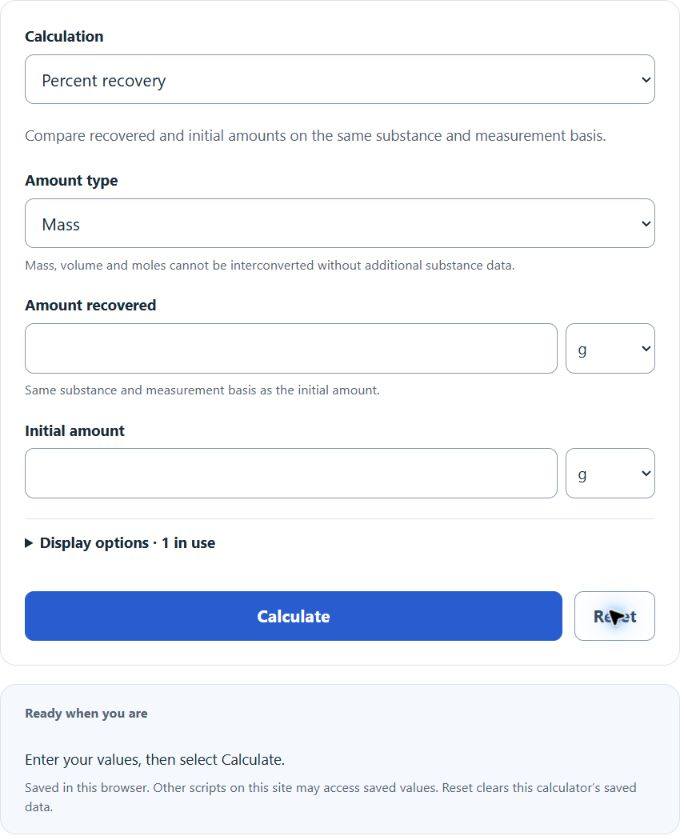
Calculate percent recovery from initial and recovered amounts, solve for missing recovered or initial value, and check spike recovery.
- All Chemistry Calculators
- Chemical Yield Calculator
- Molarity Calculator
- Equilibrium Constant Calculator
Percent Recovery Formula
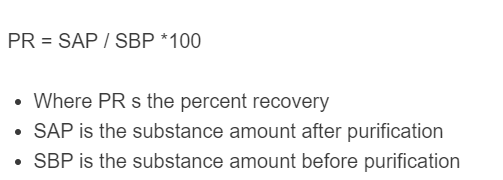
The following equation calculates mass recovery relative to the stated starting mass. Use a positive initial mass and a recovered mass measured on a consistent basis.
- %R = percent recovery (%)
- m_f = final mass after purification (any unit)
- m_i = initial mass before purification (same unit as m_f)
Convert both masses to the same unit before using this formula; other amount ratios must use compatible quantities on the same basis. Analytical spike recovery instead uses (spiked result − unspiked result) / expected spike increase × 100. Enter all three concentrations in the same units and on the same sample basis, accounting for dilution before entry. The expected spike increase is the added concentration on that basis, not the stock solution concentration.
Percent Recovery Definition
For purification, percent recovery compares the recovered amount with a stated starting amount. If the denominator is crude sample mass, the result is mass recovery relative to that crude sample, not a direct measure of purity or the fraction of its target compound recovered. Analytical spike recovery measures the observed increase relative to a known added amount. In reaction reporting, percent yield instead compares collected product with the theoretical amount calculated from reaction stoichiometry.
Purification can lose material through residual solubility, washing and transfers, while removal of impurities also lowers recovery relative to crude starting mass. An apparent mass recovery above 100% calls for checking units, sample basis, drying and measurements; the number alone does not identify the cause. Analytical spike recovery can be below zero or above 100% and must be interpreted using the applicable method and acceptance limits.
Illustrative Recovery Ranges by Purification Method
The numeric ranges below are retained as illustrative examples, not validated expected ranges or acceptance criteria. The listed loss mechanisms are possible examples, not complete explanations. Recovery depends on the substance, starting composition, solvent, operating conditions and collection procedure; a percentage alone does not establish product purity or method acceptability.
| Purification Method | Illustrative Range | Possible Loss Mechanism |
|---|---|---|
| Recrystallization | 60 to 90% | Compound dissolved in cold mother liquor |
| Liquid-liquid extraction | 70 to 95% | Unfavorable partition equilibrium |
| Column chromatography | 50 to 90% | Adsorption to stationary phase |
| Steam distillation | 50 to 80% | Incomplete condensation |
| Protein purification (HPLC) | 60 to 95% | Non-specific binding and denaturation |
Theoretical Maximum Recovery in Recrystallization
A simple solubility-limited estimate subtracts the amount that can remain dissolved at the selected cold filtration temperature from the initial target-compound mass. It assumes complete initial dissolution, equilibrium, a fixed solvent volume and consistent solubility units, and excludes washing and mechanical losses. Changing solvent, temperature or volume changes this estimate. If the solvent can hold all the initial compound, the estimated crystal recovery is zero.
- S_c = solubility at the cold filtration temperature (g/mL)
- V = cold solvent volume on the same volume basis used for S_c (mL)
- m_i = initial mass of the target compound in this model (g), greater than zero
Illustrative example: assume a target compound has a cold solubility of 0.29 g/100 mL of solvent, with 2.0 g initially dissolved and 20 mL of solvent remaining at filtration. The estimated solubility-limited recovery is max(0, 1 – 0.0029 x 20 / 2.0) x 100 = 97.1%, before washing and transfer losses. These are assumed inputs, not a validated benzoic-acid prediction.
Percent Recovery Example
How to calculate percent recovery?
- Measure the initial mass before purification.
Weigh the substance before any purification step. For example, 5.00 g of crude acetanilide.
- Measure the recovered mass after purification.
After recrystallization and drying, weigh the purified product. For example, 3.80 g of purified acetanilide.
- Apply the percent recovery formula.
Divide dry recovered mass by crude starting mass and multiply by 100: (3.80 / 5.00) x 100 = 76.0%. This is recovery relative to the crude sample; its interpretation depends on starting composition and recovered-product purity.
FAQ
Purification recovery is the recovered amount divided by a stated starting amount, multiplied by 100. A dry recovered mass divided by crude starting mass is recovery relative to the crude sample and does not by itself measure purity or target-analyte recovery. Analytical spike recovery compares an observed increase with a known added amount.
There is no universal good percent recovery. Interpret purification recovery with starting composition, product purity and the process used. For analytical spike recovery, use the acceptance limits and data-handling rules specified by the method or project. Without supplied limits, the percentage alone does not establish acceptability.
Yes. Apparent mass recovery above 100% means the reported recovered amount exceeds the stated starting amount; check units, sample basis, drying and measurements before assigning a cause. Analytical spike recovery can also exceed 100% because it is an analytical response estimate. Interpret it using method-specific criteria rather than an automatic contamination diagnosis.
In reaction reporting, percent yield compares collected product with the theoretical product amount calculated from reaction stoichiometry. Purification recovery compares recovered material with a stated starting amount, while analytical spike recovery compares measured response increase with expected added analyte. These use different denominators and are not interchangeable.