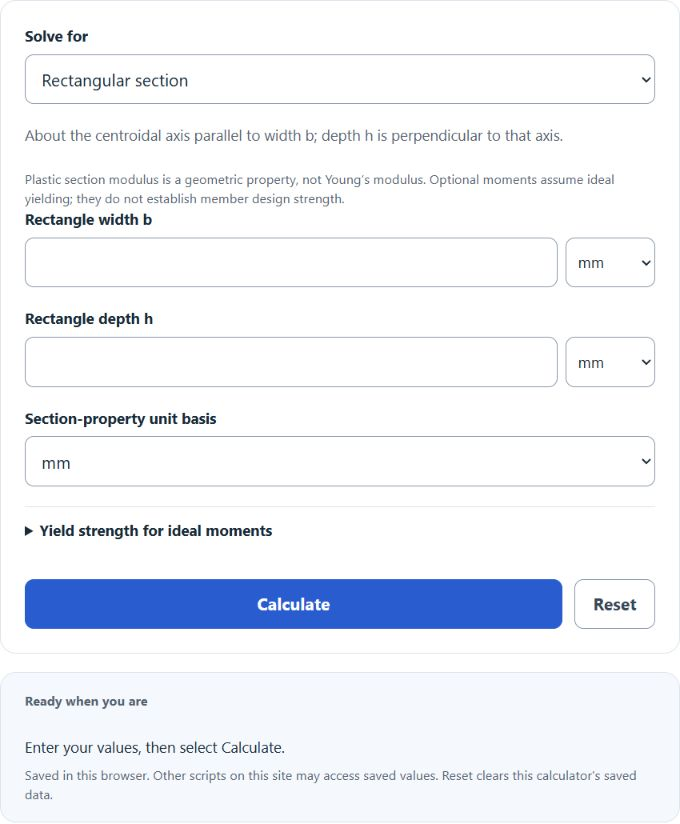
Calculate plastic section modulus for rectangular, circular, hollow round, or symmetric I-sections, with elastic section modulus, shape factor and optional ideal moments. Section modulus is a geometric property with cubic-length units, not the material’s Young’s modulus.
Related Calculators
- Bending Stress Calculator
- Structural Efficiency Calculator
- Overturning Moment Calculator
- Cost Per Pound of Steel Calculator
- All Construction Calculators
Plastic Modulus Formulas
Plastic section modulus (Z) is the sum of the absolute first moments of area on both sides of the plastic neutral axis. These formulas use the horizontal centroidal axis parallel to the rectangle width or I-section flanges; the circular formulas apply about any centroidal diameter. The I-section has equal flanges and sharp corners, without rolled fillets.
| Shape | Plastic Section Modulus (Z) | Elastic Section Modulus (S) |
|---|---|---|
| Symmetric sharp-corner I-section | BfTf(D − Tf) + Tw(D − 2Tf)² / 4 | I / (D/2) |
| Rectangle | bh² / 4 | bh² / 6 |
| Solid circle | D³ / 6 | πD³ / 32 |
| Concentric circular annulus, 0 ≤ d < D | (D³ − d³) / 6 | π(D⁴ − d⁴) / (32D) |
Shape Factor (f = Z / S)
The shape factor is the ratio of plastic to elastic section modulus, Z/S. In an ideal homogeneous, elastic-perfectly plastic section with equal tensile and compressive yield strengths, pure bending and no instability, it also equals Mp/My, where My = FyS and Mp = FyZ. A factor of 1.5 therefore means an ideal plastic moment 50% above first yield; it is not a promised reserve in an actual member.
| Shape | Shape Factor (f) | Ideal Section Interpretation |
|---|---|---|
| Rectangle | 1.50 | Mp = 1.50 My |
| Solid circle | 16/(3π) ≈ 1.70 | Mp ≈ 1.70 My |
| Diamond, vertex up, horizontal centroidal axis | 2.00 | Mp = 2 My |
| Seven W-sections listed below | ≈ 1.11 – 1.18 | About the catalog x-axis; values depend on the specific section |
For a given area and depth, placing more material near the flanges can increase elastic bending stiffness and bring Z/S closer to 1. The factor still depends on the actual dimensions and axis; the listed W-section values are examples rather than a universal range or an overall measure of structural efficiency.
Plastic Moment Capacity
The ideal fully plastic moment for the stated homogeneous, equal-yield-strength, pure-bending model is:
Actual member design strength requires the applicable specification and all relevant limit states, including yielding, local buckling and lateral-torsional buckling, with the applicable restraint and slenderness conditions. In AISC LRFD, φ = 0.90 is used for flexure, but FyZ is not automatically the governing nominal strength. See AISC 360 and its applicable member provisions. This calculator does not calculate code design strength.
Representative Material Grades: Yield Strength Reference
| Grade / Product | Fy (ksi) | Fy (MPa) | Applicability |
|---|---|---|---|
| A36 | 36 | ≈ 248 | Applicable structural shapes and plates; check product and thickness limits |
| A572 Grade 50 | 50 | ≈ 345 | Applicable rolled shapes and plates; availability and product requirements apply |
| A992 | 50 minimum | ≈ 345 minimum | Preferred specification for W shapes; member and seismic checks are separate |
| S355, cited product thickness ≤ 16 mm | ≈ 51.5 | 355 | Thicker products can have lower specified minima |
| Aluminum 6061 extruded T6/T6511 | 35 | ≈ 241 | Minimum 0.2% proof strength for the cited product conditions |
Wide-Flange Zx Reference Table
These rolled-section x-axis properties are from the Nucor-Yamato structural-shape catalog, tables revised March 2024. Shape factors are Zx/Sx; ideal Mp at 50 ksi is 50Zx/12 kip-ft. Factors and moments are rounded. Catalog properties include rolled fillets and rounded edges, unlike the calculator’s sharp-corner I model.
| Section | Zx (in³) | Sx (in³) | Shape Factor | Ideal Mp at 50 ksi (kip-ft) |
|---|---|---|---|---|
| W8×31 | 30.4 | 27.5 | 1.11 | 127 |
| W10×45 | 54.9 | 49.1 | 1.12 | 229 |
| W12×50 | 71.9 | 64.2 | 1.12 | 300 |
| W14×82 | 139 | 123 | 1.13 | 579 |
| W18×35 | 66.5 | 57.6 | 1.15 | 277 |
| W21×44 | 95.4 | 81.6 | 1.17 | 398 |
| W24×55 | 134 | 114 | 1.18 | 558 |
In these examples, W24×55 has a shape factor of approximately 1.18 and W14×82 approximately 1.13. The difference follows from their complete area distributions about the x-axis; depth or weight alone does not determine the factor.
What is Plastic Modulus?
The plastic section modulus Z is the sum of the absolute first moments of area about the plastic neutral axis (PNA). For a homogeneous section with equal tensile and compressive yield strengths under pure bending without axial force, the PNA divides the area equally so the yield forces balance. It coincides with the stated centroidal axis for the symmetric sections supported here. For an asymmetric section, the PNA must instead be located by the appropriate force balance; this calculator does not support those geometries.
Elastic section modulus S = I/c relates to first yield at the extreme fiber in the ideal elastic bending model. Plastic section modulus Z relates to the fully yielded section in the ideal plastic model. For the supported symmetric sections, Z is greater than S and Z/S is the shape factor. Neither property alone accounts for buckling, restraint, axial force or other member limit states.
Worked Example
I-section: D = 300 mm, Bf = 150 mm, Tf = 20 mm, Tw = 10 mm
With an illustrative entered Fy = 345 MPa, the ideal Mp = (345 N/mm²)(1,009,000 mm³) = 348,105,000 N·mm = 348.105 kN·m. This is an ideal section moment, not a verified member design strength; material specification, compactness, restraint and all applicable limit states still require separate checks.