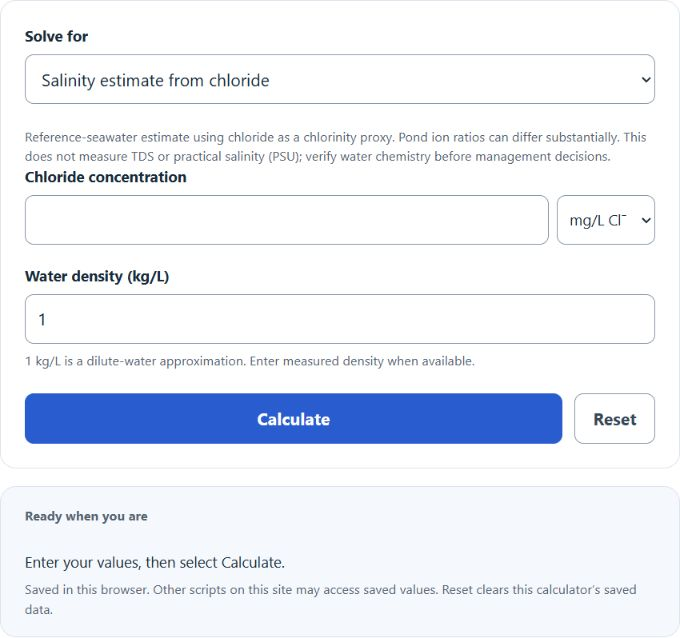
Estimate salinity from chloride, or reverse the estimate, using a reference-seawater ratio. Chloride uses mg/L, g/L or mol/L; salinity uses g/L or density-adjusted g/kg (ppt). This conditional model does not measure PSU or total dissolved salts in arbitrary pond water.
Related Calculators
- Salt Brine Calculator
- Density Percentage Calculator
- Percent Water Calculator
- Percent Solution Calculator
- All Chemistry Calculators
How to Use the Pond Salinity Calculator
The pond salinity calculator converts chloride concentration into an estimated pond salinity. This is helpful when you have a lab or field test for chloride but want a faster way to interpret the water as freshwater, slightly saline, or brackish for pond management, aquaculture, irrigation, and general water-quality review.
The reference-seawater mass-salinity-to-chlorinity factor is 1.80655 × (35.16504/35) ≈ 1.81506865749. Chlorinity includes halogen equivalents, so measured chloride is only a proxy. The inverse gives chloride associated with the same assumed ratio, not a dosing target or a universal pond relationship.
Pond Salinity Formula
Where:
- PS = reference-seawater salinity concentration estimate in g/L
- Cl– = chloride concentration in mg/L
If you need to solve for chloride from a target salinity, rearrange the equation as follows:
What the Inputs and Outputs Mean
- Chloride concentration is the amount of dissolved chloride in the pond water, commonly measured in mg/L, g/L, or mol/L.
- Reference-seawater salinity estimate is reported in g/L and, after dividing by water density in kg/L, in g/kg (ppt by mass).
- g/L and g/kg are numerically equal only at density 1 kg/L. PSU is associated with conductivity-based Practical Salinity and is not an interchangeable mass-concentration unit. For chloride, 1 mol/L is 35,450 mg/L using chlorine’s 35.45 g/mol molar mass.
How to Calculate Pond Salinity Manually
- Measure chloride and convert it to mg/L. Assess whether the assumed seawater-like ion ratio is appropriate.
- Multiply that chloride value by 0.00181506865749.
- The result is the reference-seawater salinity estimate in g/L. Divide by density in kg/L to obtain g/kg (ppt).
- If starting with a desired salinity, divide the salinity by 0.00181506865749 to estimate the corresponding chloride concentration.
Example Conversions
| Chloride Concentration | Reference-seawater Salinity Estimate (g/L; ppt only at 1 kg/L) | General Interpretation |
|---|---|---|
| 1.25 mg/L | 0.00227 ppt | Extremely low salinity |
| 250 mg/L | 0.45377 ppt | Very low salinity / freshwater range |
| 500 mg/L | 0.90753 ppt | Lightly saline |
| 2,000 mg/L | 3.63014 ppt | Noticeably brackish |
Reverse Lookup Examples
| Reference-seawater Salinity (g/L; density 1 kg/L) | Estimated Chloride Needed |
|---|---|
| 1 ppt | 550.94 mg/L |
| 5 ppt | 2,754.72 mg/L |
| 35 ppt | 19,283.02 mg/L |
Why Pond Salinity Matters
Salinity affects far more than taste or conductivity. In ponds, it can influence fish stress, osmoregulation, species suitability, plant response, microbial activity, treatment performance, and the way water interacts with liners, pumps, and metal equipment. Even small changes can matter if you are managing sensitive species or trying to maintain stable water chemistry over time.
When This Calculator Is Most Useful
- When a water test reports chloride but not salinity
- When checking whether a pond is staying within a desired salinity range
- When comparing pond conditions across seasons, rainfall events, or water changes
- When reviewing water quality for fish ponds, ornamental ponds, and aquaculture systems
- When planning adjustments and wanting a quick chloride-to-salinity estimate
Important Limitations of Chloride-Based Salinity Estimates
This calculator estimates salinity from chloride, not from a full dissolved-ion profile. That distinction matters because salinity is made up of many ions, including sodium, calcium, magnesium, sulfate, bicarbonate, and others. If the water has an unusual chemical balance, the calculated salinity may differ from a direct meter reading.
- Best for estimation: when chloride is a representative part of the pond’s dissolved salts
- Use caution: when the pond receives mineral runoff, well water with unusual chemistry, or treatment inputs that change the ionic balance
- Verification: use an appropriate calibrated method and a complete ion analysis when water composition differs from seawater; conductivity and refractometer conversions also depend on calibration and composition
Tips for Better Results
- Use recent water test data instead of older values from a previous season.
- Keep units consistent when entering data.
- Measure at the same pond location and similar depth when tracking trends.
- Review salinity alongside pH, alkalinity, hardness, ammonia, and dissolved oxygen for a more complete picture.
- If readings change suddenly after rain, dilution, salt addition, or evaporation, retest before making management decisions.
Common Questions
Is chloride the same thing as salinity?
No. Chloride is one dissolved ion, while salinity reflects the total dissolved salts in the water. This calculator uses chloride as a practical predictor of salinity.
Can I use this for any pond?
No universal chloride-to-salinity ratio applies to all ponds. Use this conditional estimate only when a seawater-like ion ratio is a reasonable assumption, and verify it with suitable water analysis.
Why might my salinity meter show a different value?
A meter infers salinity from conductivity or another measured property using a calibration model. This calculation instead assumes a chloride-to-salt ratio. Different composition, density, calibration and temperature can produce different values.
Should I manage a pond using salinity alone?
No. Salinity is only one water-quality indicator. Healthy pond management usually requires checking multiple parameters together rather than relying on a single number.