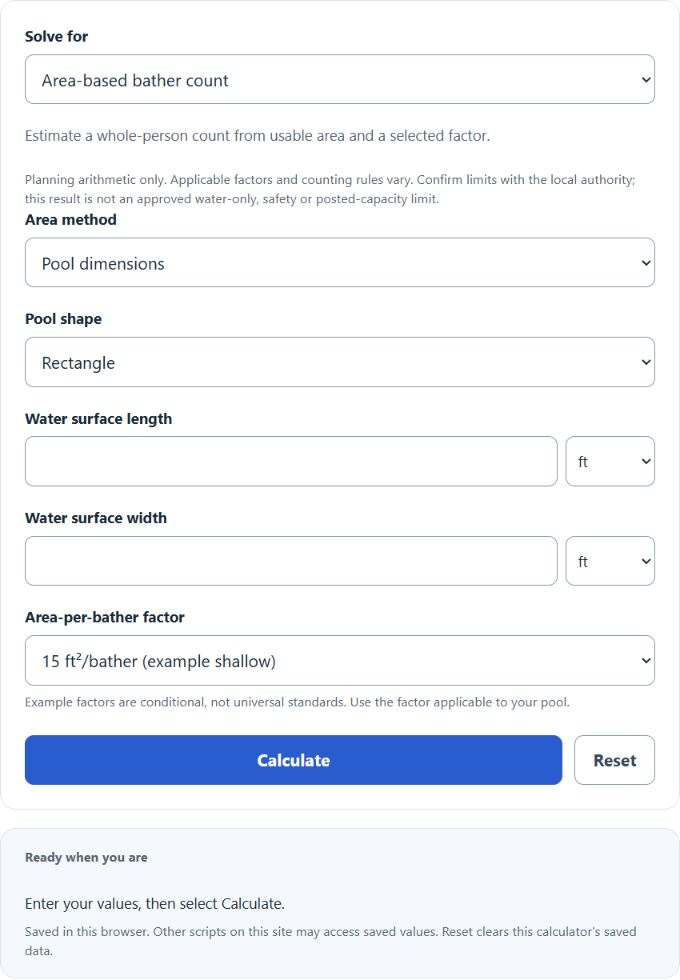
Estimate an area-based bather count, required surface area, or area per bather using dimensions, zones, example or custom factors, and metric units. This planning tool does not determine an approved pool capacity.
Related Calculators
- Pool Heat Time Calculator
- Pool Weight Calculator
- Pool Chlorine Calculator
- Pool Turnover Rate Calculator
- Pool Slope Calculator
- Pool Gallons Calculator
- All Everyday Life and Education Calculators
Pool Occupancy Formula
This tool performs area-ratio arithmetic. It does not determine an approved pool capacity. Applicable counting rules depend on the jurisdiction, pool type, water depth, deck configuration, diving provisions and other facility requirements.
Bather estimate = floor(surface area / area per bather). Rectangle area = length × width. Circle area = π × diameter² / 4. Use water-surface dimensions, not pool volume.
Required surface area = whole bather count × selected area per bather. Area per bather = surface area / whole bather count. The result is available in square feet and square meters; 1 ft² = 0.09290304 m². Required-area output units are in Optional settings.
Example Factors and Zone Calculation
The 15, 20 and 300 ft² per bather choices are examples, not universal standards. Indiana Department of Health guidance uses that row when deck area is less than total pool water-surface area. It distinguishes shallow water at or below 5 ft from deep water over 5 ft. Its maximum-load definition counts patrons throughout the pool enclosure, including deck areas, rather than only people in the water.
Other deck-to-water ratios in that guidance use different shallow and deep factors. Other jurisdictions use different diving-area provisions. A selected example does not establish which rule applies to your pool.
The zone option preserves this illustrative calculation:
Estimate = floor(shallow area / 15) + floor(deep non-diving area / 20) + floor(diving area / 300).
Enter nonoverlapping zone areas; a blank zone is zero and at least one must be positive. Each component is rounded down separately before addition. This follows the conservative component rounding in Indiana’s worked guidance example. The tool does not calculate deck area, select the governing deck-ratio row or verify regulatory diving-area requirements.
Worked Examples
A rectangular 40 ft × 20 ft surface has 800 ft². At an illustrative 15 ft² per bather, floor(800 / 15) = 53 bathers. The unrounded ratio is 53.3333. This arithmetic result is not a posted limit.
With 600 ft² shallow, 400 ft² deep and 300 ft² diving areas, the example zone method gives floor(600 / 15) + floor(400 / 20) + floor(300 / 300) = 40 + 20 + 1 = 61. Do not transfer that example to a facility without confirming its governing conditions.
For 40 bathers at 20 ft² per bather, required area is 800 ft² (74.322432 m²). Conversely, 800 ft² divided by 40 bathers is 20 ft² per bather. Bathers are whole people; fractional or nonpositive counts are rejected.
Using the Result
Use a custom factor only after confirming its intended basis and units. Required area and area per bather are planning comparisons, not approvals. Treatment and turnover capacity, supervision, access/egress, pool features and the approved operating plan may impose other limits. Use the authorized posted capacity and consult the responsible local authority for an operational or legal limit.
Sources
Indiana Department of Health, Maximum Bather Load guidance, revised May 2020, still linked by the current public swimming pool program, checked October 21, 2026. The example uses area arithmetic and independently rounded components; its applicability must be confirmed for each facility.