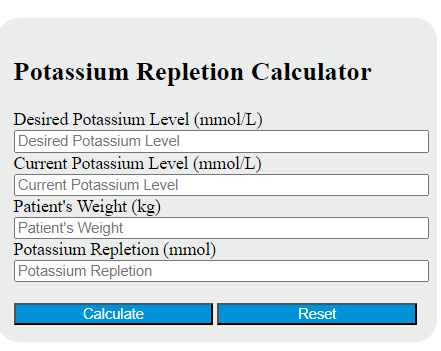
Estimate potassium deficit from current and target serum levels, patient weight, and an adjustable distribution factor, with kg/lb support and clinical safety reminders.
Medical safety note: This calculator provides a simplified educational estimate and is not a prescription or dosing recommendation. Potassium replacement can be dangerous (risk of hyperkalemia, arrhythmias, and death) and must be ordered and monitored by a licensed clinician with repeat labs and ECG monitoring when indicated—especially if there is kidney disease/dialysis or use of medications that raise potassium (e.g., ACE inhibitors, ARBs, potassium-sparing diuretics). For treatment decisions, follow local hospital protocols and professional guidelines.
- All Health and Medical Calculators
- Corrected Potassium Calculator
- Potassium Replacement Calculator
- Magnesium Repletion Calculator
Potassium Repletion Formula
The following formula is used in this page’s simplified estimate. The factor f is an assumption that may vary by individual.
Variables:
- K is the simplified estimated potassium deficit (mmol)
- D is the desired potassium level (mmol/L)
- C is the current potassium level (mmol/L)
- W is the patient's weight (kg)
- f is an assumed distribution factor (often 0.6 as a rough default)
To estimate the simplified deficit, subtract the current potassium level from the desired potassium level. Multiply the result by the patient's weight and then by the chosen factor (f).
What is a Potassium Repletion?
Potassium repletion is a medical treatment process that involves the restoration of normal potassium levels in the body. Potassium is a vital mineral and electrolyte that plays a crucial role in various bodily functions such as nerve and muscle cell functioning, heart function, and maintaining fluid balance. When the body's potassium levels are low, a condition known as hypokalemia, it can lead to serious health issues. Therefore, potassium repletion, often through oral or intravenous supplementation, is necessary to correct this imbalance.
How to Calculate Potassium Repletion?
The following steps outline how this page computes the simplified estimate using the formula: K = (D - C) * W * f
- First, determine the desired potassium level (D) in mmol/L.
- Next, determine the current potassium level (C) in mmol/L.
- Next, determine the patient's weight (W) in kg.
- Select an assumed factor (f).
- Multiply the difference between the desired and current potassium levels (D - C) by the patient's weight (W).
- Multiply the result by the selected factor (f) to obtain K.
Example Problem:
Use the following variables as an example problem to test your knowledge.
Desired potassium level (D) = 4 mmol/L
Current potassium level (C) = 3 mmol/L
Patient's weight (W) = 70 kg