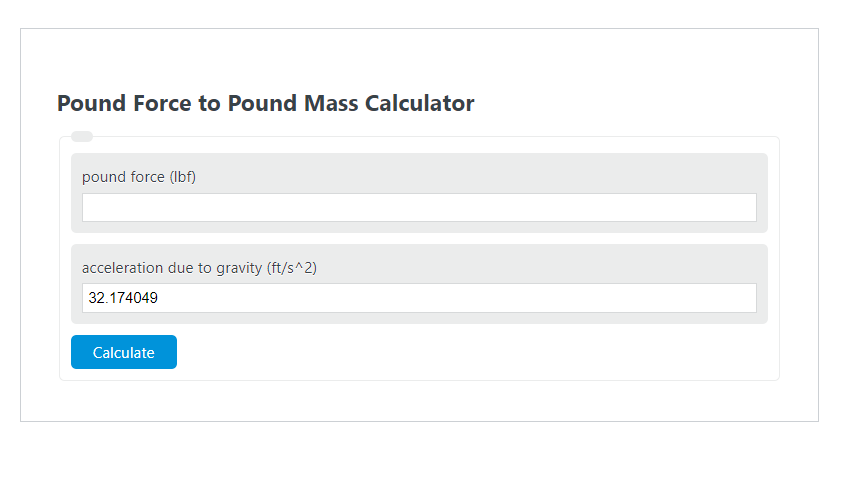
Convert between pound-force, pound-mass, and acceleration with the required g_c factor, SI equivalents, standard-gravity comparison, and reverse solves.
- All Unit Converters
- All Mass Calculators
- Pound Mass to Pound Force Calculator
- Particles to Mass Calculator
Pound Mass Formula
The following formula is used to calculate the Pound Mass.
- Where PM is the Pound Mass (lbs)
- PF is the pound force (lbf)
- a is the acceleration due to gravity (ft/s^2)
To calculate pound mass from pound force, divide the pound-force by the acceleration.
| Pound Force (lbf) | Pound Mass (lbm) |
|---|---|
| 0.5 | 0.016 |
| 1 | 0.031 |
| 2 | 0.062 |
| 3 | 0.093 |
| 5 | 0.155 |
| 10 | 0.311 |
| 15 | 0.466 |
| 20 | 0.622 |
| 25 | 0.777 |
| 30 | 0.932 |
| 40 | 1.243 |
| 50 | 1.554 |
| 60 | 1.865 |
| 75 | 2.331 |
| 100 | 3.108 |
| 150 | 4.662 |
| 200 | 6.216 |
| 250 | 7.770 |
| 300 | 9.324 |
| 400 | 12.432 |
| * Rounded to 3 decimals. Assumes standard gravity g₀ = 32.174 ft/s² and F = m × a. At 1 g: 1 lbf ≈ 0.031081 lbm. | |
How to Calculate Pound Mass?
The following example problems outline how to calculate Pound Mass.
Example Problem #1:
- First, determine the pound force (lbf).
- The pound force (lbf) is given as 500.
- Next, determine the acceleration due to gravity (ft/s^2).
- The acceleration due to gravity (ft/s^2) is provided as 32.174049.
- Finally, calculate the Pound Mass using the equation above:
PM = PF / a
The values given above are inserted into the equation below and the solution is calculated:
PM = 500 / 32.174049 = 15.540 (lbs)
FAQ
What is the difference between pound mass (lbs) and pound force (lbf)?
Pound mass (lbs) is a unit of mass in the imperial system, representing the mass that is accelerated by gravity to produce a force. On the other hand, pound force (lbf) is a unit of force in the same system, representing the force exerted by gravity on a pound mass at the Earth's surface. Essentially, pound mass measures how much matter is in an object, while pound force measures the gravitational force exerted on that mass.
Why is the acceleration due to gravity (ft/s^2) a constant in these calculations?
The acceleration due to gravity is considered a constant in these calculations because, for practical purposes, the value of 32.174049 ft/s^2 is used to represent the average acceleration of an object due to Earth's gravity at or near the surface. This approximation allows for simplified calculations in engineering and physics without significant loss of accuracy for most applications.
Can the formula PM = PF / a be used on other planets?
Yes, the formula PM = PF / a can be used on other planets, but the acceleration due to gravity (a) will differ from that on Earth. Each planet has its own specific gravity, affecting the acceleration due to gravity. Therefore, to use this formula accurately on other planets, you must substitute Earth's acceleration due to gravity with the respective planet's acceleration due to gravity in the calculation.