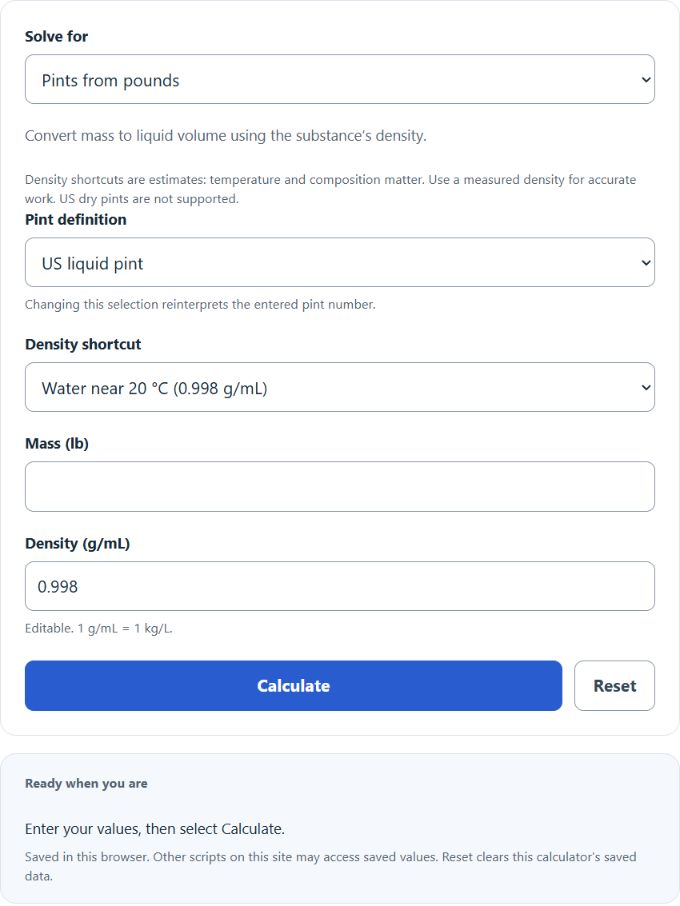
Convert pounds to pints (US liquid, US dry or Imperial) using the density of water, milk, oil or honey, or your own density, and convert pints to pounds.
- All Unit Converters
- Pounds to Barrels Calculator
- Pounds to Quarts Calculator
- Quarts to Pounds Calculator
- Lbs to Liters Calculator
- Lbs to mL Calculator
- mL to Lbs Calculator
Pounds To Pints Formula
The following formula converts mass to liquid volume. CF = 453.59237 ÷ (density in g/mL × mL per pint): use 473.176473 mL per US liquid pint or 568.26125 mL per Imperial pint. Density depends on temperature and composition; US dry pints (550.61 mL) are also available.
Variables:
- PT is the volume in pints
- P is the weight in pounds
- CF is the conversion factor (pints per pound) for the specific substance (and pint definition)
To calculate the volume in pints, multiply the weight in pounds by the conversion factor for the specific substance. The conversion factor represents the volume that one pound of the substance would occupy.
| Pounds (lb) | Pints (US pt) |
|---|---|
| 1/16 | 0.063 |
| ⅛ | 0.125 |
| 1/6 | 0.167 |
| ¼ | 0.250 |
| ⅓ | 0.333 |
| ⅜ | 0.375 |
| ½ | 0.500 |
| ⅝ | 0.625 |
| ⅔ | 0.667 |
| ¾ | 0.750 |
| ⅞ | 0.875 |
| 1 | 1.000 |
| 1¼ | 1.250 |
| 1⅓ | 1.333 |
| 1½ | 1.500 |
| 1¾ | 1.750 |
| 2 | 2.000 |
| 2½ | 2.500 |
| 3 | 3.000 |
| 4 | 4.000 |
| *This table is an illustration using CF = 1 US pint per lb. Actual CF depends on the substance (density) and pint definition. | |
What is Pounds To Pints?
Pounds to pints is not a single fixed conversion, because pounds are a unit of weight (mass) and pints are a unit of volume. Converting between them requires knowing the substance’s density (and whether you mean a US pint or an Imperial pint). In practice, people use a conversion factor (for example, pints per pound) that is specific to the substance being measured.
How to Calculate Pounds To Pints?
The following steps outline how to calculate the Pounds To Pints using the formula PT = P * CF.
- First, determine the weight in pounds (P).
- Next, choose the pint definition and enter the substance’s density in g/mL. Density shortcuts are illustrative estimates, not product specifications.
- Next, gather the formula from above: PT = P * CF.
- Finally, calculate the volume in pints (PT).
- After inserting the variables and calculating the result, check your answer with the calculator above.
Example Problem :
Use the following variables as an example problem to test your knowledge.
weight in pounds (P) = 10
conversion factor (CF) = 2 US liquid pints per pound (an illustrative custom density of approximately 0.479306 g/mL, not water). The example result is 10 × 2 = 20 US liquid pints.