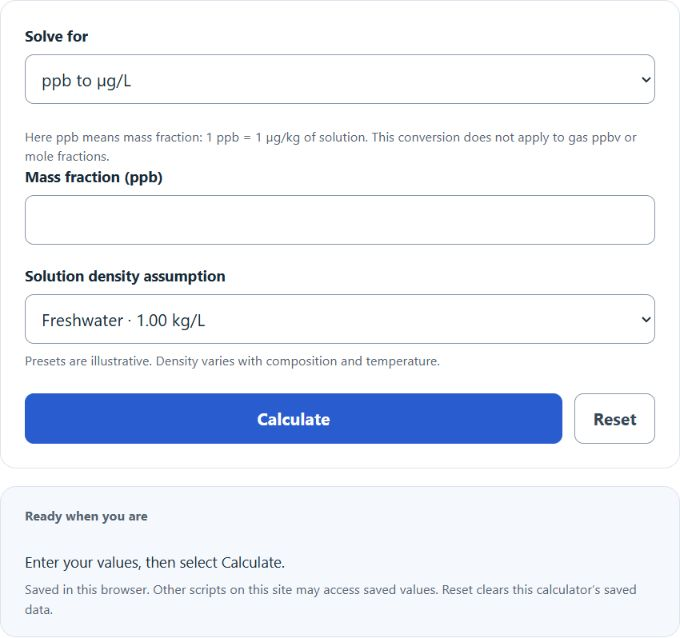
Convert ppb to µg/L for water and other liquids: 1 ppb ≈ 1 µg/L in freshwater, with seawater, oil, brine or your own density, and µg/L back to ppb.
- All Unit Converters
- mg/L To ppb Calculator
- ppb to ng/ml Converter
- mg/l to pounds Converter
- mg/kg to Percent Calculator
- lb/hr to ppm Calculator
Calculator Functions
| Function | What it does | What it requires |
|---|---|---|
| ppb to µg/L | Converts a mass fraction in ppb to a mass concentration in µg/L | Requires the mass fraction in ppb and a solution density |
| µg/L to ppb | Converts a mass concentration to a mass fraction in ppb | Requires the mass concentration in µg/L, mg/L or ng/mL and a solution density |
The solution density is picked from four presets, freshwater, seawater, light oil and dense brine, or entered as a measured value in kg/L, g/mL or kg/m³. Each result also shows the density used and the concentration in mg/L.
ppb to µg/L Formulas
| µg/L | Mass concentration, micrograms of substance per liter of solution |
| ppb | Mass fraction in parts per billion, which is micrograms per kilogram of solution [2] |
| ρ | Density of the solution (kg/L) |
ppb to µg/L
The main formula applies directly. In freshwater at 1.00 kg/L, 10 ppb is 10 × 1.00 = 10 µg/L, which is why the two units are treated as the same for dilute water samples [2]. In seawater at 1.025 kg/L, 10 ppb is 10 × 1.025 = 10.25 µg/L.
µg/L to ppb
A seawater sample at 25 µg/L is 25 ÷ 1.025 = 24.39 ppb. A concentration entered in mg/L is multiplied by 1,000 first, and ng/mL is the same as µg/L, so 0.5 mg/L in freshwater is 500 ppb.
Density presets
| Liquid | Density (kg/L) | 10 ppb in µg/L |
|---|---|---|
| Freshwater | 1.00 | 10 |
| Seawater | 1.025 | 10.25 |
| Light oil | 0.85 | 8.5 |
| Dense brine | 1.20 | 12 |
Limits of This Estimate
- Only ppb by mass is converted. A ppb figure by volume, as used for gases, or by mole fraction needs a different conversion.
- The four density presets are round, illustrative values. Real density depends on what is dissolved and on temperature, so a measured density gives a better answer. These estimates are based on the best available data and estimations.
- At low concentrations in freshwater the two units are nearly equal [1], so the density step only matters for liquids that are clearly heavier or lighter than water.
- The result is a unit conversion. It does not show whether a sample is safe or meets a regulatory limit.
Sources
- U.S. Geological Survey, Circular 1262, Conversion factors and water-quality units: multiplying a per-mass concentration by density to get a per-liter concentration, and near equality in freshwater
- U.S. EPA, Test Methods, Data Reporting Questions: 1 µg/kg or 1 µg/L equals 1 ppb for water samples