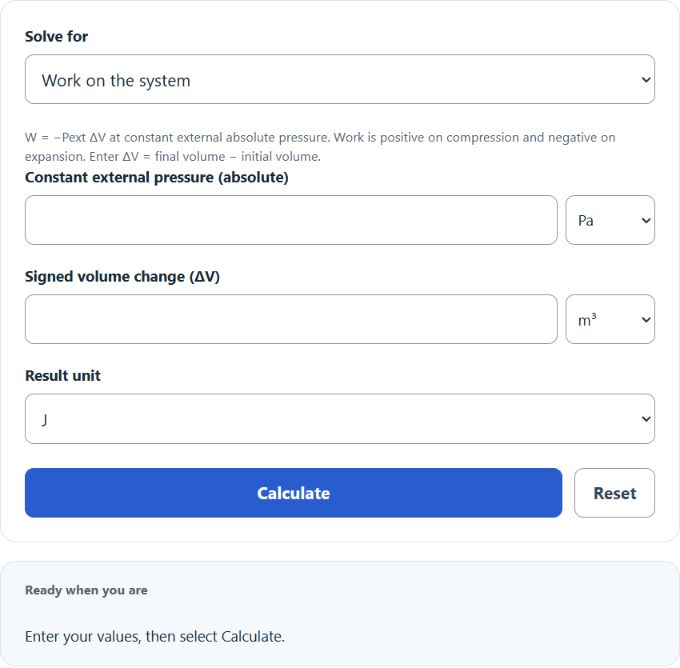
Calculate pressure-volume work, pressure, or volume change from any two values using W = -pΔV with constant pressure and unit conversions.
Work From Pressure and Volume Formula
Pressure-volume work describes the energy transferred when a system expands or is compressed against a constant pressure. For this calculator, the relationship is:
- W = pressure-volume work
- P = constant external absolute pressure acting during the process
- ΔV = change in volume, found from final volume minus initial volume
This form is the constant-pressure version of the more general thermodynamics expression:
If the pressure does not stay constant, the simple calculator result should be treated as an approximation unless an appropriate average pressure is used.
What the Negative Sign Means
The sign of the answer depends on the convention used by the calculator:
- If the volume increases, then ΔV is positive and the calculated work is negative.
- If the volume decreases, then ΔV is negative and the calculated work is positive.
This convention is common when work is defined as work done on the system. In some courses, the opposite sign convention is used for work done by the system, so the magnitude may match while the sign differs.
How to Use the Calculator
- Enter the pressure value.
- Enter the change in volume, not just the final volume.
- Select the correct units for pressure, volume, and work.
- Select the quantity to solve for, then enter the two known values.
- Click calculate and interpret the sign of the result using the convention above.
If you need to solve for pressure or volume change instead of work, rearrange the equation as follows:
Variable Definitions and Units
| Quantity | Description | Common Units |
|---|---|---|
| Pressure | The constant pressure resisting or driving the boundary motion | Pa, kPa, bar, psi, atm |
| Change in Volume | The difference between final and initial volume | m³, L, cm³, in³, ft³ |
| Work | Energy transferred by expansion or compression | J, kJ, cal, kcal |
In SI units, pressure-volume work naturally converts to joules when pressure is entered in pascals and volume change is entered in cubic meters.
Examples
Example 1: Expansion at constant pressure
A gas expands under a constant pressure of 200,000 Pa and its volume increases by 0.015 m³.
The work is negative, which indicates expansion under this sign convention.
Example 2: Compression at constant pressure
A system is compressed at 95,000 Pa and its volume decreases by 0.004 m³.
The work is positive because the volume change is negative.
Common Mistakes
- Using total volume instead of change in volume: the formula requires the difference between final and initial volume.
- Dropping the sign on ΔV: a decrease in volume must be entered as a negative change.
- Mixing incompatible units: always confirm the selected unit matches the number entered.
- Using this equation for non-constant pressure without adjustment: the direct multiplication form assumes pressure is constant during the process.
When This Calculator Is Most Useful
- Introductory thermodynamics problems
- Piston-cylinder expansion and compression calculations
- Physics and engineering homework involving constant pressure
- Quick energy estimates for gas volume changes
Quick Notes
- Expansion means the final volume is greater than the initial volume.
- Compression means the final volume is less than the initial volume.
- The calculator is most accurate when the pressure remains constant throughout the volume change.
- If your class uses the opposite work sign convention, the magnitude of the result is still useful, but the sign may need to be reversed.