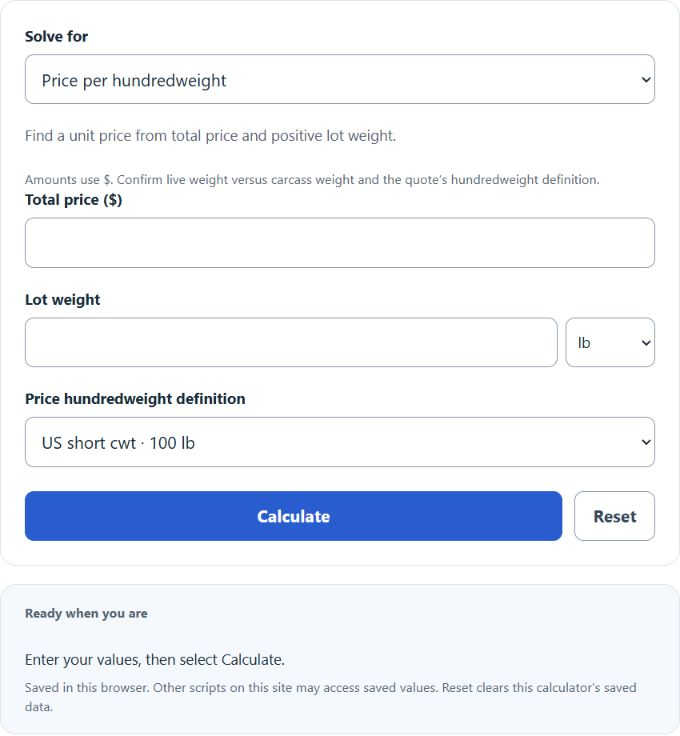
Choose price per cwt, total price, lot weight or equivalent unit prices, then enter the displayed values and confirm the US or UK hundredweight basis.
Related Calculators
- Pig Profit Calculator
- Copper Price Calculator
- Reverse Margin Calculator
- Gross Margin Calculator
- All Business Calculators
Price Per Cwt Formula
The following formula uses the US short hundredweight (100 lb). For the UK long hundredweight, replace 100 with 112.
- Total Price ($): the total cost paid for the goods
- Weight (lbs): total weight in pounds
- Price Per Cwt ($/cwt): the cost per selected hundredweight (100 lb US or 112 lb UK)
What is Price Per Cwt?
Price per cwt (hundredweight) is the cost per 100 pounds. In the United States, 1 cwt = 100 lbs. In the United Kingdom, 1 cwt = 112 lbs (the “long hundredweight”). US commodity quotes commonly use the 100 lb definition; confirm the exact contract or report basis. Expressing price per cwt lets buyers and sellers compare lot sizes of any weight on a single consistent basis, without recalculating price per pound for each transaction size.
Where CWT Pricing Is Used
Livestock: Fed cattle, feeder cattle, hogs, and lambs are quoted in $/cwt in USDA Agricultural Marketing Service reports and CME futures. Live weight and dressed (carcass) weight produce two different cwt values for the same animal. A 1,400 lb steer sold at $240/cwt live yields $3,360. At a hypothetical 63% dress yield, the same animal produces an 882 lb carcass. A dressed-weight quote must be applied to carcass weight; this calculator does not infer that quote from a live-weight price.
Dairy: USDA Federal Milk Marketing Orders publish minimum Class I, II, III, and IV prices in $/cwt each month. The historical March 2026 base Class I price was $15.47/cwt, as reported by USDA. Actual Class I prices include applicable location differentials; this base figure is not one uniform producer-payment floor.
LTL freight: Less-than-truckload carriers quote base rates per cwt by NMFC freight class (class 50 to 500). Rate per cwt decreases as shipment weight increases. A 500 lb shipment on class 65 costs more per cwt than a 5,000 lb shipment on the same lane because heavier loads qualify for lower weight-break tiers. This inverse rate structure is the core financial reason shippers consolidate smaller loads into larger ones.
Steel and paper: Hot-rolled coil, rebar, and structural steel are quoted in $/cwt or $/ton (1 short ton = 20 cwt) in North American mill pricing. Paper products use cwt pricing alongside MSF (per 1,000 sq ft) for comparing grades with different basis weights.
Illustrative CWT Quote Scenarios
The ranges below are hypothetical quote inputs for unit-price comparisons, not verified market benchmarks. They cannot establish a fair price; consult dated reports and the exact grade, location, delivery and weight basis.
| Commodity | $/cwt Range | Illustrative basis |
|---|---|---|
| Fed cattle (live weight) | $224 – $244 | Hypothetical live-weight quote; not a market benchmark |
| Feeder cattle (500-600 lb) | $330 – $360 | Hypothetical feeder-cattle quote; confirm weight and grade |
| Choice beef cuts (wholesale) | $330 – $380 | Hypothetical wholesale quote; confirm cut and grade |
| Milk (USDA Class I) | $14.50 – $17.00 | Hypothetical Class I quote; location differentials apply |
| LTL freight (NMFC class 65, ~1,000 lbs) | $15 – $35 | Varies by carrier, lane, and weight-break tier |
| Steel (hot-rolled coil) | $30 – $60 | North American mill pricing, quoted per cwt or per ton |
Example: Cattle Purchase
A cattle buyer purchases 12 steers weighing a combined 14,400 lbs for $34,560.
Price Per Cwt = ($34,560 / 14,400) x 100 = $240.00/cwt
The arithmetic is $240/cwt on the stated live-weight basis. This hypothetical purchase does not establish fair market value; compare only with independently verified quotes for the same date, grade, location and delivery terms.