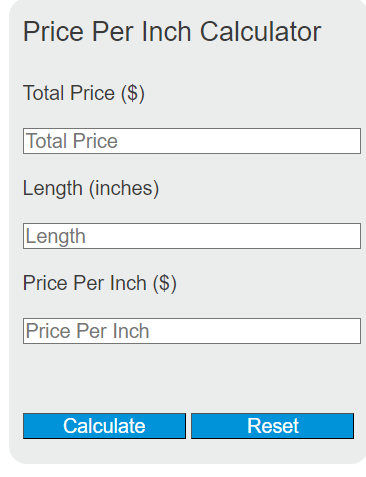
Calculate price per inch, total price, or length from any two values, with automatic conversions for inches, feet, yards, centimeters, and meters.
Price Per Inch Formula
Price per inch converts a total purchase price into a unit-length cost. It is a simple way to compare items sold by length, especially when products come in different package sizes, roll lengths, board lengths, or cable cuts.
- PPI = price per inch
- TP = total price
- Lin = length in inches
If you already know the unit price and need to solve for total price or length, the same relationship can be rearranged.
General Price Per Unit Length Formula
The same idea works for any linear unit, not just inches. When comparing products, the most important step is keeping every option in the same unit.
This is useful for price per foot, price per centimeter, or price per meter when the item is sold in those units.
How to Calculate Price Per Inch
- Find the total price paid for the item.
- Measure the full usable length of the item.
- Convert the length to inches if needed.
- Divide the total price by the length in inches.
- Use the result to compare products on an equal unit-cost basis.
Converting Length to Inches
If your length is not already in inches, convert it first. This keeps the calculation accurate and makes comparisons easier.
| Starting Unit | Conversion to Inches | Common Uses |
|---|---|---|
| Feet | Lᵢₙ = 12 × Lft |
Lumber, rope, trim, wire |
| Centimeters | Lᵢₙ = (Lcm) / (2.54) |
Imported products, crafts, packaging |
| Meters | Lᵢₙ = 39.3701 × Lₘ |
Fabric rolls, flooring, industrial materials |
Examples
If an item costs $24 and has a length of 96 inches, the unit cost is:
The item costs $0.25 per inch.
Now compare two options with different lengths:
Option B has the lower price per inch, so it delivers more length for each dollar spent.
When a Price Per Inch Calculator Is Useful
- Comparing rolls of fabric, ribbon, or wrapping material
- Evaluating cables, tubing, chain, or hose sold by length
- Comparing boards, molding, trim, and construction materials
- Checking whether a bulk package actually lowers unit cost
- Building quick budgets when you know the required length
Why Price Per Inch Matters
Sticker price alone can be misleading. A cheaper item is not always the better value if it contains much less material. Price per inch standardizes the comparison so you can judge the true cost of length rather than the package price.
| Result | Interpretation |
|---|---|
| Lower price per inch | Better value for the same quality and specifications |
| Higher price per inch | More expensive on a length basis |
| Equal price per inch | Similar value by length, so other factors decide |
Important Comparison Tips
- Use the same unit for every product. Compare inch-to-inch, foot-to-foot, or meter-to-meter.
- Check usable length. Packaging, connectors, waste, or cut loss can reduce the effective amount.
- Do not ignore quality. A lower unit price may not be better if thickness, durability, brand, or grade differs.
- Round at the end. Keeping extra decimals improves close comparisons.
- Use linear pricing only for linear goods. For sheets or surface coverings, price per square inch or square foot may be more meaningful.
Price Per Inch vs. Other Unit Pricing Methods
| Method | Best For | What It Measures |
|---|---|---|
| Price per inch | Linear products | Cost for each inch of length |
| Price per foot | Longer construction or utility materials | Cost for each foot of length |
| Price per square unit | Flooring, paper, tiles, fabric width-based purchases | Cost for area coverage |
| Price per volume unit | Liquids, fill materials, bulk compounds | Cost for cubic or liquid quantity |
Common Questions
Is a lower price per inch always better?
Only if the items are otherwise comparable. Material quality, width, thickness, brand reliability, and waste can all matter.
Can I use this for feet, centimeters, or meters?
Yes. Convert the measurement to inches first, or use the matching price-per-unit option if your calculator supports other units directly.
What happens if the length is zero?
Price per inch cannot be calculated when length is zero because division by zero is undefined.
Can this formula help with budgeting?
Yes. If you know the target price per inch and required length, you can solve for total price using the rearranged formula above.
Practical Use Cases
Consumers use price per inch to compare household items and craft supplies, while contractors and DIY users apply it to trim, piping, wiring, and lumber. It is also useful in estimating project costs before purchase, especially when suppliers offer multiple package lengths at different prices.
Whenever the purchase decision depends on length, converting the cost into a price-per-inch figure gives a faster and more accurate value comparison than relying on total price alone.