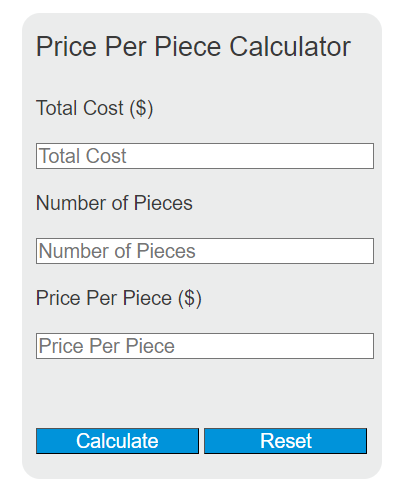
Calculate price per piece, total cost, or number of pieces from any two values, and compare pack prices to find the lower unit cost.
- All Business Calculators
- Price Per Cup Calculator
- Price Per Meter Calculator
- Price Per Quart Calculator
Price Per Piece Formula
The price per piece measures the cost of one individual unit inside a pack, case, order, or production batch. It is a simple but powerful unit-cost calculation for comparing package sizes, evaluating supplier quotes, estimating manufacturing cost per unit, and checking whether a larger purchase actually delivers better value.
| Variable | Meaning |
|---|---|
| PPP | Price per piece |
| TC | Total cost of the package, order, or batch |
| NP | Number of pieces |
To calculate the price per piece, divide the total cost by the total number of pieces. For a meaningful result, the piece count must be greater than zero, and the total cost should reflect the exact cost basis you want to analyze.
Rearranged Forms
If you already know the price per piece, the same relationship can be rearranged to find total cost or the number of pieces.
How to Calculate Price Per Piece
- Determine the total cost of the order, package, or production run.
- Count the total number of pieces included.
- Divide the total cost by the number of pieces.
- Round the answer to a practical currency precision if needed.
If your goal is a true delivered or effective unit cost, include all relevant charges in total cost, such as shipping, handling, or packaging. If your goal is only to compare product sticker prices, use base item cost alone.
Example
A box costs $48 and contains 24 pieces. The unit cost is:
Each piece costs $2.00.
Comparing Two Purchase Options
Price per piece is especially useful when total package prices are different. A higher total price does not always mean a worse deal if the package contains more units.
| Option | Total Cost | Pieces | Calculation | Price Per Piece |
|---|---|---|---|---|
| Pack A | $9.00 | 12 | PPP = (9) / (12) = 0.75 |
$0.75 |
| Pack B | $14.00 | 20 | PPP = (14) / (20) = 0.70 |
$0.70 |
Even though Pack B costs more overall, it has the lower price per piece, so it provides better unit value.
When This Calculator Is Useful
- Bulk buying: Compare different pack sizes on an equal basis.
- Supplier analysis: Evaluate quotes from multiple vendors with different case counts.
- Retail pricing: Understand unit acquisition cost before setting a selling price.
- Manufacturing: Estimate cost per finished part, component, or assembled unit.
- Budgeting: Forecast how many units can be purchased within a fixed spend.
- Inventory decisions: Identify whether larger orders create meaningful unit-cost savings.
Practical Tips for Accurate Results
- Use the same cost basis every time. Do not compare one option with shipping included and another without it unless that difference is intentional.
- Convert everything to pieces first. If an item is sold by case, box, sleeve, or set, translate it into the total number of individual pieces before dividing.
- Use usable pieces when appropriate. If some units are damaged, scrapped, or promotional extras, divide by the number of good pieces to estimate effective cost per usable unit.
- Avoid early rounding. Keep a few decimal places during calculations when comparing close alternatives.
- Separate cost from selling price. Price per piece can describe what you pay per unit or what you charge per unit, but those are different business decisions.
Common Mistakes
- Dividing by the number of boxes instead of the number of pieces inside the boxes.
- Ignoring fees that materially change the real cost per unit.
- Comparing products with inconsistent piece definitions.
- Using a piece count of zero or leaving the piece count blank.
- Assuming the largest package is automatically the best value.
Frequently Asked Questions
Should shipping and tax be included?
Include them if you want a landed cost per piece. Exclude them if you are only comparing base product prices.
Can this calculator be used for manufacturing cost per unit?
Yes. Use the full batch cost as total cost and the finished output quantity as the number of pieces. If scrap or defects are significant, divide by the number of good units rather than total attempted units.
What if the package includes mixed item sizes?
The result is only meaningful when each piece is treated as comparable. If item sizes differ materially, a different unit basis such as cost per ounce, cost per foot, or cost per kilogram may be more appropriate.
Why is price per piece important?
It converts total package price into a standardized unit measure, making comparisons faster, clearer, and more accurate. That standardization is what makes unit-cost decisions far more reliable than comparing total package prices alone.