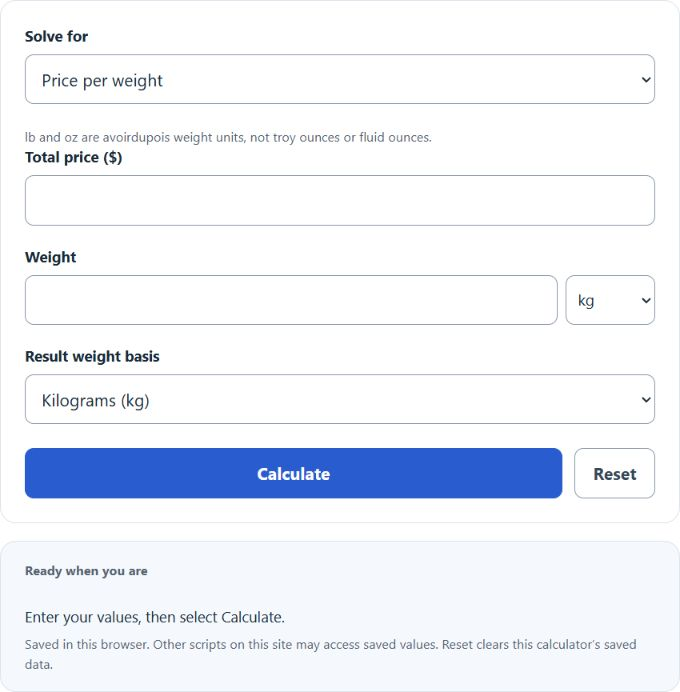
Choose total price, weight, or price per unit weight, then enter the two known values in kilograms, grams, pounds, or avoirdupois ounces.
Price Per Weight Formula
The price per weight calculator finds the cost of an item for each unit of weight. This makes it much easier to compare products sold in different package sizes, brands, or measurement systems.
- PPW = price per weight
- P = total price of the item
- W = total weight of the item
The result is usually expressed in one of these forms:
- dollars per kilogram
- dollars per gram
- dollars per pound
- dollars per ounce
How to Calculate Price Per Weight
- Enter the total price of the product.
- Enter the total weight of the product.
- Select the weight unit that matches the package label.
- The calculator divides price by weight and returns the unit price.
If you are comparing multiple products, make sure every result is converted to the same unit before deciding which option is cheaper.
Why Price Per Weight Matters
Price per weight is one of the fastest ways to judge value. A larger package may have a higher shelf price, but a lower unit cost. Likewise, a smaller package may look cheaper while actually costing more per pound or per kilogram.
- Grocery shopping: compare meat, produce, rice, flour, coffee, nuts, and bulk foods.
- Household products: compare pet food, detergent powder, lawn materials, or charcoal.
- Metals and materials: compare silver, copper, feed, fertilizer, or industrial goods sold by mass.
- Budgeting: identify when a warehouse-size purchase truly saves money.
Unit Consistency
The formula is simple, but the units must stay consistent. If one product is priced per ounce and another per pound, convert both to the same basis before comparing.
| Common Weight Relationship | Meaning |
|---|---|
| 1 kilogram = 1000 grams | Use when comparing metric retail packages |
| 1 pound = 16 ounces | Use when comparing U.S. customary package sizes |
| 1 kilogram ≈ 2.20462 pounds | Use when comparing metric and imperial listings |
If needed, you can convert first and then calculate.
Example
A product costs $18 and weighs 6 lb. The price per pound is:
This means the product costs $3 per pound.
If another product costs $8 for 40 oz, convert or calculate directly by ounces:
That result means $0.20 per ounce. To compare it to a per-pound price, multiply by 16 ounces per pound:
So the second product costs $3.20 per pound, which is more expensive than the first product at $3.00 per pound.
How to Interpret the Result
- Lower price per weight usually means better value.
- Higher price per weight means you are paying more for the same amount of material.
- If quality differs, unit price should be considered alongside grade, freshness, brand, waste, and yield.
Common Comparison Tips
- Compare products in the same unit.
- Check whether the listed weight is net weight or total package weight.
- Watch for products with water, bone, peel, or packaging that reduce usable quantity.
- For sale items, calculate using the discounted price, not the original shelf label.
- For subscriptions or bulk orders, include any mandatory fees if you want a true unit cost.
Common Mistakes
- Mixing pounds and ounces without converting.
- Comparing gross package weight instead of the edible or usable portion.
- Ignoring temporary promotions, coupons, or shipping costs.
- Assuming a larger package is always cheaper per unit.
Price Per Weight vs. Total Price
Total price tells you how much you pay at checkout. Price per weight tells you how much value you get for that money. A product with a higher checkout price can still be the better buy if its cost per unit of weight is lower.
Frequently Asked Questions
Is a lower price per weight always better?
Usually yes for pure value comparison, but product quality, spoilage, shelf life, and usable yield also matter.
Can I use this calculator for grams, kilograms, pounds, and ounces?
Yes. Just enter the weight and choose the unit that matches the package measurement.
What happens if I double the weight but keep the same price?
The price per weight is cut in half.
Can this be used for precious metals, food, and bulk materials?
Yes, when the weight unit matches the product. The lb and oz options are avoirdupois units; convert troy-ounce precious-metal weights before using them.
What if I already know the desired unit price and weight?
You can reverse the relationship to estimate total price.
When This Calculator Is Most Useful
This calculator is especially useful when package sizes are inconsistent, when stores use different units on their labels, or when you want a fast objective comparison between multiple products. By reducing every option to a single unit price, it helps you make a clearer and more cost-effective decision.