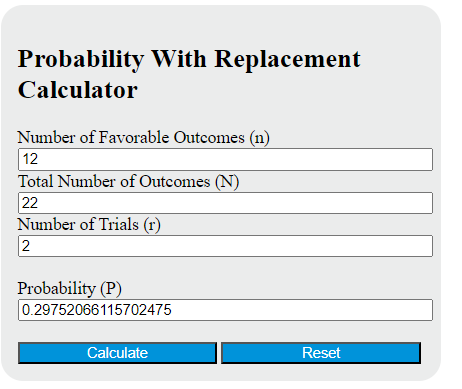
Calculate probability with replacement from favorable and total outcomes, including all trials favorable, exactly k successes, or at least one success.
Related Calculators
- Expected Cost Calculator
- P-hat Calculator
- Marginal Frequency Calculator
- Standard Error Of Proportion Calculator
- All Statistics Calculators
Probability With Replacement Formula
The following formula is used to calculate the probability that a favorable outcome occurs on every one of the r independent trials when sampling with replacement (i.e., constant per-trial probability n/N).
Variables:
- P is the probability that the outcome is favorable on all r trials (r successes in r trials)
- n is the number of favorable outcomes (per trial)
- N is the total number of equally likely outcomes (per trial)
- r is the number of trials (draws)
To calculate this probability, divide the number of favorable outcomes by the total number of outcomes to get the single-trial probability (n/N). Then raise this quotient to the power of the number of trials r. Note: if you want the probability of at least one success in r trials, use 1 − (1 − n/N)r, and if you want the probability of exactly k successes, use the binomial formula (see the calculator tabs above).
What Is Probability With Replacement?
“With replacement” describes a sampling method where an item is drawn from a set and then returned to the set before the next draw (often implying the set is mixed/shuffled again). Because the set’s composition does not change, each draw has the same probabilities as the previous ones, and successive draws are treated as independent. This is used in scenarios such as drawing cards with replacement, picking balls from a bag and putting them back, or repeatedly selecting a number from a set while allowing repeats.
How to Calculate Probability With Replacement?
The following steps outline how to calculate the Probability With Replacement.
- First, determine the number of favorable outcomes (n).
- Next, determine the total number of outcomes (N).
- Next, determine the number of trials (r).
- Next, gather the formula from above for the probability that all r trials are favorable: P = (n/N)^r.
- Finally, calculate the Probability With Replacement.
- After inserting the variables and calculating the result, check your answer with the calculator above.
Example Problem :
Use the following variables as an example problem to test your knowledge.
number of favorable outcomes (n) = 3
total number of outcomes (N) = 10
number of trials (r) = 2, so the probability that both trials are favorable is P = (3/10)2 = 0.09 (9%).