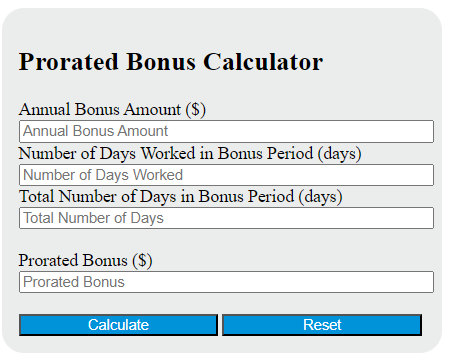
Calculate a prorated bonus from eligible dates or manual periods—or solve for the full target bonus—with salary-based targets, performance, and FTE adjustments.
Prorated Bonus Formula
The following formula is used to calculate the prorated bonus.
Variables:
- PB is the prorated bonus ($)
- A is the annual bonus amount ($)
- D is the number of days worked in the bonus period (days)
- T is the total number of days in the bonus period (days)
To calculate the prorated bonus, multiply the annual bonus amount by the number of days worked in the bonus period. Then divide the result by the total number of days in the bonus period.
What is a Prorated Bonus?
A prorated bonus is a partial bonus payment adjusted to reflect the proportion of a bonus period an employee actually worked. Employers use proration when an employee was not present for the entire performance cycle, whether due to a mid-year hire date, a mid-year departure, an extended leave of absence, or a transition from part-time to full-time status. The underlying principle is proportional fairness: the employee receives compensation that matches their actual contribution window rather than receiving no bonus at all or the full amount.
Proration applies to several types of variable compensation, not just year-end bonuses. Signing bonuses with clawback clauses often use prorated repayment schedules. Retention bonuses paid upfront may require prorated refunds if the employee departs before the agreed retention date. Quarterly performance bonuses, spot bonuses tied to project milestones, and profit-sharing distributions can all be prorated depending on company policy and the employment agreement.
Proration Methods Compared
Not all companies prorate bonuses the same way. The method chosen can meaningfully change the payout, particularly for employees who start or leave near the boundary of a calendar month or quarter.
Daily proration divides the actual calendar days worked by the total calendar days in the bonus period. This is the most precise method and the one used by the calculator above. An employee hired on March 15 in a January 1 to December 31 bonus period would have 292 days worked out of 365, yielding a proration factor of 0.8000. Applied to a $10,000 bonus, the payout is $8,000.
Monthly proration counts only full calendar months of employment and divides by 12. That same March 15 hire would typically receive credit for 9 full months (April through December), producing a proration factor of 9/12 = 0.75 and a payout of $7,500 on the same $10,000 bonus. Some employers grant partial-month credit if the employee started before the 15th of the month, but this varies.
Quarterly proration rounds to the nearest full quarter worked and divides by 4. The March 15 hire would receive credit for 3 full quarters (Q2, Q3, Q4), giving a proration factor of 3/4 = 0.75 and a $7,500 payout. This method is less precise but simpler for companies with quarterly reporting cycles.
Performance-weighted proration adds a multiplier to the time-based calculation. The formula becomes PB = A x (D / T) x P, where P is a performance factor typically ranging from 0.0 to 1.5. An employee who worked 75% of the year with a 1.2 performance rating on a $10,000 target bonus would receive $10,000 x 0.75 x 1.2 = $9,000. This method is common in sales compensation plans and executive bonus structures.
Average Bonus Percentages by Industry
The size of the bonus being prorated varies substantially across industries. Understanding where your industry falls provides context for what your prorated amount should look like relative to your base salary.
| Industry | Typical Bonus as % of Salary | Example: Prorated Bonus on $80,000 Salary (6 months worked) |
|---|---|---|
| Finance and Banking | 15% to 30% | $6,000 to $12,000 |
| Technology | 5% to 15% | $2,000 to $6,000 |
| Consulting | 10% to 25% | $4,000 to $10,000 |
| Pharmaceutical / Biotech | 8% to 20% | $3,200 to $8,000 |
| Manufacturing | 3% to 10% | $1,200 to $4,000 |
| Retail / Consumer Goods | 2% to 5% (hourly), 10% to 20% (corporate) | $800 to $2,000 (hourly), $4,000 to $8,000 (corporate) |
| Healthcare | 1% to 5% | $400 to $2,000 |
| Leisure and Hospitality | 1% to 3% | $400 to $1,200 |
For exempt (salaried) employees across all industries, the average bonus sits at roughly 11% of salary. Nonexempt salaried employees average about 6.8%, and hourly employees average approximately 5.6%. Executive bonuses are significantly higher, often ranging from 20% to 50% of base compensation at the C-suite level.
Common Proration Scenarios
Mid-year new hire: This is the most frequent reason for proration. An employee joins after the bonus period has already begun. Most companies define eligibility as starting before a cutoff date (often October 1 for a calendar-year bonus cycle). If the employee starts after that cutoff, some employers exclude them from the bonus pool entirely for that year rather than prorating.
Voluntary resignation: Whether a departing employee receives a prorated bonus depends entirely on the employment agreement and company policy. Many bonus plans include language requiring the employee to be "actively employed on the date of payment" to receive any bonus. In those cases, an employee who resigns in November but whose bonus is paid in March of the following year would receive nothing, regardless of having worked 11 months.
Involuntary termination: Employees laid off or terminated without cause may have stronger claims to a prorated bonus, depending on jurisdiction. Some states treat earned bonuses as wages, meaning the employer may be legally required to pay the prorated portion at termination. Termination for cause almost always forfeits bonus eligibility.
Leave of absence: Employees on FMLA, disability leave, parental leave, or sabbatical present a more complex proration question. Employers typically subtract the leave period from the days-worked count. An employee on a 12-week parental leave during a 365-day bonus period would have 281 eligible days, yielding a proration factor of 0.77. However, some companies choose not to reduce bonuses for legally protected leave to avoid potential discrimination claims.
Part-time to full-time conversion: An employee who moves from part-time (e.g., 20 hours per week) to full-time (40 hours per week) mid-year may see a blended proration. One approach: calculate the bonus for the part-time months at 50% of the daily rate and for the full-time months at 100%, then sum the two periods.
Tax Treatment of Prorated Bonuses
Prorated bonuses are classified as supplemental wages by the IRS. Employers can withhold federal income tax on supplemental wages using one of two methods. The flat rate method applies a 22% withholding rate (37% for amounts exceeding $1 million in a calendar year). The aggregate method combines the bonus with the employee's most recent regular paycheck and withholds based on the combined amount using standard tax tables, which often results in a higher withholding rate.
State income tax withholding varies. Some states mandate a flat supplemental rate (for example, California uses 10.23%), while others require the aggregate method. Social Security tax (6.2%) and Medicare tax (1.45%) also apply to the bonus, with an additional 0.9% Medicare surtax for employees whose total wages exceed $200,000 in a year.
The effective tax bite on a prorated bonus is often higher than expected because the withholding is calculated on the lump sum. An employee receiving a $4,000 prorated bonus may see $880 withheld in federal tax alone (22% flat rate), plus state taxes and FICA, potentially netting only $2,700 to $3,000. The actual tax liability is reconciled when the employee files their annual return, and overwithholding is refunded at that time.
Clawback Provisions and Repayment Obligations
Signing bonuses and retention bonuses frequently include clawback clauses requiring the employee to repay a prorated portion of the bonus if they leave before a specified date. A typical structure is a two-year declining repayment schedule: leaving within the first year requires repayment of 100% of the bonus, and leaving in the second year requires repayment of 50%.
The enforceability of clawback provisions depends on state law. Courts generally uphold repayment obligations that are clearly stated in writing, signed by both parties, and tied to a legitimate business interest such as recouping recruitment or relocation costs. Vague or overly punitive clawback language may be struck down.
California enacted new restrictions effective January 1, 2026, limiting "stay-or-pay" agreements. Under the new rules, repayment obligations cannot accrue interest, must be prorated based on the remaining term (which cannot exceed two years from receipt of payment), and the employee must have the option to defer receipt until the end of the retention period to eliminate the repayment obligation entirely. Other states are considering similar legislation.
When repaying a clawback, the tax treatment depends on timing. If the bonus and the repayment occur in the same tax year, the employer adjusts the W-2 and the transaction is largely invisible on the employee's return. If the repayment occurs in a later tax year, the employee may need to claim a deduction or credit under the "claim of right" doctrine (IRC Section 1341), which can be complex and may require professional tax advice.
Negotiating a Prorated Bonus
Bonus proration terms are often negotiable during the hiring process, particularly for mid-year hires. Candidates who are forfeiting a bonus at their current employer have the strongest leverage to request either a guaranteed minimum prorated bonus in their first year or a signing bonus that offsets the forfeited amount.
Key points to address in negotiation include the proration method (daily is most favorable to the employee), whether the bonus is guaranteed or discretionary in the first year, the minimum employment date required for eligibility, whether the "actively employed" requirement applies, and any clawback terms on signing or retention bonuses. Getting these details in writing as part of the offer letter or employment agreement prevents disputes later.
Discretionary vs. Non-Discretionary Prorated Bonuses
The legal distinction between discretionary and non-discretionary bonuses has direct implications for proration. A non-discretionary bonus is one where the criteria for earning it are established in advance (for example, a bonus paid if the company hits a specific revenue target). These bonuses are generally considered earned wages, and employers may be legally required to pay the prorated portion upon separation.
A discretionary bonus is one where the employer retains full authority over whether to pay it, how much to pay, and to whom. Year-end "holiday bonuses" with no published formula are typically discretionary. Because no contractual right to the bonus exists, the employer has no obligation to prorate it for departing or newly hired employees.
Under the Fair Labor Standards Act (FLSA), non-discretionary bonuses must be included in the regular rate of pay for overtime calculations. If a non-discretionary bonus is prorated, the employer may also need to recalculate overtime pay for any weeks in which the employee worked more than 40 hours during the bonus period. This recalculation obligation does not apply to discretionary bonuses.