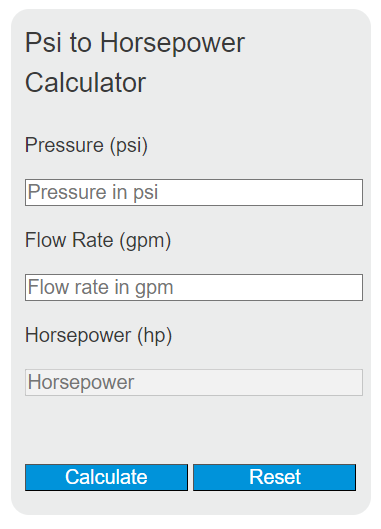
Calculate hydraulic horsepower from pressure and flow rate, or solve for PSI, GPM, shaft power, and pump efficiency in common units.
| PSI to HP (at 10 GPM) | HP to PSI (at 10 GPM) |
|---|---|
| 500 psi = 2.917 hp | 1 hp = 171.4 psi |
| 750 psi = 4.376 hp | 2 hp = 342.8 psi |
| 1,000 psi = 5.834 hp | 3 hp = 514.2 psi |
| 1,250 psi = 7.292 hp | 5 hp = 857 psi |
| 1,500 psi = 8.752 hp | 7.5 hp = 1,285.5 psi |
| 1,750 psi = 10.212 hp | 10 hp = 1,714 psi |
| 2,000 psi = 11.668 hp | 15 hp = 2,571 psi |
| 2,500 psi = 14.585 hp | 20 hp = 3,428 psi |
| 3,000 psi = 17.502 hp | 25 hp = 4,285 psi |
| 3,500 psi = 20.420 hp | 30 hp = 5,142 psi |
| Formulas: HP = (PSI x GPM) / 1714 and PSI = (HP x 1714) / GPM. | |
| PSI to HP (at 20 GPM) | HP to PSI (at 20 GPM) |
|---|---|
| 500 psi = 5.834 hp | 2 hp = 171.4 psi |
| 750 psi = 8.752 hp | 5 hp = 428.5 psi |
| 1,000 psi = 11.668 hp | 7.5 hp = 642.8 psi |
| 1,250 psi = 14.585 hp | 10 hp = 857 psi |
| 1,500 psi = 17.502 hp | 15 hp = 1,285.5 psi |
| 1,750 psi = 20.420 hp | 20 hp = 1,714 psi |
| 2,000 psi = 23.336 hp | 25 hp = 2,142.5 psi |
| 2,500 psi = 29.170 hp | 30 hp = 2,571 psi |
| 3,000 psi = 35.004 hp | 40 hp = 3,428 psi |
| 3,500 psi = 40.838 hp | 50 hp = 4,285 psi |
| Formulas: HP = (PSI x GPM) / 1714 and PSI = (HP x 1714) / GPM. | |
- All Unit Converters
- CC to HP Calculator
- WHP to HP Calculator
- CFM to HP Calculator
- RWKW to HP Calculator
- Newton to HP Calculator
- GPH to HP Calculator
- Hydraulic Flow to HP Calculator
Psi to Horsepower Formula
hp = hydraulic horsepower | psi = pressure in pounds per square inch | gpm = flow rate in gallons per minute
The constant 1714 comes from unit conversions: 1 HP = 33,000 ft·lb/min; 1 gallon = 0.13368 ft³; 1 PSI = 144 lb/ft². Multiplied out: 33,000 / (144 x 0.13368) = 1,714.3. This means 1 hydraulic horsepower equals 1,714 psi·gpm.
Real-World Hydraulic HP Reference
| Equipment | Typical PSI | Typical GPM | Hydraulic HP Range |
|---|---|---|---|
| Log splitter | 2,500–3,000 | 2–5 | 2.9–8.8 hp |
| Skid steer loader | 3,000–3,500 | 15–30 | 26–61 hp |
| Mini excavator | 3,000–4,000 | 15–25 | 26–58 hp |
| Agricultural tractor | 2,000–3,000 | 10–20 | 12–35 hp |
| Industrial power unit | 1,000–3,000 | 5–50 | 3–88 hp |
| High-pressure press | 5,000–10,000 | 2–10 | 6–58 hp |
| Crane / lift | 3,000–4,000 | 20–50 | 35–117 hp |
| Values are approximate. HP = (PSI x GPM) / 1714. Add 15–20% for pump inefficiency when sizing motors. | |||
Hydraulic HP vs. Required Motor HP
The formula gives theoretical hydraulic horsepower at 100% efficiency. Real pumps have mechanical losses, so the motor or engine must supply more than the hydraulic HP output. Divide hydraulic HP by pump efficiency to find required input power.
| Pump Type | Typical Efficiency | Motor HP per 10 HHP |
|---|---|---|
| Gear pump | 80–85% | 11.8–12.5 HP |
| Vane pump | 82–87% | 11.5–12.2 HP |
| Axial piston pump | 87–95% | 10.5–11.5 HP |
| Motor HP = Hydraulic HP / efficiency. Always size up to the next standard motor rating. | ||
What is PSI?
PSI (pounds per square inch) measures hydraulic fluid pressure. It represents the force per unit area the pump exerts on the fluid. Most industrial hydraulic systems operate at 1,000 to 5,000 PSI. High-pressure circuits for presses or specialized equipment can exceed 10,000 PSI. Higher PSI produces more force from a given cylinder bore but increases heat generation and component wear.
What is Hydraulic Horsepower?
Hydraulic horsepower (HHP) is the power carried by pressurized fluid. It is distinct from shaft or motor horsepower: HHP is the theoretical power delivered to the hydraulic actuator, while shaft HP is what the engine or electric motor must supply to achieve it. Because all pumps have efficiency losses, shaft HP is always higher than HHP. A pump with 90% efficiency delivering 10 HHP requires 11.1 shaft HP from the motor.
Worked Example
Given: Pressure = 150 psi, Flow rate = 50 gpm
At 85% pump efficiency, the required motor HP: 4.376 / 0.85 = 5.15 HP. Select the next standard motor size (5.5 HP or 7.5 HP).