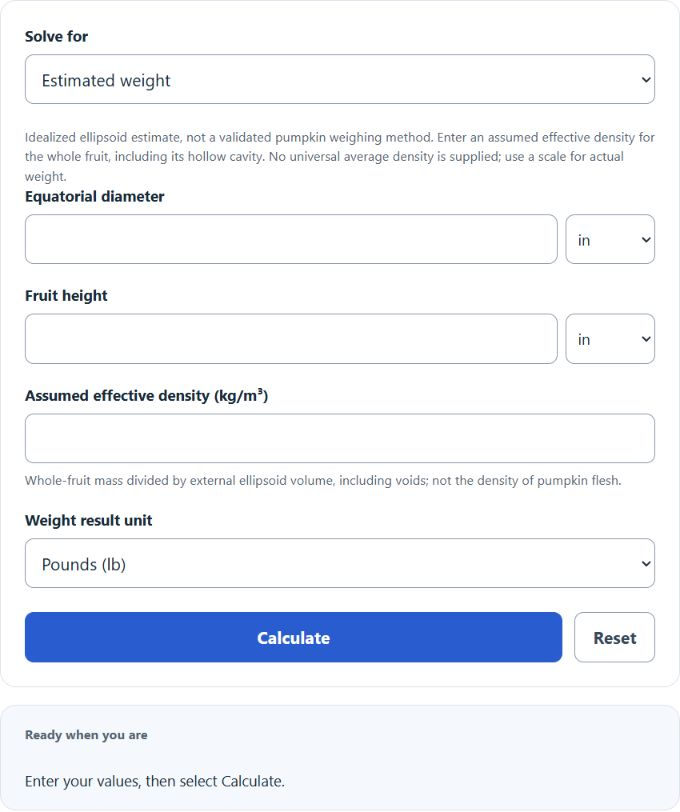
Estimate pumpkin weight, diameter or height with an idealized ellipsoid model and a user-supplied effective whole-fruit density. Select the value to solve and enter the other two measurements plus the density assumption.
Related Calculators
- Potato Yield Calculator
- Servings Calculator
- 30 Minutes Per Pound Calculator
- Cost Per Serving Calculator
- All Food and Cooking Calculators
Pumpkin Weight Formula
The following formula is used to estimate the weight of a pumpkin by approximating it as an ellipsoid and using a user-supplied effective density. This model is not a validated pumpkin weighing method; fruit shape and hollow space can cause substantial error.
Variables:
- W is the estimated weight of the pumpkin (lbs)
- D is the diameter of the pumpkin (inches)
- H is the height of the pumpkin (inches)
- ρ is the assumed effective whole-fruit density, including its cavity. The inch-pound formula uses lb/in³; the calculator accepts kg/m³ and converts dimensions and mass consistently. No universal pumpkin density is supplied.
To estimate the weight of a pumpkin, compute the ellipsoid volume V ≈ (π/6)·D2·H (in³), then multiply by the assumed density ρ to convert volume to weight.
What is a Pumpkin Weight?
A pumpkin weight refers to the mass or heaviness of a pumpkin. This can vary greatly depending on the type of pumpkin and its size. Variety, external shape and hollow space affect mass. The Great Pumpkin Commonwealth uses over-the-top measurements and fitted charts for its separate weight estimates; this calculator does not implement that method. A scale is needed to determine actual weight.
How to Calculate Pumpkin Weight?
The following steps outline how to estimate Pumpkin Weight using the formula: W ≈ (π/6)·D2·H·ρ
- First, choose Estimated weight and determine the equatorial diameter (D) and an effective whole-fruit density assumption. Use inches for this hand-calculation formula or the corresponding units in the calculator.
- Next, determine the fruit height (H), excluding the stem, in inches for the hand calculation.
- Next, square the diameter of the pumpkin (D2).
- Next, multiply the squared diameter (D2) by the height (H).
- Multiply the result by π/6 to estimate the pumpkin’s volume as an ellipsoid (in³).
- Finally, multiply by the assumed density (ρ) to estimate the weight (W).
- After inserting the values for D and H into the formula and performing the calculations, check your answer with the calculator above.
Example Problem:
Use the following variables as an example problem to test your knowledge.
Diameter of the pumpkin (D) = 10 inches
Height of the pumpkin (H) = 8 inches
For illustration only, assume effective density 900 kg/m³ (0.90 g/cm³, about 0.03251456 lb/in³). The model gives W ≈ 13.62 lb. This hypothetical density is not an established pumpkin average; weigh the fruit for its actual mass.