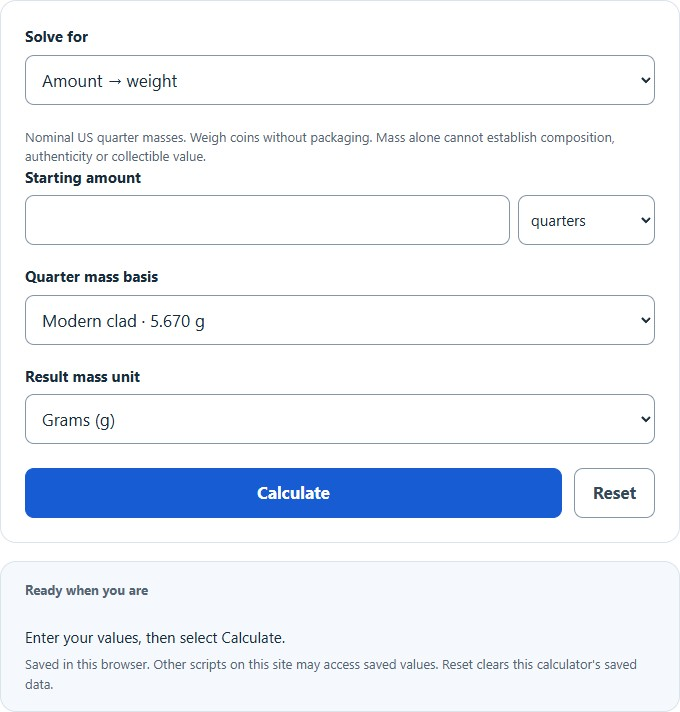
Calculate quarter weight from coins, dollars, rolls, or boxes, reverse-estimate face value from a scale, and compare clad and silver weights.
Related Calculators
- Barbed Wire Weight Calculator
- Polystyrene Weight Calculator
- Loader Bucket Capacity Calculator
- Price Per Meter Calculator
- All Construction Calculators
Quarter Weight Formula
- N = number of quarters
- w = weight per quarter in grams (5.670 g modern clad, 6.250 g standard 90% silver)
- Amount = your input value (dollars, quarters, rolls, or boxes)
- k = conversion factor: 4 (dollars), 1 (quarters), 40 (rolls), 2,000 ($500 boxes)
For the reverse mode, divide the scale weight in grams by w to estimate the count, then multiply by $0.25 for face value. These are nominal mass estimates, with packaging excluded. Wear can reduce mass; dirt and wrappers can increase a scale reading. Scale error and mint tolerances also affect a count inferred from weight. Average mass alone does not identify a coin’s composition or authenticity.
Reference Tables
Use these as quick checks against the calculator output.
| Quantity | Face Value | Modern (g) | Modern (lb) | Silver (lb) |
|---|---|---|---|---|
| 1 quarter | $0.25 | 5.67 | 0.0125 | 0.0138 |
| 1 roll (40) | $10.00 | 226.8 | 0.50 | 0.55 |
| $100 | $100.00 | 2,268 | 5.00 | 5.51 |
| 1 box (2,000) | $500.00 | 11,340 | 25.0 | 27.6 |
| $1,000 | $1,000.00 | 22,680 | 50.0 | 55.1 |
| Quarter Type | Years | Weight | Composition |
|---|---|---|---|
| Modern clad | 1965–present | 5.670 g | Cu-Ni clad on Cu core |
| Silver Washington | 1932–1964 | 6.250 g | 90% Ag, 10% Cu |
| Silver proof (90%) | 1992–2018 | 6.250 g | 90% Ag, 10% Cu |
| 99.9% silver proof reference | 2019 onward | 6.343 g | 99.9% Ag; verify the issue specification |
Worked Example
You have a bag that weighs 4.5 lb on a kitchen scale and you want to know what it is worth in modern quarters.
- Convert: 4.5 lb × 453.59237 = 2,041.165665 g
- Divide by per-coin weight: 2,041.16 ÷ 5.670 = 360.0 quarters
- Face value: 360 × $0.25 = $90.00 (nine full rolls)
Why your scale reading might be off: packaging, wear, dirt, mixed coin types and scale uncertainty can change the reading. Subtract the measured container/wrapper mass and check the scale. The reported residual is measured mass minus rounded count times the selected nominal coin mass; it is not a universal acceptance tolerance.
Can you spot silver quarters by weight? Mass can support a preliminary comparison, but cannot by itself establish composition or authenticity. A standard 6.250 g silver quarter is nominally 0.580 g heavier than a 5.670 g clad quarter: 40 coins are 250.0 g versus 226.8 g. A 6.343 g silver-proof reference gives 253.72 g for 40 coins. Inspect the issue, markings and other evidence independently.