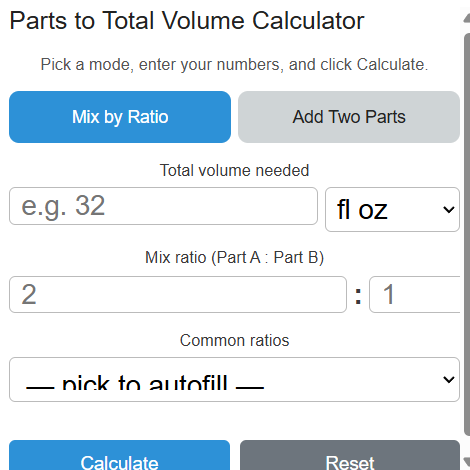
Split a target volume by a two- or multi-part ratio, or calculate total and remaining component volumes from one known amount.
Related Calculators
- Bin Volume Calculator
- Inches To Liters Calculator
- Liquid Volume Calculator
- mg/l to lb/gal Converter
- All Unit Converters
Ratio To Volume Formula
Ratio-to-volume calculations are used to find the total amount of a mixture or to split a known total into individual parts. For a two-part mixture, the total volume is the sum of Part A and Part B.
If the total volume and one part are known, the missing part is found by subtraction.
| Symbol | Meaning |
|---|---|
| TV | Total volume of the mixture |
| A | Volume of Part A |
| B | Volume of Part B |
When a Ratio Is Known Instead of the Actual Volumes
Many mixing problems start with a ratio such as 3:2, 4:1, or 7:3 rather than the actual volumes. In that case, first convert the ratio into shares of the total volume.
Here, r:s is the ratio of Part A to Part B. This approach is useful for recipes, concentrates, cleaning solutions, paint mixtures, fertilizer dilution, beverage blending, and other two-part mixtures.
How to Calculate Ratio to Volume
- Make sure both parts use the same unit of volume.
- If you already know the two part volumes, add them to get the total volume.
- If you know the total volume and one part, subtract to find the missing part.
- If you only know a ratio and a total volume, add the ratio parts together to get total shares.
- Multiply the total volume by each part’s share of the ratio.
Example
Suppose a mixture has a total volume of 40 liters and the ratio of Part A to Part B is 3:1. The ratio contains 4 total shares, so Part A gets 3 of those shares and Part B gets 1.
So the mixture contains 30 liters of Part A and 10 liters of Part B.
Quick Reference
| If you know | Use this relationship |
|---|---|
| Part A and Part B | TV = A + B |
| Total volume and Part B | A = TV - B |
| Total volume and Part A | B = TV - A |
| Total volume and ratio r:s | A = TV × (r) / (r + s), B = TV × (s) / (r + s) |
Common Mistakes
- Mixing units: Do not combine liters with gallons or cubic feet without converting first.
- Using ratio numbers as direct volumes: A ratio of 2:1 does not mean 2 units and 1 unit unless the total is 3 units.
- Forgetting total shares: In a ratio of 5:3, the denominator is 8 total shares, not 3.
- Subtracting the wrong part: When solving for a missing component, subtract the known part from the total volume.
Extending the Idea to More Than Two Parts
The same concept can be used for mixtures with three or more components. Each part receives a fraction of the total based on its share of the full ratio.
This means each component volume equals the total volume multiplied by that component’s ratio value divided by the sum of all ratio values.
Practical Notes
- Use the same volume unit throughout the calculation for accurate results.
- For everyday mixing and planning, the total volume is typically treated as the sum of the component volumes.
- Ratios are dimensionless, but the final answers always take the unit of the total volume you start with.
- If you are scaling a mixture up or down, keep the ratio constant so the composition stays the same.