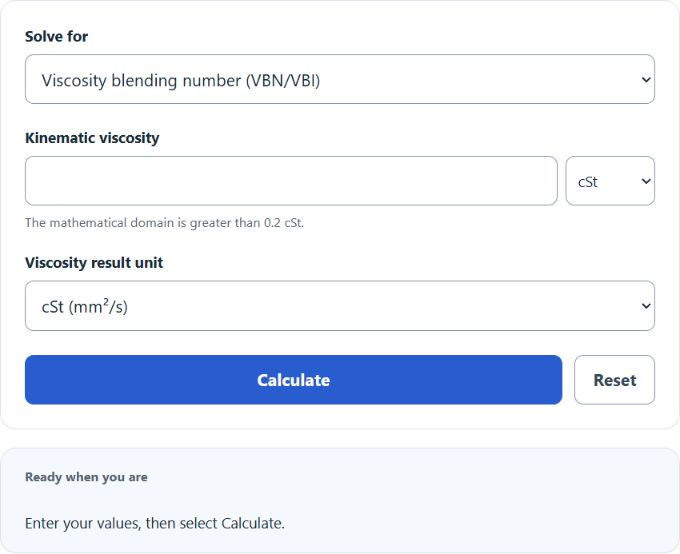
Convert kinematic viscosity in cSt, St, or m²/s to VBI/VBN, or calculate viscosity from a VBI/VBN value using the Refutas equation.
Refutas Equation Formula
The Refutas equation converts kinematic viscosity into a viscosity blending number, also called VBN or VBI. The inverse equation converts VBN/VBI back into kinematic viscosity.
Unit conversions used before or after the Refutas equation:
- VBN or VBI = viscosity blending number or viscosity blending index, dimensionless
- ν = kinematic viscosity in centistokes, cSt, for the Refutas equation
- ln = natural logarithm
- e = Euler’s number
- cSt = centistokes, numerically equal to mm²/s
- St = stokes
- m²/s = square meters per second
Choose the value to solve. For VBN/VBI, enter kinematic viscosity; the calculator first converts it to cSt. For viscosity, enter VBN/VBI; the calculator uses the inverse Refutas equation. The calculated viscosity can then be shown in cSt, St, or m²/s.
The Refutas equation requires kinematic viscosity greater than 0.2 cSt because the double logarithm must be defined.
Common Kinematic Viscosity Unit Conversions
| Unit | Equivalent in cSt | Notes |
|---|---|---|
| 1 cSt | 1 cSt | Same as 1 mm²/s |
| 1 St | 100 cSt | Used less often than cSt |
| 1 m²/s | 1,000,000 cSt | SI base-area unit form |
Typical VBN Values for Selected Viscosities
| Kinematic Viscosity | Approximate VBN/VBI | Interpretation |
|---|---|---|
| 1 cSt | 3.25 | Very low viscosity |
| 10 cSt | 23.57 | Light oil range |
| 100 cSt | 33.20 | Higher viscosity oil |
| 1,000 cSt | 39.07 | Very viscous fluid |
Refutas Equation Examples
Example 1: Convert kinematic viscosity to VBN
You have a kinematic viscosity of 100 cSt.
The viscosity blending number is about 33.20.
Example 2: Convert VBN to kinematic viscosity
You have a VBN of 23.53.
The kinematic viscosity is about 9.92 cSt.
Refutas Equation Calculator FAQ
What is the Refutas equation used for?
The Refutas equation is used to transform kinematic viscosity into a viscosity blending number. This is useful because viscosity does not blend linearly. The transformed VBN values can be used in blending calculations more easily than raw viscosity values.
Is VBN the same as VBI?
In this context, VBN and VBI refer to the same type of Refutas viscosity blending value. Both are dimensionless values calculated from kinematic viscosity.
Why must viscosity be greater than 0.2 cSt?
The equation contains ln(ln(ν + 0.8)). For this to be valid, the inside logarithm must be positive. That requires ν + 0.8 > 1, so ν > 0.2 cSt.