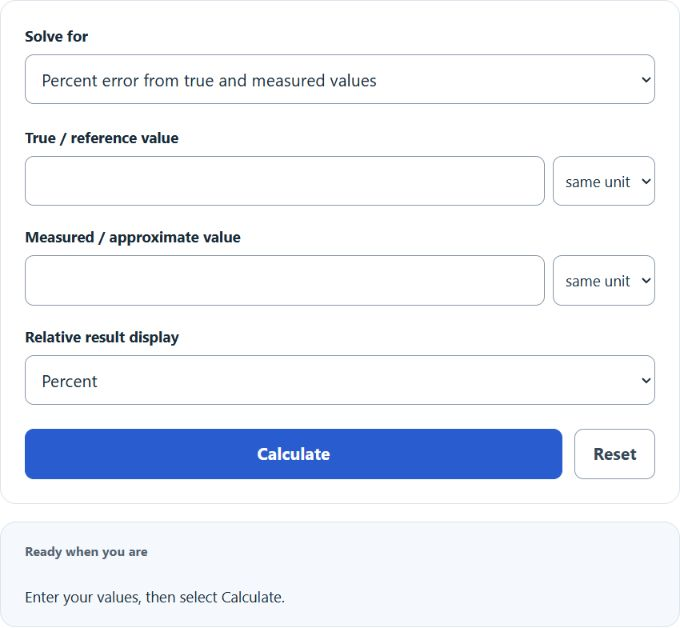
Calculate relative accuracy, percent error, and measurement differences from actual and measured values, including an EPA-style RATA statistical estimate. The RATA mode uses the reference mean and user-selected thresholds; it does not establish regulatory compliance.
Related Calculators
- RPD (Relative Percent Difference) Calculator
- RSD – Relative Standard Deviation Calculator
- Similarity Index Calculator
- Z-Score Calculator
- All Statistics Calculators
Relative Accuracy Formula
The following formula is used to calculate the relative error (percent error), often labeled RA:
Variables:
- RA is the relative error / percent error (%)
- TV is the true value
- AV is the approximate (measured) value
To calculate RA, take the absolute difference between the true value and the approximate value, divide by the absolute value of the true value, and then multiply by 100 to get a percentage. (If the true value is 0, the relative error is undefined.)
What is Relative Accuracy?
Relative accuracy (RA), as computed on this page, is a relative error measure of how close an approximate or measured value is to the true value, expressed as a percentage. Smaller RA values indicate the measurement is closer to the true value (RA = 0% is a perfect match). This is commonly used in engineering and science to quantify measurement accuracy (closeness to a true value), not measurement precision (repeatability).
How to Calculate Relative Accuracy?
The following steps outline how to calculate the Relative Accuracy.
- First, determine the true value (TV).
- Next, determine the approximate value (AV).
- Use the formula RA = |(TV – AV) / TV| * 100% to calculate the relative error (percent error).
- Finally, interpret RA as a percentage (smaller percentages mean closer to the true value).
- After inserting the variables and calculating the result, check your answer with the calculator above.
Example Problem:
Use the following variables as an example problem to test your knowledge.
True Value (TV) = 100
Approximate Value (AV) = 95