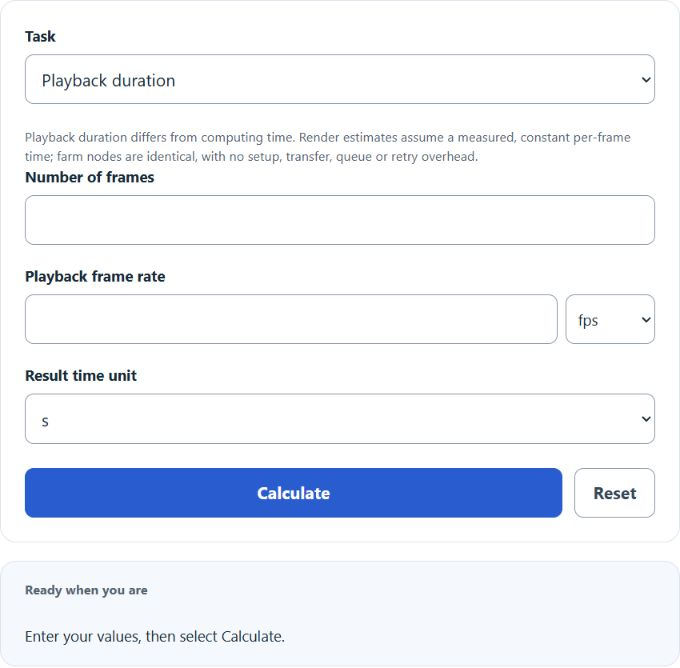
Estimate render time, finish time, and render farm cost from frame count, frame rate, per-frame time, parallel nodes, and node-hour pricing.
Render Time Formula
The following formula is used to estimate the total render time for a sequence when you know the number of frames and the average time to render one frame:
Variables:
- RT is the total render time for all frames
- F is the number of frames in the sequence
- T is the time taken to render one frame (average)
- R is the frame rate (frames per second) used to convert between playback duration and frames (optional)
To calculate the total render time, multiply the number of frames by the average time taken to render one frame. If you only know the finished video duration D and the frame rate R, first compute the frame count with F = D × R, then use RT = F × T.
What is a Render Time?
Render time refers to the amount of time it takes for a computer or software to process and generate a final output from raw data. This term is commonly used in the field of computer graphics, video editing, and animation. The render time can vary greatly depending on several factors, such as the complexity of the data, the processing power of the computer, the efficiency of the software, and the desired quality of the output. For instance, rendering a high-resolution, feature-length 3D animation with lots of special effects would require a significant amount of processing power and time. On the other hand, rendering a short, low-resolution 2D animation would be much quicker. Therefore, optimizing render times is a crucial aspect of managing workflows in graphics-intensive fields.
How to Calculate Render Time?
Select the task in the calculator: playback conversion, serial rendering, or farm timing. Playback duration is not computing time. Farm timing assumes identical nodes and constant frame times with no queue, setup, transfer, or retry overhead; cost covers active node-hours only. The following steps describe the serial estimate.
- Determine the number of frames to be rendered (F).
- Determine the average time to render one frame (T) (for example, render a test and compute T = (end − start) / frames rendered).
- Calculate the total render time with RT = F × T.
- If you measured a completed render directly, the total render time is simply end − start.
- After inserting the variables and calculating the result, check your answer with the calculator above.
Example Problem:
Use the following variables as an example problem to test your knowledge.
Start time (seconds) = 10
End time (seconds) = 30
Number of frames rendered = 100
Total render time = 30 − 10 = 20 seconds. Average per-frame time = 20 / 100 = 0.2 seconds per frame.