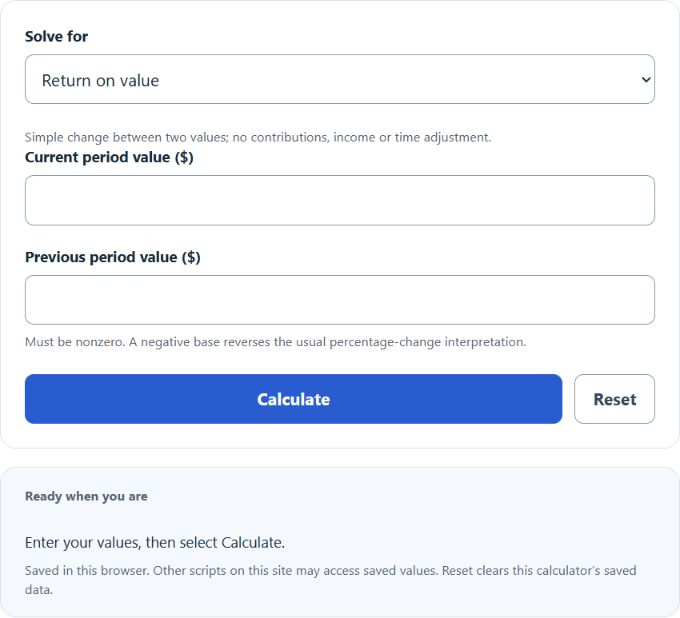
Select return on value, current period value or previous period value, then enter the two requested amounts. This is an unadjusted percentage change, not a total or annualized investment return.
Return on Value Formula
The return on value formula measures the percentage gain or loss from the previous period value to its current period value.
To solve for current period value:
To solve for previous period value:
- ROV = Return on value, expressed as a percentage
- CV = Current period value, in dollars
- PV = Previous period value, in dollars
Select the value to solve, then enter the requested values. The previous value must be nonzero. At −100% ending at zero, the previous-value inverse is not unique. A negative previous value reverses the usual gain/loss sign interpretation. No dividends, fees or interim cash flows are included. If you enter current period value and previous period value, it calculates the return percentage. If you enter previous period value and return percentage, it calculates the current period value. If you enter current period value and return percentage, it calculates the previous period value.
Return on Value Result Guide
Use this table to interpret the percentage result from the calculation.
| Return on Value | Meaning | Example |
|---|---|---|
| Positive return | The current period value is higher than the previous period value. | Previous value $2.00, current value $3.00 |
| 0% | The current period value equals the previous period value. | Previous value $2.00, current value $2.00 |
| Negative return | The current period value is lower than the previous period value. | Previous value $2.00, current value $1.50 |
Common Return Percentages
| Previous Period Value | Current Period Value | Return on Value |
|---|---|---|
| $1.00 | $0.50 | -50% |
| $1.00 | $1.00 | 0% |
| $1.00 | $1.50 | 50% |
| $1.00 | $2.00 | 100% |
| $1.00 | $3.00 | 200% |
Example
Example 1: Calculate return on value
A value increased from $2.50 in the previous period to $4.00 in the current period.
The return on value is 60%.
Example 2: Calculate current period value
The previous period value was $1.80 and the return on value is 25%.
The current period value is $2.25.
FAQ
What does return on value mean?
Return on value is the percentage gain or loss between a nonzero previous period value and a current period value. A positive percentage means the value has increased from a positive previous value. A negative percentage means the value has decreased from a positive previous value.
Can return on value be negative?
Yes. If the current period value is less than the previous period value, the result is negative. For example, if the previous period value was $2.00 and the current period value is $1.00, the return is -50%.
Is return on value the same as dollar change?
No. Return on value is a percentage. Dollar change is an amount; it is profit only when the amounts actually represent a purchase and comparable sale value. For example, if the previous period value was $2.00 and the current period value is $3.00, the dollar change is $1.00 and the return on value is 50%.