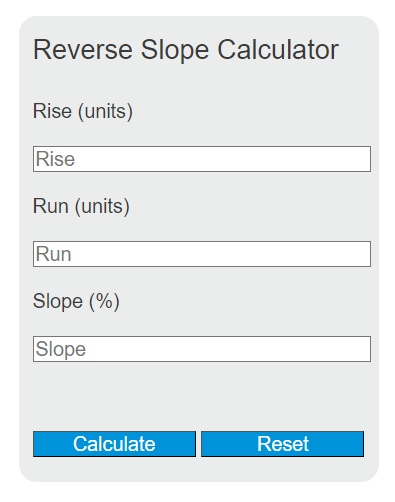
Enter the rise and run into the calculator to determine the slope. A reverse slope is indicated by a negative slope value (meaning the surface falls in your chosen “positive” reference direction). This calculator can also solve for a missing variable when enough other variables are provided (at least one must be a length).
- All Math and Numbers Calculators
- Ditch Slope Calculator
- Fence Slope Calculator
- Gradient To Slope Calculator
Reverse Slope Formula
The reverse slope calculator converts vertical change and horizontal distance into a slope percentage. In grading and drainage work, a reverse slope usually means the surface falls opposite the intended direction of flow or away from the expected grade. The calculation itself is straightforward: divide the rise by the run, then convert the result to a percent.
- S = slope or grade, expressed as a percent
- R = rise, fall, or total vertical change
- Ru = run, or horizontal distance
If rise and run are measured in the same unit, the units cancel out. That means you can use feet, inches, meters, or centimeters as long as both inputs use the same unit system.
Useful Rearrangements
If you know the slope and need to solve for rise or run, these forms are helpful:
If you need the slope as an angle instead of a percent grade, use:
How to Calculate Reverse Slope
- Measure the vertical change of the surface.
- Measure the horizontal run over which that change occurs.
- Divide rise by run.
- Multiply by 100 to convert the ratio to a percent grade.
- Interpret the direction based on your project reference line. If the surface falls opposite the intended direction, it is considered a reverse slope.
When sign convention matters, some users record a descending reverse slope as a negative grade. Others report only the magnitude and describe the direction separately. Either approach can work as long as it is consistent with the drawing, plan set, or field notes.
Example
If the rise is 5 units and the run is 20 units, the slope is:
A 25% slope means the surface changes 25 units vertically for every 100 units of horizontal distance. If that change is opposite the intended drainage direction, it would be interpreted as a 25% reverse slope.
How to Read the Result
| Result | Meaning |
|---|---|
| 0% | Perfectly flat surface with no vertical change |
| Less than 10% | Generally a gentle grade |
| 10% to 50% | Moderate to steep slope depending on the application |
| 100% | Rise equals run, which corresponds to a 45° line |
| Greater than 100% | Very steep grade where vertical change exceeds horizontal distance |
Where Reverse Slope Calculations Are Commonly Used
- Site grading: checking whether a yard, pad, or embankment drains in the intended direction
- Sidewalks and patios: confirming surfaces do not send water back toward a structure
- Roofing: identifying areas that may trap or redirect water
- Road and driveway design: evaluating transitions, crowns, and drainage paths
- Drainage systems: verifying trenches, swales, and channels maintain proper fall
- Landscape construction: checking retaining areas, planter edges, and hardscape surfaces
Common Input Mistakes
- Mixing units: using inches for rise and feet for run without converting first
- Confusing percent grade with degrees: a 25% slope is not the same as 25°
- Using sloped length instead of horizontal run: run must be horizontal distance, not surface distance
- Ignoring direction: the calculator gives magnitude, but field interpretation determines whether the slope is reverse
- Entering a run of zero: slope is undefined when horizontal distance is zero
Quick Conversion Note
Percent slope and slope ratio are closely related. A slope of 25% means:
So the surface changes 1 unit vertically for every 4 units horizontally.
Practical Tips
- Measure over a long enough run to reduce small field errors.
- Use the same reference points for both rise and run.
- For drainage checks, verify both the amount of slope and the direction of flow.
- On plans, label whether the value is a standard grade, negative grade, or reverse slope to avoid confusion.
Reverse Slope FAQ
Is reverse slope the same as negative slope?
A reverse slope is often represented as a negative slope relative to a chosen direction, but in practice the term usually emphasizes that the surface falls the wrong way or opposite the intended flow path.
Can slope be greater than 100%?
Yes. A slope above 100% means the vertical change is larger than the horizontal run.
Why is horizontal run used instead of sloped length?
Percent grade is defined from vertical change divided by horizontal distance. Using the sloped surface length will produce the wrong result.
What happens if the run is zero?
The slope is undefined because division by zero is not possible.