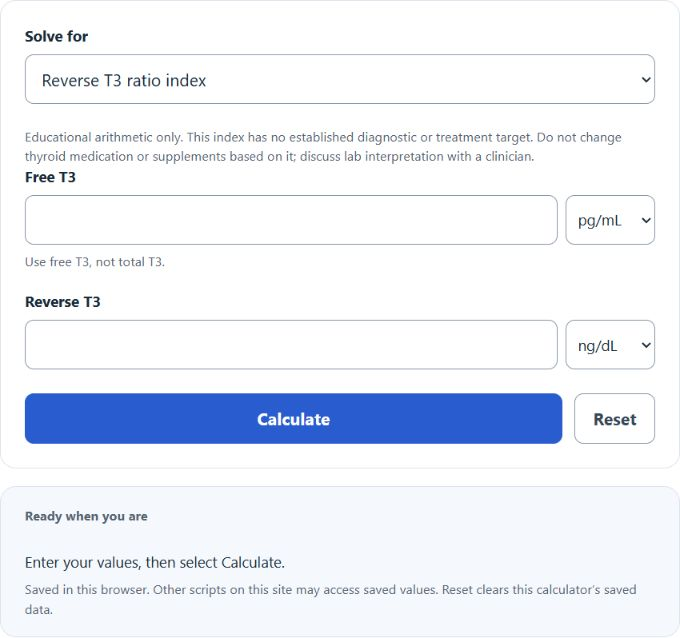
Choose the ratio mode to calculate the Reverse T3 Ratio (FT3/rT3 × 100), or an inverse mode to calculate FT3 or rT3 for an entered index. Select the units shown on your lab report; the calculator converts supported units automatically.
Medical disclaimer: This calculator is for educational purposes only and is not a diagnostic tool. Do not start, stop, or change thyroid medication or supplements based on this value—discuss thyroid symptoms and lab interpretation with a licensed clinician.
Clinical limitations (important)
The “Reverse T3 ratio” (FT3/rT3 × 100) is not a universally standardized diagnostic measure, and there are no universally agreed reference ranges or treatment targets. Thyroid evaluation is typically guided by clinical context and guideline-based labs (often centered on TSH and, when appropriate, free T4), plus your lab’s own reference ranges and units.
Lab methods, reference intervals, and units can vary. Always confirm the units on your lab report, and consider checking major endocrinology society guidance (and your clinician’s recommendations) for how thyroid tests are used in routine care.
- All Health and Medical Calculators
- TSH Calculator
- T3/T4 Ratio Calculator
- Free Testosterone Level Calculator
- Free Androgen Index Calculator
Reverse T3 Ratio Formula
The reverse T3 ratio compares free T3 (FT3) with reverse T3 (rT3). This calculator standardizes the inputs first and then computes the ratio so results stay consistent across the supported unit formats. Because the value is multiplied by 100, the output is best viewed as an index-style result rather than a literal percent.
- RTR = reverse T3 ratio
- FT3 = free T3 value used in the calculation
- rT3 = reverse T3 value used in the calculation
For this formula, the usual calculation convention is:
- FT3 in pg/mL
- rT3 in ng/dL
If your report uses a different unit system, select the matching unit beside each value. The calculator converts the supported units to FT3 in pg/mL and rT3 in ng/dL before applying the formula.
Common Unit Conversions
| Conversion | Rule |
|---|---|
| FT3 from ng/L to pg/mL | FT3pg / mL = FT3ng / L |
| FT3 from pmol/L to pg/mL | FT3pg / mL ≈ (FT3pmol / L) / (1.536) |
| rT3 from ng/L to ng/dL | rT3ng / dL = (rT3ng / L) / (10) |
| rT3 from pmol/L to ng/dL | rT3ng / dL ≈ (rT3pmol / L) / (15.36) |
These conversion factors are rounded for practical use, so very small differences can appear when compared with a lab system that carries more decimal places.
How to Calculate the Reverse T3 Ratio
- Find your free T3 result on the lab report.
- Find your reverse T3 result on the same report.
- Confirm each unit before entering the values.
- Select the units shown on the report; conversion is automatic.
- Select Calculate. Ratio mode divides FT3 by rT3 and multiplies by 100; inverse modes rearrange the same equation using an entered index and the other hormone value.
Example
If free T3 is 3.5 pg/mL and reverse T3 is 15 ng/dL, the ratio is:
How to Read the Result
- A lower ratio can happen when FT3 is lower, rT3 is higher, or both.
- A higher ratio can happen when FT3 is higher, rT3 is lower, or both.
- The ratio summarizes the relationship between two lab values; it does not explain the cause of the pattern.
- Interpretation depends on clinical context, reference intervals, symptoms, medication use, illness, and the rest of the thyroid panel.
Common Input Mistakes
- Entering total T3 instead of free T3.
- Selecting a unit that does not match the lab report.
- Comparing results from different labs as though the measurement methods were identical.
- Trying to interpret the ratio by itself without considering TSH, free T4, symptoms, and treatment history.
Clinical Context Matters
The reverse T3 ratio is a derived calculation, not a standalone diagnosis. The inverse modes are algebraic calculations for an entered index; they do not identify hormone levels to aim for or guide treatment. Review lab values alongside the rest of the thyroid workup and the patient’s overall clinical picture. Use the calculator as an educational tool and discuss any concerns about symptoms, abnormal lab values, or medication changes with a qualified clinician.