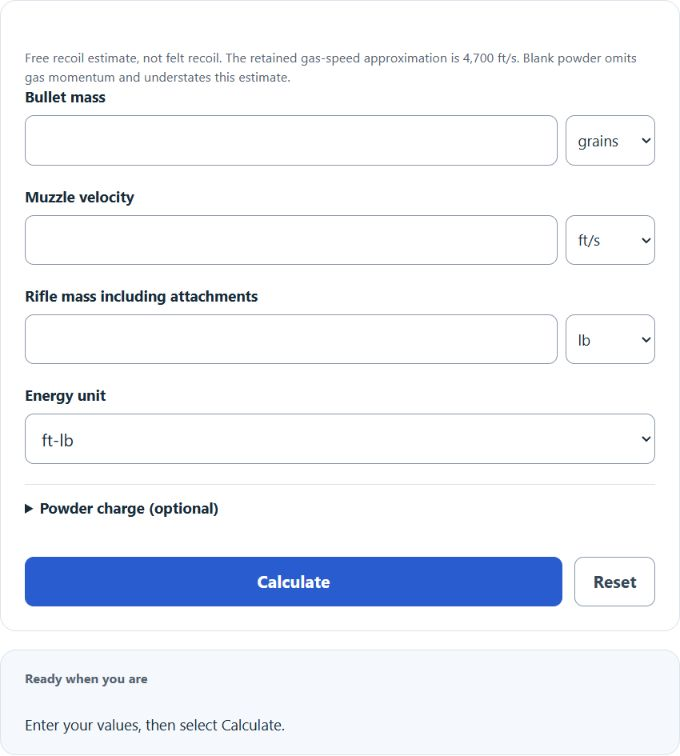
Calculate rifle free recoil energy from bullet weight, optional powder charge, muzzle velocity, and gun weight in foot-pounds or joules.
Related Calculators
- Muzzle Energy Calculator
- Gun Recoil Force Calculator
- Bullet Energy Calculator
- Muzzle Velocity Calculator
- Ballistic Drop Calculator
- MOA Calculator
- All Sports and Fitness Calculators
Rifle Recoil Formula
The calculator estimates free recoil energy. This is the energy the rifle would move rearward with before effects from your body, stock fit, recoil pads, muzzle brakes, suppressors, or gas operation.
- REft-lb = recoil energy in foot-pounds
- REJ = recoil energy in joules
- Wb = bullet weight in pounds, after converting from grains or grams
- Vb = muzzle velocity in feet per second
- Wp = powder charge weight in pounds, after converting from grains or grams
- Vg = powder gas velocity, using the retained fixed 4,700 fps approximation; actual gas velocity varies and SAAMI uses 1.75 times muzzle velocity for high-powered rifles
- Wg = rifle weight in pounds
- g = 32.174 ft/s²
The calculator first converts all inputs to base units: grains, feet per second, and pounds. Bullet and powder weights are then converted from grains to pounds by dividing by 7,000.
If you leave the powder charge blank, the calculator treats powder weight as 0. This can be useful when powder data is unknown, but it will usually understate recoil because powder gas contributes to recoil.
The result is calculated in foot-pounds first. If you select joules, the calculator converts the result using 1 ft-lb = 1.3558179483 J.
Recoil Energy Reference Ranges
These are illustrative qualitative bands, not validated thresholds for comfort or safety. Felt recoil can change a lot based on rifle shape, recoil pad, shooting position, muzzle device, and how the rifle fits you.
| Free recoil energy | Approx. joules | General feel |
|---|---|---|
| Under 5 ft-lb | Under 6.8 J | Very light |
| 5 to 10 ft-lb | 6.8 to 13.6 J | Light |
| 10 to 15 ft-lb | 13.6 to 20.3 J | Moderate |
| 15 to 25 ft-lb | 20.3 to 33.9 J | Firm |
| Over 25 ft-lb | Over 33.9 J | Heavy |
Input Unit Conversions
| Input | Conversion used |
|---|---|
| Bullet or powder weight | 1 gram = 15.4323584 grains |
| Weight in grains | 1 pound = 7,000 grains |
| Muzzle velocity | 1 m/s ≈ 3.280839895 ft/s |
| Rifle weight | 1 kg = 2.20462262185 lb |
| Recoil energy | 1 ft-lb = 1.3558179483 J |
Example Problems
Example 1: Recoil energy in foot-pounds
Suppose you enter these values:
- Bullet weight: 150 grains
- Powder charge weight: 45 grains
- Muzzle velocity: 2,800 fps
- Rifle weight: 8 lb
Convert bullet and powder weight to pounds:
- 150 ÷ 7,000 = 0.021429 lb
- 45 ÷ 7,000 = 0.006429 lb
Apply the recoil formula:
The result is about 15.81 ft-lb, or about 21.44 J.
Example 2: Metric inputs
Suppose you enter these values:
- Bullet weight: 10 grams
- Powder charge weight: 3 grams
- Muzzle velocity: 800 m/s
- Rifle weight: 4 kg
The calculator converts the inputs to its base units first:
- 10 g = 154.3236 grains
- 3 g = 46.2971 grains
- 800 m/s = 2,624.672 fps
- 4 kg = 8.8185 lb
Using those converted values, the result is about 13.94 ft-lb, or about 18.90 J.
FAQ
What is free recoil energy?
Free recoil energy is a calculated value for the rearward energy of the rifle after firing. It is based on bullet weight, powder charge, muzzle velocity, and rifle weight. It is not the same as felt recoil. Felt recoil also depends on stock design, recoil pad, stance, rifle fit, action type, and muzzle devices.
What should I enter if I do not know the powder charge?
You can leave the powder field blank or enter 0. The calculator will still run, but the result will usually be lower than the true free recoil estimate. Powder gas has momentum, so it adds to recoil.
Why does a heavier rifle have less recoil energy?
Rifle weight is in the denominator of the formula. If bullet weight, powder charge, and velocity stay the same, increasing rifle weight lowers free recoil energy. This is why a heavier rifle often feels softer with the same load.