Calculate rise time from damped or natural frequency and damping ratio, plus bandwidth, settling time, overshoot, frequency, and period.
- Natural Frequency Calculator
- Angular Frequency Calculator
- All Physics Calculators
- Length To Frequency Calculator
Rise Time Formula
For a standard underdamped second‑order system (0 < ζ < 1) responding to a unit step input, the 0–100% rise time (first time the response reaches the final value) depends on the damping ratio.
- Where tr is the rise time (0–100%, first crossing)
- ζ is the damping ratio (dimensionless)
- ωd is the damped natural frequency (rad/s), where ωd = ωn√(1 − ζ²)
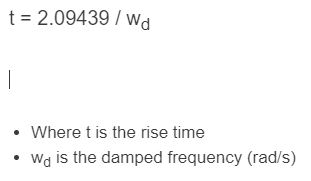
If you assume ζ = 0.5, then (π − φ) ≈ 2.09439 and the formula simplifies to tr ≈ 2.09439 / ωd.
Rise Time Definition
Rise time is the time required for a signal to transition from one specified low value to a specified high value. In electronics, it is commonly measured from 10% to 90% of the final value, while in control-system step-response analysis (especially for underdamped 2nd‑order systems) a “0–100%” rise time is often defined as the first time the response reaches the final value.
Rise Time Example
How to calculate rise time?
- First, determine ωn and ζ (or use the Second-order response mode).
For an underdamped second-order unit-step response, identify the natural frequency ωn and damping ratio ζ (0 < ζ < 1).
- Finally, compute the rise time from ωd and ζ.
Compute ωd = ωn√(1 − ζ²), then use tr = (π − φ) / ωd with φ = arctan(√(1 − ζ²)/ζ). (If you assume ζ = 0.5, you can use tr ≈ 2.09439/ωd.)
FAQ
Rise time is the time it takes for a signal to transition from a specified low level to a specified high level. A common electronics definition is 10–90% of the final value, while some control-system texts define a 0–100% rise time for an underdamped second-order step response as the first time the response reaches the final value.
For an underdamped second-order system, the damped natural frequency (angular) is ωd = ωn√(1 − ζ²) in rad/s. The corresponding frequency in Hz is fd = ωd/(2π).