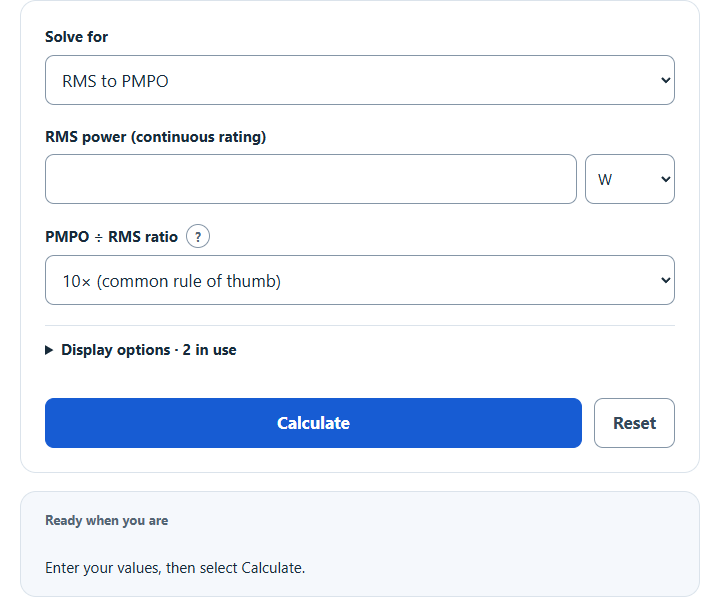
Convert RMS to PMPO watts, or PMPO to RMS, using a 10× rule-of-thumb ratio or your own, or find the ratio between two published power ratings.
| RMS to PMPO | PMPO to RMS |
|---|---|
| 2 W RMS = 20 W PMPO | 50 W PMPO = 5 W RMS |
| 5 W RMS = 50 W PMPO | 75 W PMPO = 7.5 W RMS |
| 10 W RMS = 100 W PMPO | 100 W PMPO = 10 W RMS |
| 15 W RMS = 150 W PMPO | 150 W PMPO = 15 W RMS |
| 20 W RMS = 200 W PMPO | 200 W PMPO = 20 W RMS |
| 25 W RMS = 250 W PMPO | 250 W PMPO = 25 W RMS |
| 30 W RMS = 300 W PMPO | 300 W PMPO = 30 W RMS |
| 35 W RMS = 350 W PMPO | 400 W PMPO = 40 W RMS |
| 40 W RMS = 400 W PMPO | 500 W PMPO = 50 W RMS |
| 50 W RMS = 500 W PMPO | 600 W PMPO = 60 W RMS |
| 60 W RMS = 600 W PMPO | 800 W PMPO = 80 W RMS |
| 75 W RMS = 750 W PMPO | 1000 W PMPO = 100 W RMS |
| 80 W RMS = 800 W PMPO | 1200 W PMPO = 120 W RMS |
| 100 W RMS = 1000 W PMPO | 1500 W PMPO = 150 W RMS |
| 120 W RMS = 1200 W PMPO | 2000 W PMPO = 200 W RMS |
| 150 W RMS = 1500 W PMPO | 2500 W PMPO = 250 W RMS |
| 200 W RMS = 2000 W PMPO | 3000 W PMPO = 300 W RMS |
| 300 W RMS = 3000 W PMPO | 4000 W PMPO = 400 W RMS |
| 500 W RMS = 5000 W PMPO | 5000 W PMPO = 500 W RMS |
| 1000 W RMS = 10000 W PMPO | 10000 W PMPO = 1000 W RMS |
| Hypothetical example: CF = 10, not a standard. | |
| RMS to PMPO | PMPO to RMS |
|---|---|
| 40 W RMS = 480 W PMPO | 500 W PMPO = 41.667 W RMS |
| 60 W RMS = 720 W PMPO | 1000 W PMPO = 83.333 W RMS |
| 80 W RMS = 960 W PMPO | 1500 W PMPO = 125 W RMS |
| 100 W RMS = 1200 W PMPO | 3000 W PMPO = 250 W RMS |
| 150 W RMS = 1800 W PMPO | 5000 W PMPO = 416.667 W RMS |
| Hypothetical example: CF = 12, not a standard. | |
RMS to PMPO Formula
- PMPO = Peak Music Power Output (W)
- RMS = Root Mean Square continuous power (W)
- CF = Conversion factor (dimensionless); no industry standard exists
Why a Universal CF Cannot Be Assumed
Published rating pairs differ substantially even within one manufacturer. Philips lists 145 W RMS and 2,000 W PMPO for the FWM211/55, while its MMS2550B/94 lists 28 W RMS and 2,500 W PMPO. Their ratios are about 13.79 and 89.29 respectively. Neither ratio is a general multiplier for other equipment.
| Product | Published ratings | PMPO / RMS ratio |
|---|---|---|
| Philips FWM211/55 | 145 W RMS; 2,000 W PMPO | 13.7931 |
| Philips MMS2550B/94 | 28 W RMS; 2,500 W PMPO | 89.2857 |
| These are model-specific published rating pairs. Compare measured continuous ratings with matching test conditions. | ||
What is RMS Power?
“RMS power” is common shorthand for an average or continuous power rating obtained under stated test conditions. RMS itself is an operation applied to a waveform; for a fixed resistor, average power is VRMS²/R. Amplifier comparisons also require the load impedance, bandwidth, distortion and channel-drive conditions. A single generic 1% THD test definition does not cover all amplifier and loudspeaker ratings.
What is PMPO?
PMPO means Peak Music Power Output and is used as an advertised audio-power figure. A PMPO number alone does not determine continuous output or supply a universal conversion factor. Obtain the manufacturer’s rating basis; do not infer loudness, safe speaker loading or measured continuous power from the ratio arithmetic here.
Example: Different Assumed Ratios
Consider an amplifier with a measured RMS output of 50 W:
| CF Applied | Conditional PMPO estimate | Scenario assumption |
|---|---|---|
| 8 | 400 W | Hypothetical ratio |
| 10 | 500 W | Hypothetical ratio |
| 20 | 1,000 W | Hypothetical ratio |
| 50 | 2,500 W | Hypothetical ratio |
All four rows use the same input rating and different hypothetical ratios. They illustrate arithmetic, not measured output or verified marketing claims for any device. Without a documented ratio, PMPO cannot establish a trustworthy continuous rating.